
Brain imaging uncouples attention and awareness in the primary visual cortex
Attention and awareness often feel inseparable in daily life: when you focus on the scissors at the right of your desk, you notice details such as their red handles; conversely, the red handles can draw your attention to the scissors. Yet recent behavioral work has suggested these two mental processes—attention and conscious awareness—can operate independently. New brain imaging experiments from the Max Planck Institute for Biological Cybernetics, in collaboration with Japanese researchers, provide direct neural evidence supporting that distinction.
Published in Science, the study investigated how attention and awareness separately influence activity in the primary visual cortex (V1), the first cortical stage of visual processing. Using functional magnetic resonance imaging (fMRI) to measure the blood oxygen level dependent (BOLD) signal, the research team tested whether V1 activity is driven by a stimulus being consciously visible or by the observer directing attention toward it.
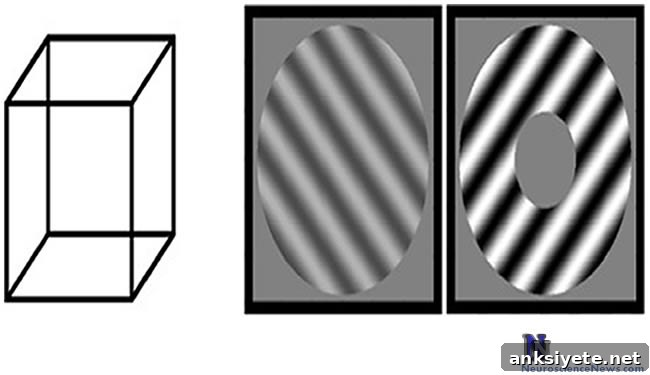
The investigators implemented a rigorous two-by-two factorial design that independently manipulated visibility (visible versus invisible) and attention (directed to versus away from the target stimulus). They used carefully timed composite images shown at high frequency to one eye while presenting a target either to the same eye or the other eye. This binocular presentation allowed the target to be rendered perceptually visible or suppressed (invisible) while attention was either focused on the target location or diverted elsewhere. The setup avoided relying on participant reports of visibility—because asking observers to report visibility would itself draw attention to the target—so perceptual state and attentional focus were controlled experimentally.
The fMRI results were clear and striking. Directing attention to the target nearly doubled the BOLD response in human V1, whereas the target’s conscious visibility produced almost no change in V1 activity. In other words, attention robustly modulated V1 BOLD signals but awareness did not. As Masataka Watanabe, a visiting scholar from the University of Tokyo, and coauthor on the study, noted, “We knew from previous experiments that visual awareness can occur without attention, and attention without awareness. But it was a real challenge to design experiments that can reliably record BOLD activity while reproducing the rather unnatural two laboratory conditions.” The present data show that, at least in V1 under these experimental conditions, attention and awareness dissociate: attention alters neural activity measured with fMRI, while awareness does not.
These findings have implications for how researchers understand the neural correlates of consciousness and the relationship between awareness and other cognitive functions. Many prior studies reported awareness-related modulation of V1 BOLD signals, but those experiments often did not separate attention from awareness. The current results suggest that some previous reports of awareness effects in V1 may have reflected confounded attentional influences. As Watanabe cautioned, however, this study is one part of a larger puzzle: “The experiment is one of a kind, showing differences in modulation between awareness and attention in the primary visual cortex, hence supporting the idea that neural activity corresponding to attention and awareness are, if not more, partially dissociated. The results need to be followed up by other types of stimuli, measurement methods, species, etc., with independent manipulation of attention and awareness.”
Follow-up experiments can determine at which levels of the visual processing hierarchy awareness begins to modulate neural activity, and whether different stimulus classes or measurement techniques reveal additional dissociations. For now, the study establishes that in human V1 the BOLD response is primarily governed by attention, not by whether a stimulus reaches conscious awareness.
Notes about this neuroscience research article
Contacts: Janna Eberhardt – Press and Public Relation, Max Planck Campus Tuebingen
Masataka Watanabe – Max Planck Institute for Biological Cybernetics
Source: Max Planck press release
Image Source: Neuroscience image adapted from Max Planck press release image
Original Publication: Masataka Watanabe; Kang Cheng, Yusuke Murayama, Kenichi Ueno, Takeshi Asamizuya, Keiji Tanaka, Nikos Logothetis
Attention but not Awareness Modulates the BOLD Signal in Human V1 During Binocular Suppression Science, 11 November 2011