
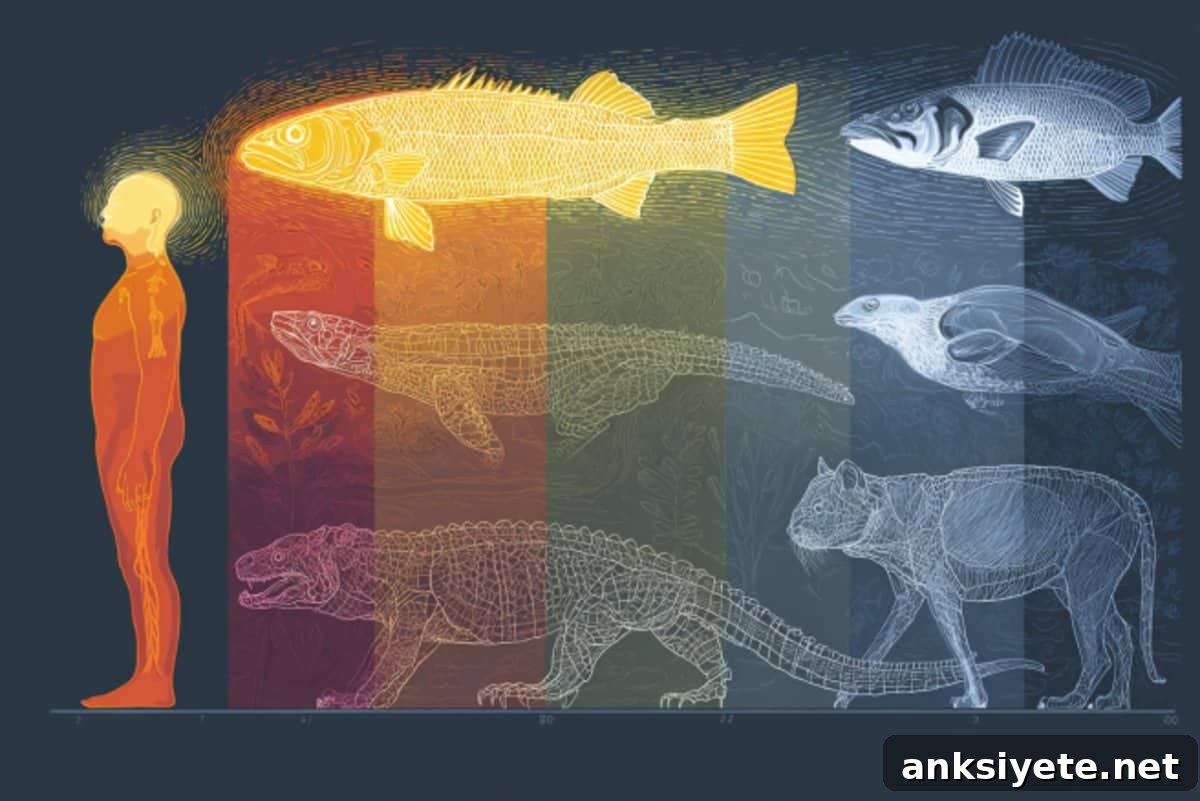
Summary: A comprehensive study of vertebrates shows that body temperature is a primary factor shaping brain size evolution. Warm-blooded animals—mammals and birds—maintain steady internal temperatures that support the sustained energy demands of larger brains. Cold-blooded species, whose body heat depends on the environment, face stronger energetic limits that constrain brain growth.
The researchers also demonstrate that species that produce larger, well-provisioned offspring are more likely to evolve bigger adult brains. Larger neonates can bear the high early-life energy costs of a rapidly growing brain. Together, sustained warmth and substantial parental investment helped pave the evolutionary path that led humans to have the largest brain relative to body size among vertebrates.
Key Facts
- Body temperature link: Endothermic animals maintain stable, higher temperatures that support continuous energy supply to the brain, enabling larger brain sizes.
- Developmental constraint: Species that produce larger offspring provide the energy needed during early development to build and sustain larger brains.
- Evolutionary insight: Endothermy likely evolved for reasons such as nocturnal activity or sustained flight, but it had the side effect of permitting increased encephalization.
Source: Max Planck Institute
Wide variation in brain size: Among vertebrates, relative brain size can differ dramatically—even animals of similar body mass may show up to a hundredfold difference in brain volume.
Generally, mammals and birds have the largest brains relative to body size, followed by sharks and some reptiles. Amphibians and many fish have comparatively small brains. Several ecological and life-history factors contribute to this pattern.
Social complexity is one well-known correlate: species that live in complex social groups often have larger brains than solitary species, likely because navigating social relationships demands greater cognitive resources. But sociality alone does not explain the broad differences among vertebrate classes.
Brain tissue is energetically costly and requires a steady supply of energy. Unlike many other organs, the brain cannot be turned off during fasting or sleep without serious loss of function. According to the “Expensive Brain Hypothesis,” brains can only enlarge if the organism either generates extra energy to support them or changes its life history so that increased brain size improves survival enough to offset slower reproduction.
This framework helps explain patterns such as why some primates that avoid seasonal food shortages have larger brains, and why non-migratory birds—those that remain in resource-rich places—tend to have larger brains than migratory species that face seasonal energy shortfalls.
Scientists at the Max Planck Institute for Animal Behavior analyzed data across vertebrate groups to test how broadly these principles apply. Their comparative work shows two main constraints that together account for much of the variation in relative brain size:
- Ability to produce large, well-provisioned offspring—either by protecting eggs, providing yolk, or feeding embryos and newborns—which supplies the additional energy required during early brain construction.
- Ability to maintain a consistently high body temperature—because cooler or fluctuating temperatures impair neural performance and limit the energetic efficiency of brain tissue.
Their results indicate that within virtually every vertebrate group, higher and more stable body temperatures generally correlate with larger brain size. This trend also appears among cold-blooded species that habitually occupy warmer microenvironments or warm waters: when they sustain higher body temperatures, they tend to support greater encephalization.
In addition, newborn size is a crucial limiting factor. Brains are particularly costly relative to body mass during early life, so species that produce larger young—often coupled with parental care—can invest the energy needed to build larger brains that persist into adulthood.
Lineages that combine both traits—sustained high body temperature and the ability to produce large, well-fed offspring—show the most pronounced encephalization for a given body size. Humans are a striking example: warm-bodied physiology plus long periods of parental provisioning allowed exceptional brain enlargement relative to body mass.
Professor Carel von Schaik, lead of a research group at the Max Planck Institute for Animal Behavior, summarizes: “Our warm-blooded physiology and the long developmental investment we make in large, dependent offspring created the energetic conditions that permitted our species to evolve exceptionally large brains.”
Importantly, endothermy likely evolved for benefits such as activity at night or extended flight performance; its role in facilitating brain enlargement was an evolutionary side effect. This illustrates how physiological or behavioral innovations can open new adaptive possibilities beyond their original functions.
Key Questions Answered:
A: Their ability to sustain a stable, relatively high body temperature supports the continuous energy flow that large brains require.
A: Social complexity, offspring size, and environmental energy stability all play roles; species that are warm-bodied and produce larger, well-provisioned young are more likely to evolve larger brains.
A: Human encephalization reflects a combination of endothermy and prolonged parental investment in large offspring, creating the energetic conditions necessary for extraordinary brain growth.
About this evolutionary neuroscience research news
Author: Carla Avolio
Source: Max Planck Institute
Contact: Carla Avolio – Max Planck Institute
Image credit: Neuroscience News
Original Research: Open access. “Parental investment and body temperature explain encephalization in vertebrates” by Zitan Song et al., published in PNAS.
Abstract
Parental investment and body temperature explain encephalization in vertebrates
Variation in relative brain size across vertebrate groups has been difficult to explain fully. Building on the expensive brain hypothesis, this study proposes two broad constraints that account for much of the pattern: (1) the capacity to produce relatively large offspring, providing the energetic resources needed to construct larger brains, and (2) the capacity to sustain consistently high body temperatures, because cooler or fluctuating brain temperatures reduce neural efficiency and fitness.
Comparative analyses across major vertebrate classes (n ≈ 2,600 species) show that parental protection or provisioning of eggs and embryos is linked to larger newborn size. Class-level analyses indicate correlated evolution of newborn size and adult brain size in birds, mammals, and cartilaginous fishes, but not in other fishes, amphibians, and reptiles. Mean body temperature also correlates positively with brain size within classes, and a combined analysis across all vertebrates reveals a positive interaction between body temperature and newborn size. The findings suggest that pronounced encephalization occurred primarily in lineages that both produce large offspring (via internal fertilization and matrotrophy) and can sustain high body temperatures, conditions commonly associated with endothermy.