
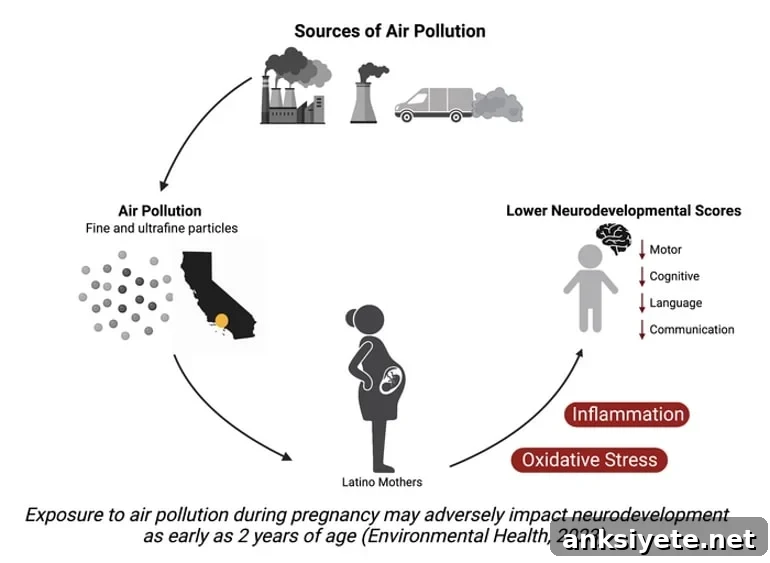
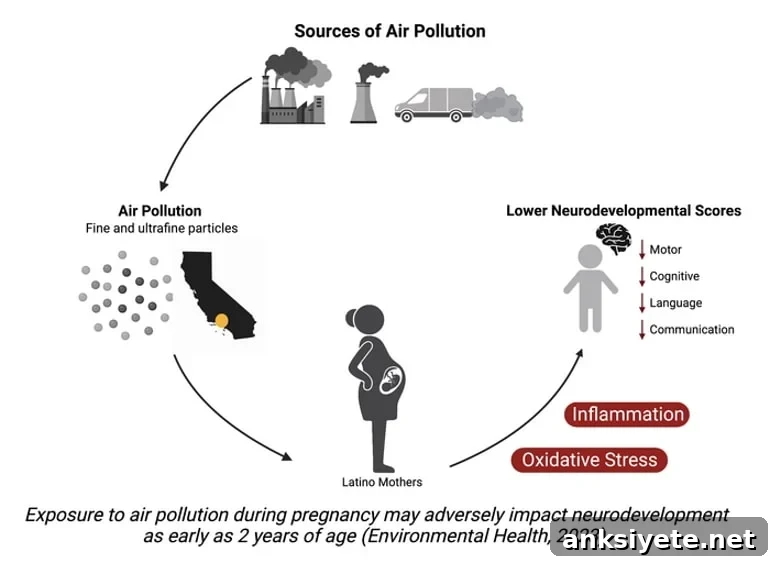
Summary: Maternal exposure to air pollution during mid-to-late pregnancy was associated with lower scores on tests of cognition, language, and motor skills in children at the age of two.
Source: University of Colorado
Toddlers whose mothers experienced higher levels of air pollution during mid- to late-pregnancy tended to score lower on measures of cognition, motor coordination, and language ability, according to new research from the University of Colorado Boulder.
Published in the journal Environmental Health, the study followed Latino mother–child pairs and is one of the first to examine links between prenatal air pollution exposure and neurodevelopment in infancy. The findings add to growing evidence that exposure to polluted air during critical windows of fetal development can have measurable effects on early childhood outcomes.
“Our results indicate that pollution exposure, particularly during the middle and later stages of pregnancy, may negatively influence neurodevelopment in early life,” said Tanya Alderete, assistant professor of integrative physiology at CU Boulder and senior author of the study.
The research team tracked 161 healthy mother–infant pairs living in Southern California who were enrolled in the Mother’s Milk Study, a longitudinal investigation of infant health. Participants provided detailed residential histories, which allowed researchers to estimate prenatal exposure to air pollutants.
Using data from the U.S. Environmental Protection Agency’s Air Quality System, which monitors ambient pollution near roads, industrial sites, wildfires and other sources, the investigators calculated each mother’s exposure to nitrogen dioxide (NO2) and inhalable particulate matter (PM2.5 and PM10) throughout pregnancy.
At age two, the children completed a series of neurodevelopmental assessments that measured cognitive skills, motor function, and language. The team used the Bayley Scales of Infant and Toddler Development (Bayley-III) to produce composite and scaled scores in these domains.
Analyses adjusted for socioeconomic status, breastfeeding frequency, timing of delivery, maternal pre-pregnancy body mass index, infant birthweight and sex, and other potential confounders. The results showed that higher prenatal exposure to particulate matter (both PM10 and PM2.5) was significantly associated with lower composite cognitive scores at age two. For example, children whose prenatal PM10 exposure was at the 75th percentile scored roughly three points lower on the cognitive composite than those at the 25th percentile.
In practical terms, 16% of children in this sample had composite cognitive scores indicating some degree of impairment. The researchers estimated that if every participant had been exposed to PM10 levels equivalent to the 75th percentile, the prevalence of cognitive impairment in the cohort would rise to about 22%.
Mid- to late-pregnancy is a sensitive period
Timing mattered: exposure during mid- to late-pregnancy showed the strongest links to lower neurodevelopmental scores, said first author Zach Morgan, who recently completed a master’s degree in integrative physiology. “Brain development proceeds in stages, and disruptions during critical windows can alter developmental trajectories,” he explained.
During the middle and later months of pregnancy, circuits that support sensory processing, communication, and motor control form and refine, making the fetus potentially more vulnerable to environmental stressors during these periods.
While the precise biological mechanisms remain under study, prior research suggests that inhaled pollutants can trigger systemic inflammation and oxidative stress, which may reach the fetus and interfere with neurodevelopment. Alderete’s earlier work also indicates that air pollution can alter an infant’s gut microbiome in ways that promote inflammation, offering another plausible pathway by which prenatal exposure could affect the developing brain.
Other studies of older children link prenatal pollutant exposure with reduced white matter volume, thinner cortex, altered cerebral blood flow, and lower IQ scores, supporting the broader concern that air pollution can influence brain structure and function over time.
This study focused exclusively on Latino infants, so additional research is needed to determine how these findings generalize to other populations. The authors note that exposure to particulate matter often disproportionately affects racial and ethnic minorities and low-income communities. In many regions, a majority of people are exposed to particulate matter above recommended guidelines, and environmental injustice can magnify those risks.
Alderete emphasized the public health implications: “These results highlight the importance of addressing air pollution’s impact on disadvantaged communities and suggest practical steps families can take to reduce exposure.” She cautioned, however, that prenatal exposure to higher pollution does not guarantee lasting cognitive deficits in an individual child.
As precautionary measures, the research team recommends that pregnant people try to limit exposure to airborne pollutants when feasible, particularly during the second and third trimesters. Practical actions include avoiding outdoor exercise on days with high pollution, using effective indoor air filtration systems, reducing indoor smoke exposure while cooking, and avoiding secondhand tobacco smoke.
“Being mindful of air quality is one of several actions expectant parents can take to give their child a healthier start,” Alderete said.
About this pollution and cognitive development research news
Author: Lisa Marshall
Source: University of Colorado
Contact: Lisa Marshall – University of Colorado
Image: The image is credited to CU Boulder
Original Research: Open access. “Prenatal exposure to ambient air pollution is associated with neurodevelopmental outcomes at 2 years of age” by Tanya Alderete et al. Environmental Health
Abstract
Prenatal exposure to ambient air pollution is associated with neurodevelopmental outcomes at 2 years of age
Background
Higher prenatal exposure to ambient air pollution has previously been linked to impaired neurodevelopment in preschool and school-aged children. This study aimed to evaluate the relationship between prenatal exposure to air pollutants and neurodevelopmental outcomes measured during infancy.
Methods
The study examined 161 Latino mother–infant pairs from the Southern California Mother’s Milk Study. Researchers assessed prenatal exposure to nitrogen dioxide (NO2) and particulate matter smaller than 2.5 and 10 microns (PM2.5 and PM10). Pregnancy was divided into early, mid, and late windows corresponding to the first, middle, and final three months. Infant neurodevelopment at 2 years was measured using the Bayley-III Scales of Infant and Toddler Development. Multivariable linear models and distributed lag models were applied to examine associations between prenatal exposure and Bayley-III scores, adjusting for socioeconomic status, breastfeeding frequency, delivery timing, maternal pre-pregnancy BMI, infant birthweight, and sex.
Results
Higher prenatal exposure to PM10 and PM2.5 was negatively associated with composite cognitive scores. Average prenatal PM10 exposure was also linked to lower composite and scaled motor scores, lower gross and fine motor scores, and lower composite and scaled language and expressive communication scores. Distributed lag models identified mid- and late-pregnancy as windows when higher air pollution exposure was most strongly associated with poorer motor, cognitive, and language outcomes.
Conclusions
Greater exposure to ambient air pollutants during pregnancy—especially during the middle and late prenatal periods—was associated with lower motor, cognitive, and language scores at two years of age. These findings suggest that prenatal air pollution exposure may negatively affect early neurodevelopment and underscore the need for policies and personal strategies that reduce exposure during pregnancy.