
Summary: A new study finds that the arrangement of photoreceptors in primate eyes helps humans detect socially relevant color changes—like blushing—better than other types of color vision, including the evenly spaced color channels used in many cameras.
Source: NYU.
Key findings
Researchers report that human and many primate trichromatic vision is especially well suited to detect social color signals such as facial reddening. In tests, observers using simulations of primate trichromacy identified these signals more accurately and faster than observers using simulated camera-like color encoding or common forms of color blindness.
Human color vision is organized differently from the color-capture systems used in photographic devices. In primates, the green (M) and red (L) photoreceptors are tuned to fairly similar wavelengths and are densely integrated. By contrast, artificial systems and many engineered cameras distribute color sensors more evenly across the spectrum. Because camera designs are optimized for capturing a broad range of colors, some have argued that engineered systems should outperform biological vision for general color discrimination. This new study challenges that assumption for socially relevant color cues.
James Higham, an assistant professor in NYU’s Department of Anthropology and one of the study’s co-authors, explains that although the close tuning of human L and M cones may seem inefficient, it appears to give primates an advantage when detecting subtle shifts in facial coloration that signal social states. The research suggests that our unusual cone arrangement is not a flaw but may be an adaptation for reading social information conveyed by skin color.
Study design
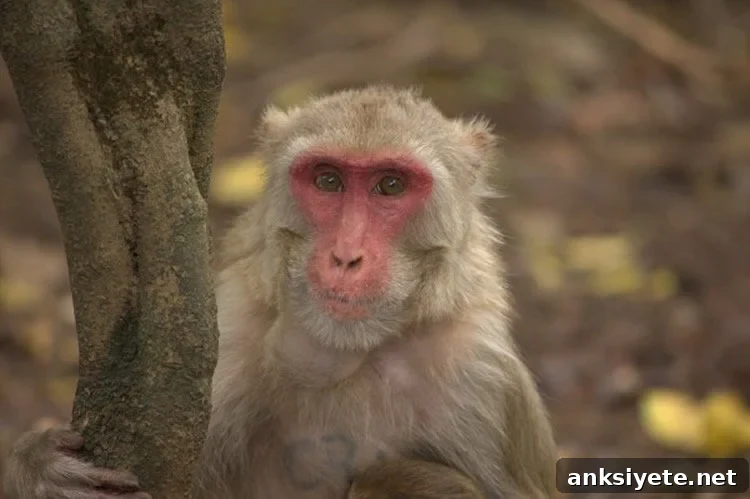
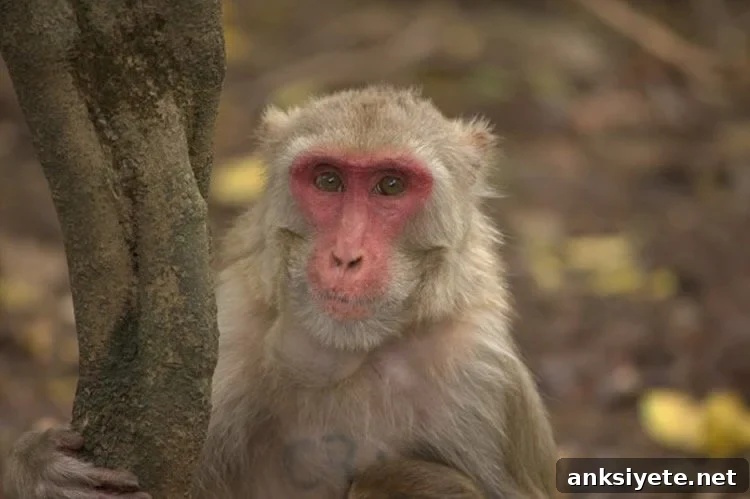
The experiment involved 60 human participants who viewed digital photographs of female rhesus macaque faces. Female rhesus macaques show coloration changes linked to reproductive state: faces become redder when a female is proceptive. The researchers used this naturally occurring change as a model for socially meaningful color variation.
Using software to simulate different types of color vision, the researchers presented the same image pairs under multiple visual conditions. These included a simulation of common catarrhine (Old World primate) trichromacy, alternative trichromatic arrangements (including one with narrowly separated L and M cone pigments), and several dichromatic conditions that mimic common forms of color blindness. They also simulated a trichromatic system with evenly spaced color channels, similar to many artificial imaging systems.
Participants were asked to choose which of two images showed the proceptive face. Their speed and accuracy were recorded across the different simulated visual systems. The results showed that performance under primate-like trichromacy—and under trichromacy with narrowly separated L and M pigments—was consistently better than performance under evenly spaced trichromacy or any dichromatic simulation.
Interpretation and implications
First author Chihiro Hiramatsu of Kyushu University notes that this experiment provides direct empirical evidence supporting the idea that primate trichromatic vision may be tuned for detecting social color signals. The findings align with the hypothesis that selection pressures related to social communication—such as the ability to detect blushing, emotional flushing, or reproductive signals—could have influenced photoreceptor sensitivities or the spectral reflectance of skin in primates.
Co-author Amanda Melin of the University of Calgary highlights the broader evolutionary implication: social signaling may have contributed to the evolution or maintenance of the unusual trichromatic system found in humans and many other primates with bare patches of skin. Detecting slight shifts in facial color can convey vital information about emotional states, health, or reproductive readiness, making such sensitivity advantageous in social species.
Funding and publication details
The research received support from the Japanese Society for the Promotion of Science, the Wenner-Gren Foundation, and U.S. National Institutes of Health programs that support comparative research resources and infrastructure. The study was published in the journal Proceedings of the Royal Society B: Biological Sciences and lists the authors Chihiro Hiramatsu, Amanda D. Melin, William L. Allen, Constance Dubuc, and James P. Higham.
Abstract (condensed)
Primate trichromatic color vision has been proposed to be especially well matched to detecting variation in facial coloration. To test this, researchers asked whether information available under primate trichromacy improves the ability to detect facial color changes that female macaques display when proceptive. Human observers were asked to identify which of two images showed the proceptive face under visual simulations corresponding to common catarrhine trichromacy, alternative trichromatic arrangements, and several dichromatic conditions. Performance was superior under common catarrhine trichromacy and trichromacy with narrowly separated L and M pigments compared with evenly spaced trichromacy or dichromacy. These results support the idea that primate trichromacy is well suited for detecting meaningful social color variation in faces, consistent with social signaling influencing photoreceptor tuning or signal reflectance.
Feel free to share this summary of the research.