
Summary: A new study raises questions about using current machine learning methods to identify possible signs of extraterrestrial intelligence.
Source: FECYT
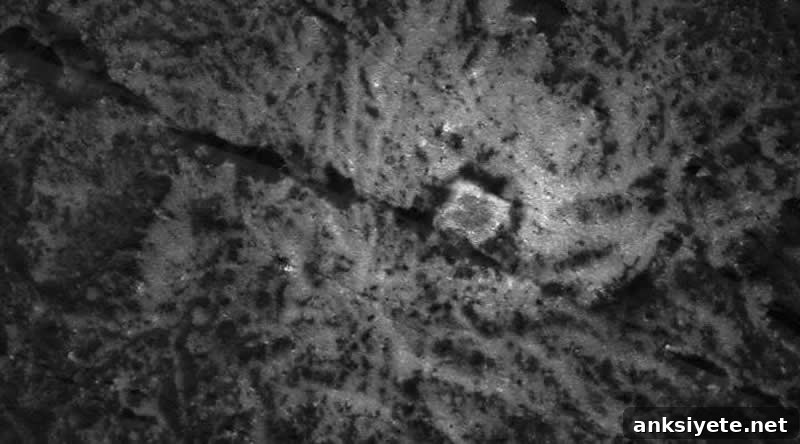
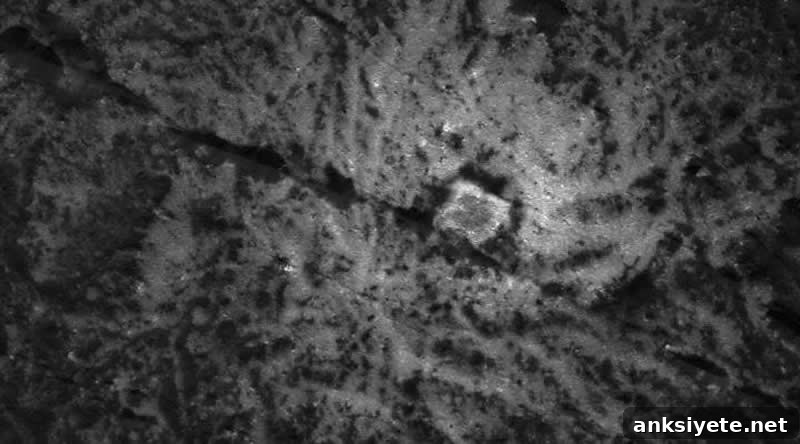
An artificial neural network identified a square-like feature nested within a triangular formation in a crater on the dwarf planet Ceres. Several human observers also reported seeing similar shapes. The visual experiment, led by a Spanish neuropsychologist, highlights limitations and risks when applying artificial intelligence to the Search for Extraterrestrial Intelligence (SETI).
Ceres is the largest object in the main asteroid belt and classified as a dwarf planet. It gained widespread attention after NASA’s Dawn mission discovered bright patches in Occator crater. Those bright spots, once the subject of speculation, were later attributed to salt and ice deposits produced by cryovolcanic activity.
Researchers at the University of Cádiz (Spain) examined a specific bright region known as Vinalia Faculae and noticed an area where geometric shapes appeared to be present. Motivated by this ambiguous pattern, the team designed an experiment to compare how humans and machine vision systems perceive the same planetary image. Their aim was to test whether artificial intelligence could reliably assist in detecting possible technosignatures—indications of artificial structures or activity—on other worlds.
“We were not the only ones to notice a square-like form in Vinalia Faculae, so we used this as an opportunity to confront human perception with AI in a demanding visual task,” explains Gabriel G. De la Torre. “This was not a routine classification exercise but a cognitive perception test with implications for SETI beyond traditional radio searches.”
The study recruited 163 volunteers without formal astronomy training and asked them what they perceived in images of Occator crater. The same images were then evaluated by an artificial vision system based on convolutional neural networks (CNNs) that had been trained on thousands of square and triangle examples to recognize those shapes.
Both human participants and the CNN reported seeing a square structure in the Vinalia Faculae images. The AI additionally flagged a triangular form; when researchers presented the triangular interpretation to human volunteers, a significantly larger proportion of participants also reported seeing the triangle. The pattern suggested that the square appeared visually inscribed within a triangular outline.
The findings, published in the journal Acta Astronautica, led the researchers to several important conclusions. First, while AI tools are increasingly powerful and widely used, they can produce misleading detections—identifying patterns that may be artifacts of lighting, shadow, or noise rather than genuine objects. Such false positives can compromise the reliability of AI for identifying potential technosignatures unless carefully validated by human experts.
Second, the experiment illustrates how suggestion and framing influence perception. Once the AI reported a triangle, more human observers identified that same shape. This mutual influence underscores how cognitive bias can affect both human and machine-assisted interpretation of ambiguous imagery.
De la Torre also raises a broader philosophical question: if AI were to detect structures or patterns that exceed familiar human concepts, could it reveal realities we are not prepared to recognize? He cautions, however, that the most plausible explanation for what the AI detected in Vinalia Faculae is natural: a play of light and shadow shaped by the crater’s topography and reflective deposits.
The study also emphasizes that AI systems inherit limitations and biases from their developers and training data. These biases should be thoroughly examined and mitigated, especially when AI tools are used in domains—like SETI—where false positives could generate misleading claims or divert scarce resources.
Source:
FECYT
Media Contacts:
SINC – FECYT
Image Source:
The image is credited to NASA/JPL-Caltech/UCLA/MPS/DLR/IDA.
Original Research: Open access
“Does artificial intelligence dream of non-terrestrial techno-signatures?” by Gabriel G. De la Torre. Acta Astronautica. DOI: 10.1016/j.actaastro.2019.11.013
Abstract
Does artificial intelligence dream of non-terrestrial techno-signatures?
Artificial intelligence is increasingly applied across scientific fields, including efforts to detect extraterrestrial intelligence. Human perception and decision-making remain essential in interpreting ambiguous or unexpected data. This study compares geometric pattern recognition performed by 163 untrained human volunteers and a convolutional neural network trained to identify squares and triangles. Using imagery of the Occator crater bright spots on Ceres, researchers examined how cognitive biases and AI performance might influence the identification of potential technosignatures. Results show that both humans and the CNN reported square-shaped features, while the AI additionally detected triangular shapes; when the triangular interpretation was suggested, human reports of triangles increased. The experiment highlights how suggestion, training data, and algorithmic behavior can shape detections, underscoring the need for careful validation of AI claims in SETI and related searches for irregular or artificial features.