
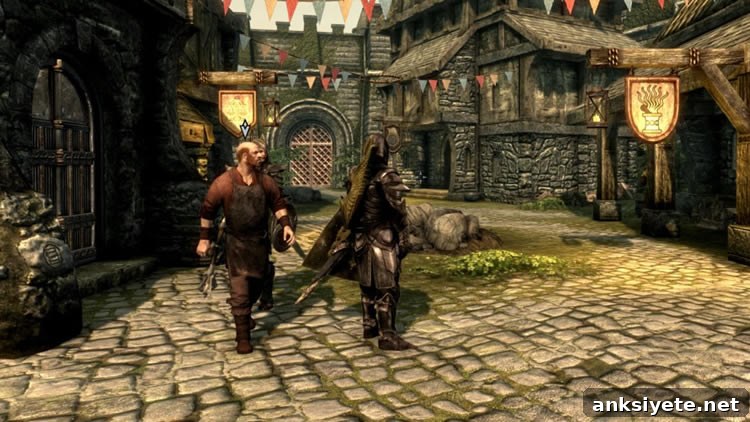
Summary: Researchers have developed a new artificial intelligence tool for games that leverages social behavior models to make nonplayer characters (NPCs) more reactive, adaptive, and varied in their responses to player actions.
Source: North Carolina State University.
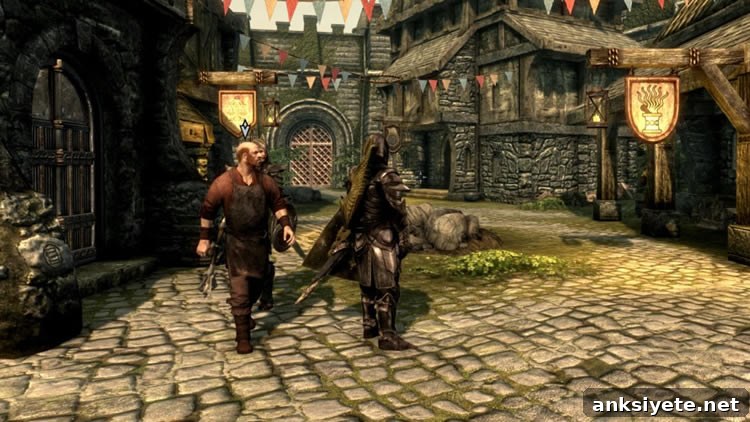
Computer science teams at North Carolina State University and Universidade de Lisboa have created CIF-CK, an AI architecture that enables richer, more flexible NPC behavior in the game Skyrim. CIF-CK applies social reasoning to allow individual NPCs to react and adapt to players in more nuanced, context-sensitive ways, increasing variability and immersion in gameplay.
“Most modern games still rely heavily on scripted decision trees to determine NPC behavior,” says Arnav Jhala, associate professor of computer science at NC State and co-author of the published paper. “Those scripted responses mean that two players who take identical actions will often experience the same NPC interactions. Our goal with CIF-CK is to move past predictable scripts and give NPCs the capacity to behave in ways that feel more organic and personalized to each player.”
The CIF-CK system builds on the Comme il-Faut (CIF) architecture originally developed in 2012 at the University of California, Santa Cruz. The CIF approach integrates social science theories to model how agents’ actions influence social perceptions among other agents. For instance, if Agent A treats Agent B kindly and Agent X despises Agent B, then Agent X’s opinion of Agent A will be adjusted downward as a consequence of their relationship with Agent B.
CIF-CK extends that foundation in two important ways. First, while the original CIF model assumed all agents had full knowledge of one another, CIF-CK makes awareness configurable: game designers decide what each NPC knows about other characters and events. This flexibility allows NPCs to have limited or partial knowledge appropriate to their role, location, or experience in the game world, which produces more believable and varied social dynamics.
Second, CIF-CK closes the loop between social perception and action. The earlier CIF implementation tracked how agents viewed one another but did not specify how those perceptions would translate into concrete behavior. CIF-CK adds actionable policies so NPCs can make decisions driven by their social evaluations—choosing actions such as offering help, withholding assistance, avoiding the player, or pursuing objectives—based on what they believe about the player’s past conduct and relationships with other agents.
To test CIF-CK in a realistic environment, the researchers released a prototype mod for Skyrim under the name “Social NPCs” on the Steam community platform to observe how real players experienced the system. Early uptake was encouraging: the prototype attracted thousands of subscribers and provided a real-world proving ground for the architecture, demonstrating that the approach can be integrated into a large, commercially available game.
“Our results show that CIF-CK can be implemented at scale,” Jhala notes. “We hope this work encourages game studios and independent developers to adopt social modeling concepts in their design pipelines, or at least draw inspiration from these ideas.”
The researchers emphasize that CIF-CK is intended to make NPC behavior more expressive and to deepen immersion without requiring developers to manually script every possible interaction. By tying NPC decisions to configurable knowledge, social evaluations, and action-selection mechanisms, CIF-CK reduces repetitive encounters and enables emergent social narratives driven by player choices.
Source: Matt Shipman, North Carolina State University
Image source: Image adapted from the North Carolina State University news release.
Original research: The paper, “CiF-CK: An Architecture for Social NPCs in Commercial Games,” was prepared for presentation at the IEEE Conference on Computational Intelligence and Games. The lead author is Manuel Guimaraes, a graduate student at Universidade de Lisboa; the paper was co-authored by Pedro A. Santos of Universidade de Lisboa and includes contributions from researchers at NC State.
North Carolina State University. “New AI Tool Increases Adaptability and Autonomy of Skyrim NPCs.” NeuroscienceNews, 2 August 2017.