
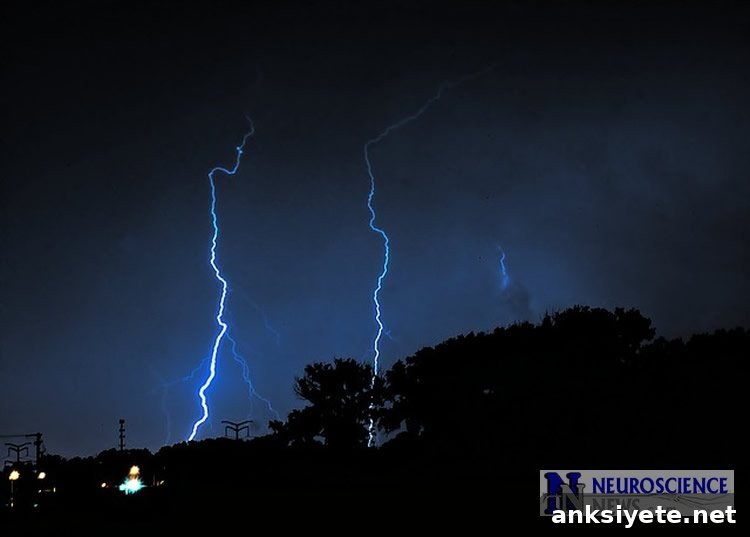
Because sound travels much more slowly than light, we frequently see distant events before we hear them. That is why counting the seconds between a lightning flash and its thunder gives a rough estimate of how far away a storm is.
Research from the University of Rochester shows that our brains can detect and use much shorter sound delays than those we notice consciously. The study found that even tiny, unconscious audio delays can influence how we interpret visual distance, refining our perception of nearby events when sound and sight are combined.
“Much of our environment is audiovisual,” said Duje Tadin, associate professor of brain and cognitive sciences at the University of Rochester and senior author of the study. “Humans rely heavily on vision, but our results show that visual distance judgments become more precise when congruent auditory signals support the visual information. The brain registers these auditory cues even when they are separated from the visual event by a time too brief to be noticed consciously.”
Phil Jaekl, who conducted the experiments while a postdoctoral researcher in Tadin’s lab, explained that humans can unconsciously register sound delays as short as about 40 milliseconds (ms) and use them to inform visual perception. “Our brains are excellent at recognizing patterns that help us interpret the world,” Jaekl said. “Now we see that the brain can link tiny sound delays with visual distance and combine those signals in a useful way—even without conscious awareness.”
The researchers published their findings in PLOS ONE, using projected three-dimensional (3D) stimuli to test whether auditory timing could serve as a cue to relative distance.
In the first experiment, participants viewed pairs of identical 3D shapes through stereoscopic glasses and adjusted their relative depth until the shapes appeared equidistant. Each shape was paired with a short audible “click.” For one shape the click occurred slightly before the visual presentation, and for the other the click occurred slightly after—these timing offsets were brief and balanced.
Despite the shapes being physically at the same depth, participants consistently perceived the shape paired with the delayed click as farther away. “This result surprised us,” Jaekl said. “When the two shapes were actually at equal distance, the delayed sound biased judgments so that the shape with the delayed click appeared more distant—even though it was not.”
In a second experiment, participants viewed 3D shapes that moved quickly either toward or away from them. When a shape was paired with a sound delayed by about 42 ms, observers were more likely to perceive it as more distant—even in some cases when the object had actually moved closer. Crucially, when an object that moved away from the participant was paired with the sound delay—an arrangement consistent with real-world timing—their judgments of relative distance became more precise.
To rule out conscious decision strategies, a control test confirmed that participants could not consciously detect the brief sound delays. The influence on visual distance estimates therefore reflects unconscious perceptual processing rather than a conscious judgment or response bias.
“It’s striking that the bias operates unconsciously,” said Jaekl, who continues related research at the University of Rochester Medical Center. “Participants could not tell when the sound delays were present, yet those delays significantly influenced how far away the visual events appeared.”
Source: Monique Patenaude – University of Rochester
Image Source: The image is in the public domain
Original Research: Full open access research for “Audiovisual Delay as a Novel Cue to Visual Distance” by Philip Jaekl, Jakob Seidlitz, Laurence R. Harris, and Duje Tadin in PLOS ONE. Published online October 9, 2015. doi:10.1371/journal.pone.0141125
Abstract
Audiovisual Delay as a Novel Cue to Visual Distance
Sound arrives later than light for the same event, and that delay grows with distance. This study tested whether humans can use such audiovisual delays as information for judging visual distance. Across two experiments, participants compared the relative distance of repetitively displayed three-dimensional dot clusters paired with sounds of varying delays. Stimuli paired with delayed sounds were consistently perceived as more distant than those paired with equivalent sound leads. The presence of an auditory delay alone was sufficient to make a stimulus appear farther away, and when auditory delays were ecologically congruent with greater distance, distance judgments became more precise. A control experiment showed that the delay durations influencing distance perception were not consciously detectable, ruling out decision-level effects. These results provide evidence that audiovisual delays can serve as an ordinal cue to visual distance.
“Audiovisual Delay as a Novel Cue to Visual Distance” by Philip Jaekl, Jakob Seidlitz, Laurence R. Harris, and Duje Tadin in PLOS ONE. Published online October 9, 2015. doi:10.1371/journal.pone.0141125