
Summary: Neurons that express prepronociceptin in the central amygdala are activated when animals consume palatable, calorie-dense foods. Selectively reducing these nociceptin-producing neurons in mice decreased binge-like consumption of rich foods without altering normal chow intake. These findings identify a specific brain circuit that promotes hedonic eating and could inform new treatments for obesity and binge-eating disorders.
Source: University of North Carolina Health Center
When you eat something irresistible, have you ever wondered why it’s so hard to stop even when you’re full? Researchers at the UNC School of Medicine have mapped a brain circuit that helps explain this urge.
In new laboratory studies, Thomas Kash, PhD, the John R. Andrews Distinguished Professor in the Department of Pharmacology, and his team identified a distinct network of neurons that originates in the emotion-processing central amygdala and drives continued consumption of palatable, calorie-rich foods despite adequate energy stores.
The work, published in Neuron, sheds light on a mammalian brain circuit that likely evolved when high-calorie meals were rare and where consuming as many calories as possible increased survival odds. In modern environments with constant access to tasty, energy-dense foods, that same wiring encourages overeating and contributes to obesity and related diseases.
“This circuit seems to be the brain’s way of telling you that if something tastes really good, then it’s worth whatever price you’re paying to get to it, so don’t stop,” Kash said.
Historically, obesity research focused on homeostatic feeding systems that respond to hunger and maintain energy balance. Those approaches have had limited success in curbing overeating. More recently researchers have concentrated on hedonic feeding—eating driven by pleasure rather than physiological need—and the neural signals that drive binge-like consumption of rewarding foods.
Evidence from Kash’s lab and others has implicated nociceptin, a small signaling peptide, in hedonic feeding. Pharmacological agents that block the nociceptin receptor reduce binge-like intake of palatable foods in rodents while sparing normal, homeostatic feeding. This profile has made nociceptin receptor antagonists attractive candidates for treating binge eating and obesity, but the precise circuits mediating these effects were unclear.
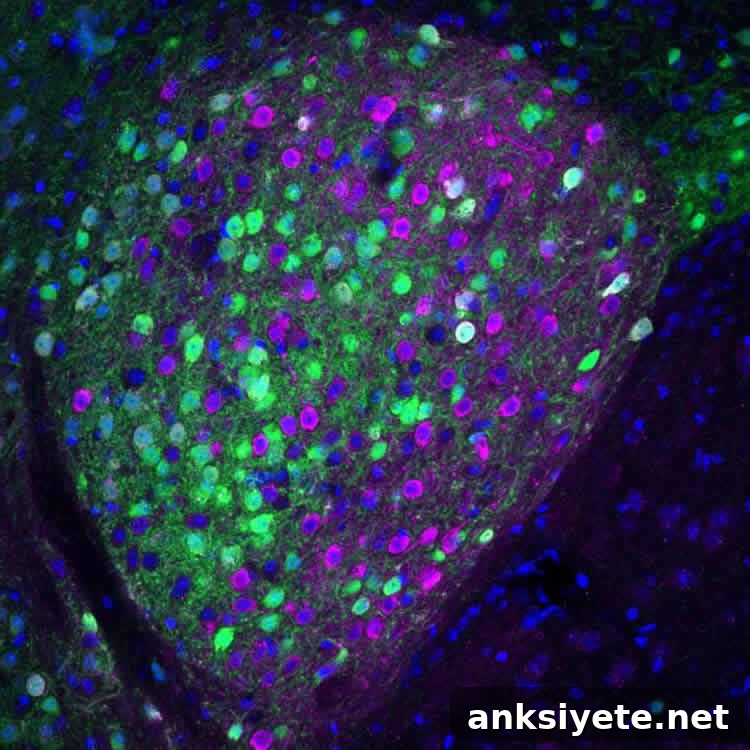
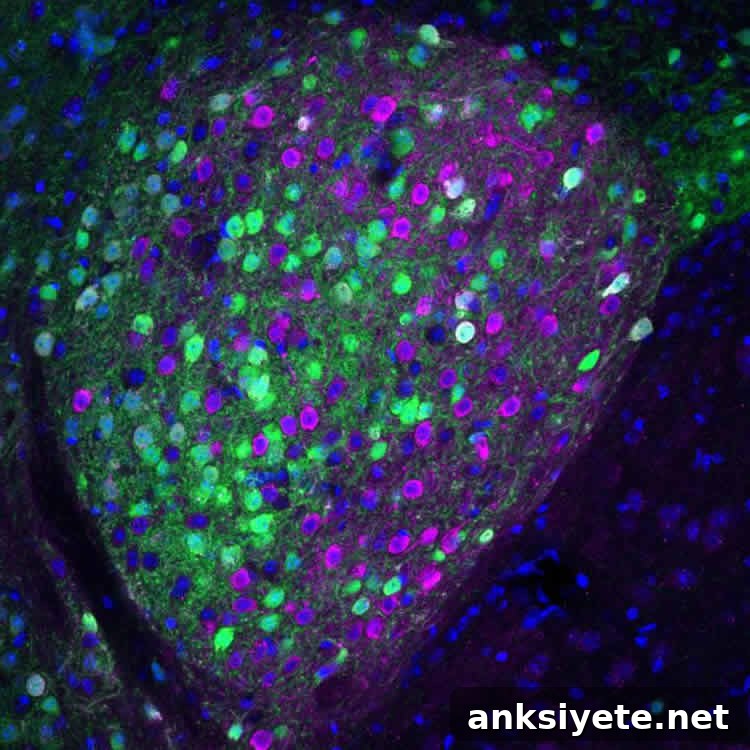
To pinpoint those circuits, the UNC team engineered mice so that cells producing prepronociceptin also expressed a fluorescent marker, allowing researchers to visualize and target nociceptin-expressing neurons. Multiple nociceptin circuits exist across the brain, but the investigators discovered a particularly relevant population in the central amygdala that became active when mice accessed calorie-rich food.
That central amygdala population—prepronociceptin-expressing (Pnoc) CeA neurons—sends projections to brain regions involved in feeding and reward, including the ventral bed nucleus of the stria terminalis (vBNST), the parabrachial nucleus (PBN), and the nucleus of the solitary tract (NTS). Selective ablation of roughly half of the Pnoc CeA neurons reduced mice’s binge-like intake of palatable food and prevented high-fat diet–induced weight gain, while leaving consumption of ordinary chow unchanged.
“Scientists have studied the amygdala for a long time and linked it to pain, anxiety, and fear, but our findings highlight its role in pathological eating as well,” Kash said. His team is now exploring the timing of this circuit’s activity, the precise mechanisms by which it influences feeding, and how nociceptin receptor blockers alter its function.
First author J. Andrew Hardaway, PhD, research assistant professor of pharmacology at UNC, noted that the study is among the first to show how an emotional brain center contributes to eating for pleasure. “Our results support the idea that mammals dynamically categorize foods along a tastiness spectrum, and that subsets of amygdala neurons encode those valences. The next major challenge is to selectively target these cell groups to develop new, effective treatments for obesity and binge eating,” Hardaway said.
Beyond metabolic disorders, nociceptin antagonists are being investigated for potential benefits in depression, pain, and substance use disorders. Kash emphasized that blocking nociceptin likely affects multiple brain mechanisms but appears to stabilize behavior and restore more normal patterns of consumption and reward.
“The behavioral effects of blocking nociceptin activity probably involve multiple mechanisms in the brain,” Kash said. “But on the whole, blocking nociceptin seems to stabilize behavior, bringing it closer to normal.”
Funding: This research received support from the National Institute on Alcohol Abuse and Alcoholism (NIAAA), the National Institute of Diabetes and Digestive and Kidney Diseases (NIDDK), the North Carolina Biotechnology Center, and the Swedish Research Council.
Authors: Thomas Kash (senior author), J. Andrew Hardaway (first author), Christopher M. Mazzone, Dipanwita Pati, Daniel W. Bloodgood, Michelle Kim, Jennifer Jensen, Jeffrey F. DiBerto, Kristin M. Boyt, Ami Shiddapur, Ava Erfani, Olivia J. Hon, Sofia Neira, Christina M. Stanhope, Jonathan A. Sugam, Greg Tipton, Zoe McElligott, Garret D. Stuber, Cynthia M. Bulik (all UNC), Lindsay R. Halladay and Andrew Holmes (NIAAA), Michael P. Saddoris (University of Colorado Boulder), Thomas C. Jhou (Medical University of South Carolina), and Michael R. Bruchas (University of Washington School of Medicine).
Source:
University of North Carolina Health Center
Media Contact:
Mark Derewicz – University of North Carolina Health Center
Image Source:
Andrew Hardaway, PhD (Kash Lab, UNC School of Medicine).
Original Research:
Article published in Neuron: “Central Amygdala Prepronociceptin-Expressing Neurons Mediate Palatable Food Consumption and Reward” (Thomas Kash et al.).
Abstract summary:
Researchers identified a population of prepronociceptin-expressing neurons in the central amygdala (Pnoc CeA) that activate during palatable food consumption. Ablation or inhibition of these cells reduces intake of tasty food and prevents high-fat-diet–induced weight gain and adiposity, without altering baseline chow consumption. Pnoc CeA neurons project to vBNST, PBN, and NTS; activation of these projections produces reward-related behavior but does not, by itself, trigger feeding. The data indicate the Pnoc CeA network is necessary for reinforcing and rewarding aspects of palatable food consumption, though activation alone is insufficient to evoke feeding.