
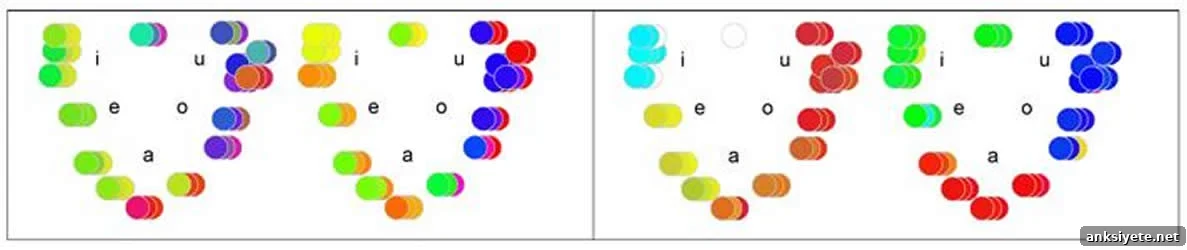
Summary: While only about 1 in 25 people has synesthesia, a new study finds that intuitions about “sound colors” are shared by a much larger portion of the population. Perceptions of sound color are driven largely by the vowel system of a language.
Source: Radboud University
Does the vowel [a:] as in “baa” feel more red or more green? Is [i:] as in “beet” perceived as light or dark? Although speech and color are processed by different senses, most people have strong intuitions about which vowels match which colors. Research by linguists at Radboud University and the University of Edinburgh shows that similar vowel–color associations occur across more than 1,000 participants, and that many listeners apply a consistent system when making these matches.
Vladimir Nabokov famously reported seeing colors when he heard certain vowels: “aa” as polished ebony and “ee” as yellow. Nabokov was a synesthete—someone whose sensory experiences overlap—but synesthesia affects only about one in 25 people. The new research demonstrates that broader, shared intuitions about vowel–color links exist well beyond the small synesthetic population.
“Aa” tends to be redder than green
More than 1,000 people completed an online experiment in which they chose colors for 16 spoken vowels. A clear majority judged the vowel [a:] (“aa”) to be redder than green, while vowels like [i:] (“ee”) were typically matched to lighter colors. These patterns held regardless of whether participants identified as synesthetes.
According to Mark Dingemanse, one of the study’s authors, “There seems to be a logic to how we link sound and colour, and the structure of language has an important role in this process.”
Vowel space
The study examined 16 vowel sounds distributed evenly across what linguists call the vowel space. When you move from [a:] to [u:] as in “boot” and then to [i:] as in “beet,” you traverse the outer points of that space. By sampling sounds across this grid, the researchers were able to map how color choices vary across different vowel positions.
Language system shapes color associations
Previous work linked color associations to acoustic features such as pitch—higher-pitched sounds tend to be matched with lighter colors. This study confirms that acoustic factors matter, but it shows that the categorical vowel system of a language plays an even larger role. Listeners grouped sounds according to phoneme categories: sounds near the Dutch vowel [i:] were often labeled light green, while nearby sounds that resemble English “ay” were assigned different hues. In short, the way a language divides the vowel space influences how listeners map vowels to colors.
Dingemanse explains: “If color associations depended only on acoustics, colors would blend smoothly across sounds like a rainbow. Instead, we find abrupt changes—clusters of blue followed by a red patch—with no gradual blue–purple–red transition. It seems our language’s organization of vowel categories acts like a sorting mechanism before we link colors to sounds, even for synesthetes whose mappings are involuntary.”
Synesthesia and systematic mapping
The team used a novel analytical approach to measure how systematic each participant’s vowel–color choices were. For each person, the chosen associations were compared to a simulated set of 10,000 random mappings to quantify structure and consistency.
“Synesthetes produced more systematic mappings than non-synesthetes,” says Christine Cuskley of the University of Edinburgh, “but many patterns are shared widely: people tend to align vowel and color spaces and connect corresponding regions across the two. Colors chosen for sounds near [i:] and [ay] are often similar, while those for [a:] and [u:] are more distant.” In other words, involuntary synesthetic pairings appear to amplify principles that also guide non-synesthetic associations.
The study was conducted as part of the Great National Research Project (GNO), a collaboration between Radboud University, the Netherlands Organisation for Scientific Research (NWO), and NTR Broadcasting. To study how senses interact across a population, the researchers needed a large, varied sample that included people with differing degrees of synesthesia. Dingemanse and neurobiologist Tessa van Leeuwen of the Donders Institute developed a web-based testing platform—supported by NWO—that enabled rapid online data collection. The software and data were made available to other researchers so future studies can build on these findings and further explore how language shapes perceptual associations.
Source:
Radboud University
Media contacts:
Mark Dingemanse – Radboud University
Image credit:
Mark Dingemanse, Radboud University.
Original research (open access):
“Cross-modal associations and synesthesia: Categorical perception and structure in vowel–color mappings in a large online sample” by Cuskley, C., Dingemanse, M., Kirby, S. et al., Behavioral Research (2019). DOI: 10.3758/s13428-019-01203-7.
Abstract (summary)
The researchers report vowel–color associations collected from more than 1,000 Dutch speakers and release materials including analysis code and a dataset of 1,164 participants, among whom over 200 were identified as synesthetes by consistency measures. Acoustic features predict some mappings, but vowel phoneme category and grapheme category are even stronger predictors of color choice. In general, high/front vowels are matched to lighter, greener, and more yellow colors than low/back vowels. Synesthetes show stronger responses along some dimensions and produce more structured mappings overall, yet roughly 70% of participants produced structured mappings, indicating that the ability to form consistent cross-modal associations is widespread across the population.