
Summary: A recent fMRI study identifies brain regions activated when people encounter foods they find aversive and suggests that parts of the reward system may also encode disgust.
Source: CNRS.
Why Some People Hate Cheese: New Neuroscience Findings
Certain foods provoke strong reactions: people tend to either enjoy or strongly dislike aged cheeses such as Camembert or goat cheese. To investigate why cheese is a common target of intense aversion, teams from the Centre de Recherche en Neuroscience de Lyon and the Laboratoire Neuroscience Paris Seine conducted behavioral surveys and functional magnetic resonance imaging (fMRI) experiments to map the brain responses associated with cheese dislike.
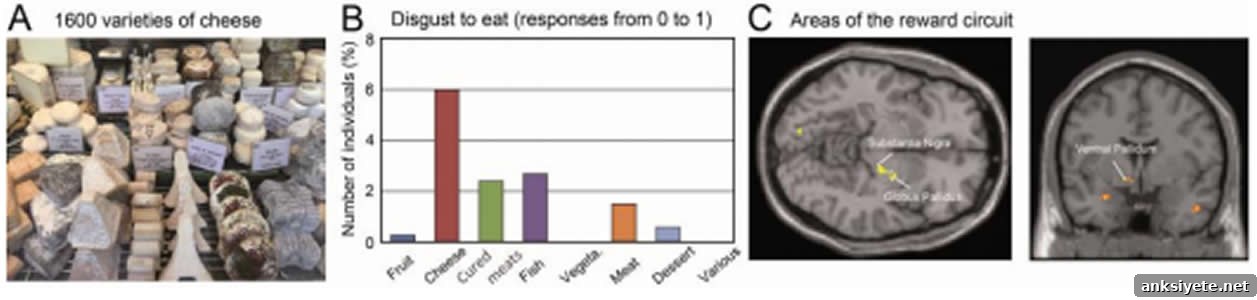
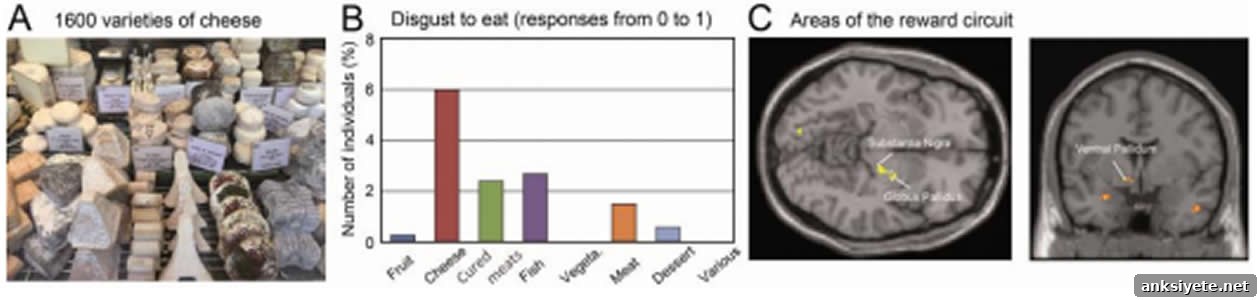
The researchers began by surveying 332 individuals about their food aversions and found that cheese was the most frequently cited food provoking strong disgust. About 6.0% of respondents reported a marked aversion to cheese, compared with 2.7% for fish and 2.4% for cured meats. Among people who dislike cheese, 18% reported lactose intolerance, and in 47% of cases at least one family member also disliked cheese. These patterns suggest a potential genetic or familial component to cheese aversion and a possible link with lactose intolerance, although further research is needed to clarify causation.
fMRI Study Design
To explore the neural basis of cheese aversion, the team selected 30 volunteers for an fMRI study: fifteen participants who reported liking cheese and fifteen who reported strong dislike. During scanning, each participant was presented simultaneously with images and odors of six different cheeses and six control foods. For each stimulus, participants indicated whether they liked the smell and appearance and whether they wanted to eat the food at that moment. This design isolated both affective reactions (liking/disliking) and motivational responses (wanting) to food-related stimuli.
Key Brain Findings
The imaging results reveal two main patterns. First, the ventral pallidum — a small but important node of the reward circuit typically active when people are motivated to eat — showed a striking absence of activation in subjects who reported disgust for cheese. When presented with cheese images and odors, these participants did not show the ventral pallidum response that appeared for other foods or for participants who liked cheese. This deactivation is consistent with a suppression of the motivational drive to eat foods perceived as disgusting.
Second, regions usually associated with reward processing — specifically the globus pallidus and the substantia nigra, components of the basal ganglia — showed greater activation in people who dislike cheese than in those who like it. Although these structures are commonly linked to positive reward, the researchers suggest they can respond to aversive stimuli as well. One plausible explanation is that these basal ganglia regions contain distinct populations of neurons with complementary functions: one engaged by rewarding stimuli and another recruited by aversive or aversion-related processing. In this view, the same anatomical circuit may encode both positive and negative motivational values depending on which neuronal subpopulations are active.
Implications
These results provide new insight into how the human brain represents food-related disgust and aversion. The study indicates that regions traditionally associated with reward are not exclusively dedicated to positive valuation; they can also reflect aversive reactions. The observed ventral pallidum suppression further highlights how disgust can actively inhibit motivation to eat. Together, the behavioral and neuroimaging data suggest complex, overlapping neural mechanisms for liking and disliking food, and point to potential genetic or familial influences on specific food aversions such as those for cheese.
The Neural Bases of Disgust for Cheese: An fMRI Study
Studying food aversion in humans is ethically challenging, and identifying a single universally disgusting food is not feasible. Cheese, however, offers an informative model: while edible to most, it provokes strong disgust in a notable minority. In a behavioral survey, a larger percentage of people reported being disgusted by cheese than by several other foods. In the fMRI experiment, participants who disliked cheese (Anti group) showed greater activation in basal ganglia structures — the internal and external globus pallidus and the substantia nigra — in response to cheese odors and pictures than participants who liked cheese. Conversely, the ventral pallidum, a core reward-region associated with motivation, was deactivated in the Anti group during wanting assessments, indicating suppression of motivational drive. These findings suggest that basal ganglia structures implicated in reward processing also participate in aversive motivated behaviors and that disgust can reduce activation in motivation-related circuits.
Study authors: Jean-Pierre Royet, David Meunier, Nicolas Torquet, Anne-Marie Mouly, and Tao Jiang. Published in Frontiers in Human Neuroscience (online October 17, 2016). DOI: 10.3389/fnhum.2016.00511.