
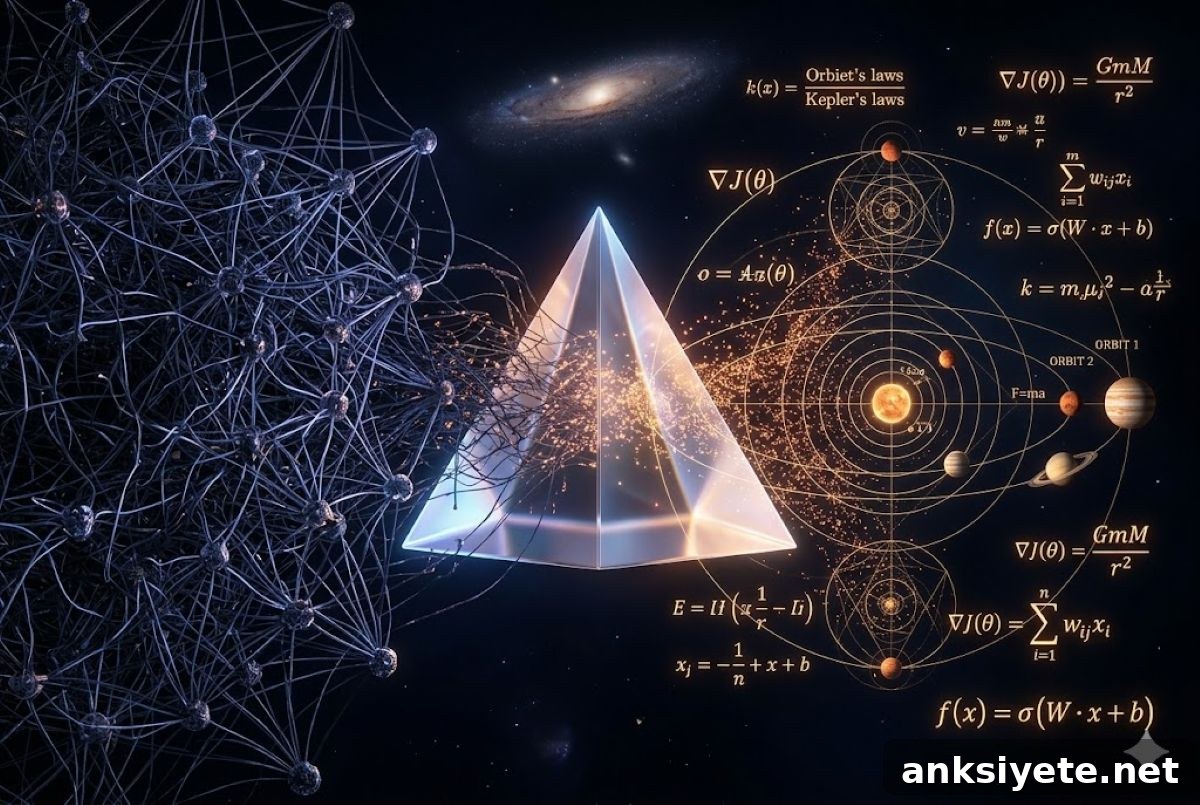
Summary: Modern AI systems such as ChatGPT and Gemini are extraordinarily capable but remain largely “black boxes.” A team of physicists at Harvard has developed a simplified mathematical “toy model” that sheds light on why large neural networks generalize well despite their size. Using tools from statistical physics, they show that high-dimensional data fluctuations—once dismissed as noise—can stabilize learning and help prevent overfitting.
This work applies renormalization ideas to machine learning, offering a potential path from empirical scaling laws toward a deeper theoretical framework for AI behavior.
Key Research Findings
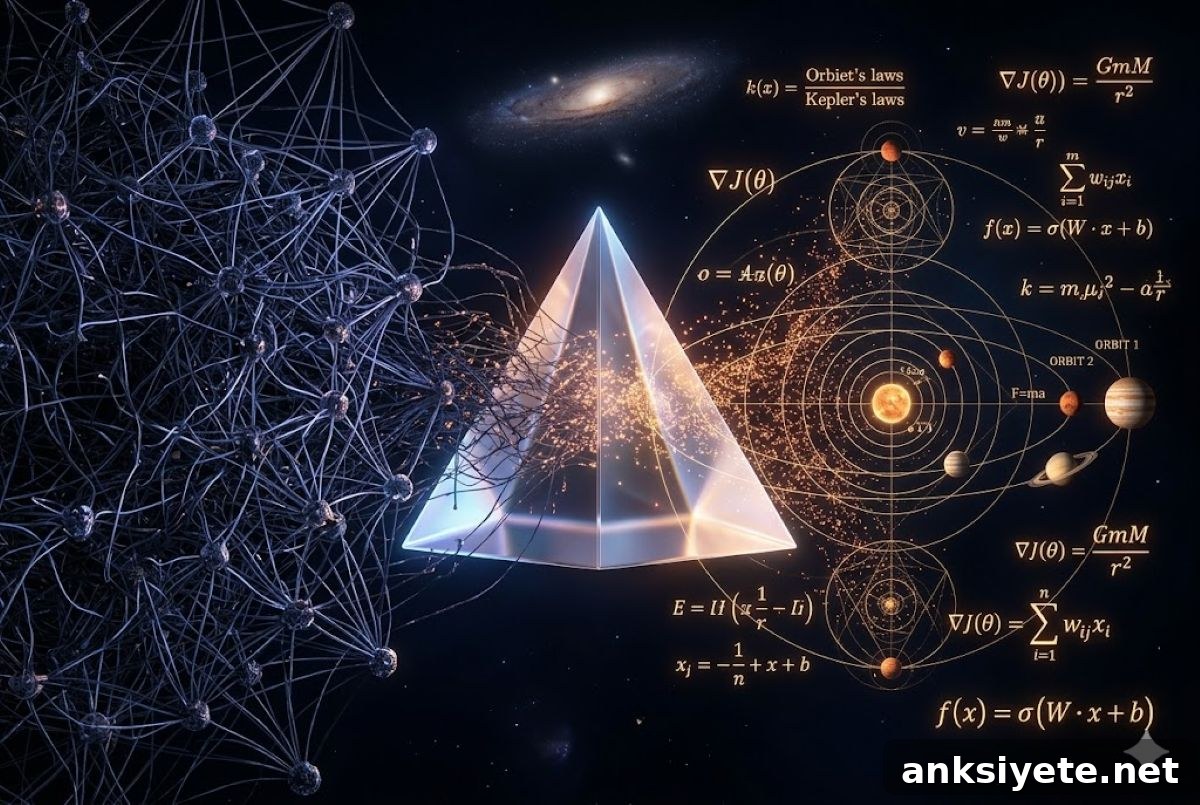
- The Keplerian phase: AI research currently documents robust empirical scaling laws—performance improves with more data and larger models—similar to how Kepler recorded planetary patterns before Newton explained them.
- Networks as emergent systems: Deep learning models behave less like hand-engineered algorithms and more like complex systems or organisms, where intelligent behavior emerges from many simple parts interacting.
- Overfitting paradox: Although large, over-parameterized models should theoretically memorize training data, many instead generalize better as they grow. The team analyzes this paradox using ridge regression as a tractable toy model.
- Renormalization principles: In very high-dimensional settings, microscopic details can be absorbed into a few effective parameters. That coarse-graining, familiar from statistical physics, explains why complex models can display stable, predictable large-scale behavior.
- Statistical fluctuations help generalization: Small random variations in high-dimensional data act to renormalize the learning problem, which can stabilize training and reduce overfitting instead of amplifying it.
Source: SISSA
Why this matters
AI systems built on neural networks—like ChatGPT, Claude, DeepSeek, and Gemini—are powerful yet opaque: we can observe input–output behavior but lack clear, mechanistic explanations. To probe these systems, Harvard physicists constructed a simplified, mathematically tractable model of learning and analyzed it with methods drawn from statistical physics and random matrix theory.
Toy models provide a controlled theoretical laboratory for identifying mechanisms that could underlie the behavior of full-scale neural networks. A clearer theory could lead to more efficient, reliable AI that requires less energy and less trial-and-error tuning.
The search for AI’s fundamental laws
The researchers compare the current stage of AI understanding to Kepler’s work: we have accurate empirical scaling laws but not yet a unifying theory—an analog to Newton’s law of gravity—that explains why those laws hold. Identifying such principles would change AI research from predominantly empirical engineering to a science grounded in predictable, general principles.
Neural networks as emergent structures
Deep learning systems are composed of many simple units—artificial neurons—connected into large networks. While each component’s operation is mathematically known, the collective behavior of millions or billions of parameters is difficult to predict. The emergent, organism-like nature of these networks explains why intuitive, component-level reasoning often fails.
Ridge regression as a toy model
Because full-scale neural networks are analytically intractable, the team studied ridge regression—a regularized form of linear regression that retains key phenomena seen in larger models yet is solvable. Ridge regression provides a clean setting to study training and generalization, and to connect observed behavior to precise mathematics.
Resolving the overfitting mystery
Overfitting occurs when a model memorizes training examples rather than learning general patterns. Paradoxically, many very large models avoid severe overfitting and generalize better with more parameters and data. The researchers show that in high-dimensional regimes, statistical fluctuations in empirical covariance matrices can be absorbed into an effective ridge parameter. That renormalization stabilizes learning and explains benign overfitting and power-law scaling observed in practice.
Broader implications
By demonstrating how statistical physics and random matrix theory illuminate learning dynamics in high dimensions, this work provides a baseline for what features of learning are universal and which depend on model specifics. Such insights can guide the design of more efficient models and help interpret scaling phenomena across diverse architectures.
Key Questions Answered:
A: A toy model is a simplified representation of a complex system that removes inessential details so the core behavior can be solved exactly. It provides a controlled setting to discover general laws that may apply to much larger, more complicated systems.
A: Overfitting is when a model memorizes training data instead of learning patterns that generalize. The mystery is that very large models, which should be prone to memorization, often generalize well. This study suggests renormalization of high-dimensional fluctuations helps prevent overfitting.
A: Understanding the underlying principles of learning could reduce the need for brute-force scaling and heavy compute, enabling the design of models that achieve strong performance with less data and energy.
Editorial Notes:
- This article was edited by a Neuroscience News editor.
- The journal paper was reviewed in full.
- Additional context was added by the editorial staff.
About this AI research news
Author: Federica Sgorbissa
Source: SISSA
Contact: Federica Sgorbissa – SISSA
Image: The image is credited to Neuroscience News
Original Research: Open access. “Scaling and renormalization in high-dimensional regression” by Alexander Atanasov, Jacob A. Zavatone-Veth, and Cengiz Pehlevan. Journal of Statistical Mechanics: Theory and Experiment. DOI: 10.1088/1742-5468/ae4bba
Abstract
Scaling and renormalization in high-dimensional regression
Simple ridge regression can display behaviors once thought unique to deep neural networks—benign overfitting, robust power-law scalings, and rich generalization phenomena. Its combination of analytical tractability and phenomenological richness makes ridge regression an ideal model for studying high-dimensional machine learning.
Using random matrix theory and free probability, the authors show that statistical fluctuations in empirical covariance matrices can be absorbed into a renormalized ridge parameter. This deterministic equivalence yields closed-form asymptotics for training and generalization errors and clarifies sources of power-law scaling in model performance. The same framework produces refined bias–variance decompositions for broad classes of random feature models with structured covariates and reveals regimes where feature-induced variance or anisotropic weight structure limits performance. These results extend and unify prior models of neural scaling laws.