
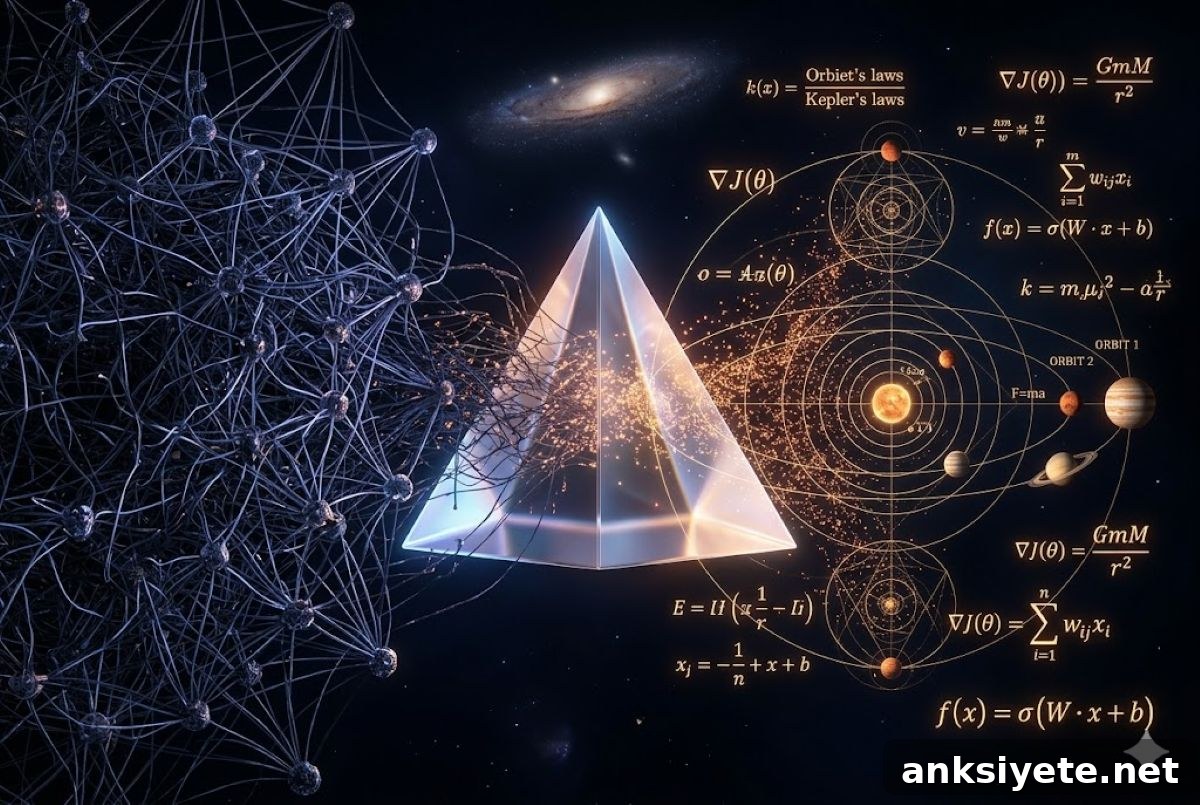
Summary: Modern AI systems like ChatGPT and Gemini are extraordinarily capable, but their internal workings remain largely opaque. To probe these hidden mechanisms, researchers built a simplified mathematical “toy model” that can be analyzed with tools from statistical physics, revealing how high-dimensional data fluctuations stabilize learning and help prevent overfitting.
Using methods from statistical physics, the research team shows that fluctuations in very high-dimensional data—once dismissed as mere noise—can actually act to regularize learning. This insight moves us closer to a principled theory explaining why large neural networks often generalize well, rather than merely memorizing training data.
Key Research Findings
- The Keplerian Phase: Current AI research resembles early planetary science: we have identified empirical scaling laws (performance improves with more data and larger models) but still lack a deeper theoretical framework explaining why these patterns emerge.
- Neural Networks as Organisms: Deep learning models behave less like hand-crafted algorithms and more like complex systems that develop emergent behavior—akin to organisms grown in a laboratory—where intelligence arises from the interactions of many simple components.
- The Overfitting Puzzle: Conventional wisdom predicts that very large models should overfit by memorizing their training sets. Yet, in practice, many large models generalize better as they scale. The team used ridge regression as a tractable toy model to study this phenomenon rigorously.
- Renormalization Principles: The authors propose that renormalization ideas from statistical physics explain how microscopic details in extremely high-dimensional problems can be absorbed into a few effective parameters, producing simple, stable large-scale learning behavior.
- Stabilizing Fluctuations: The study demonstrates that statistical fluctuations in high-dimensional data can stabilize learning—contrary to the intuition that such randomness would harm generalization.
Source: SISSA
Artificial intelligence systems built on neural networks—such as ChatGPT, Claude, DeepSeek and Gemini—are powerful but often operate as “black boxes” whose internal dynamics are not well understood.
To shed light on how these systems form reliable predictions, a team of physicists at Harvard developed a simplified, mathematically tractable model of learning that can be analyzed with tools from statistical physics.
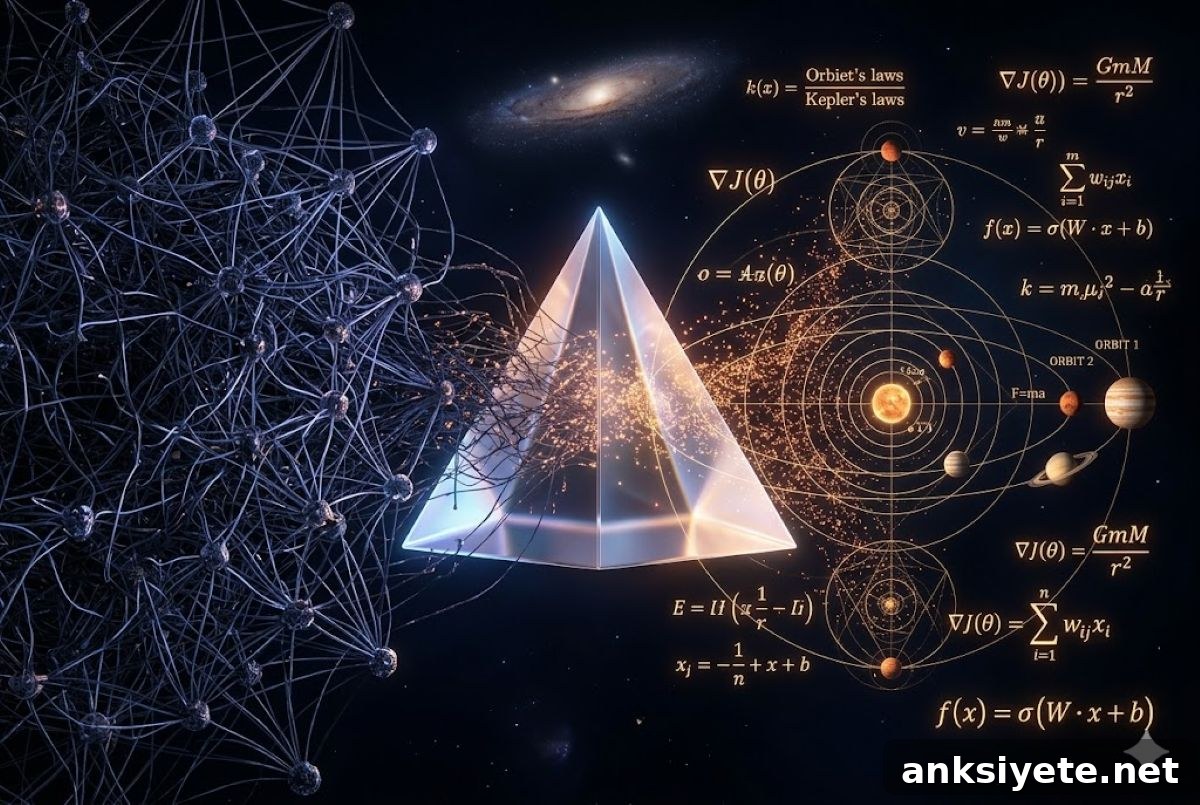
These “toy models,” described in the recent Journal of Statistical Mechanics: Theory and Experiment (JSTAT) paper, create a controlled theoretical laboratory for studying core mechanisms of neural networks. A clearer understanding of these mechanisms could guide the design of AI systems that are more efficient, reliable, and interpretable.
The laws of AI
The researchers compare the current state of AI theory to the stage of astronomy when Kepler identified empirical laws of planetary motion without yet understanding their cause. Kepler’s scaling laws later guided Newton to the theory of gravity. Similarly, today’s scaling laws in AI—rules that predict how performance improves with model size and data—are well documented, but a unifying theoretical framework explaining why those laws hold is still missing.
“We know that making a model larger or training it on more data generally improves performance,” says Cengiz Pehlevan, Associate Professor of Applied Mathematics at Harvard and senior author of the study. But knowing this empirically is not the same as understanding the underlying principles, which is necessary to design more efficient models.
Neural networks as biological systems
“Deep learning models are not systems built from hand-coded rules,” explains Alexander Atanasov, a PhD student in theoretical physics at Harvard and the study’s first author. “They are more like organisms that develop capabilities through training.” Neural networks consist of many simple processing units—artificial neurons—connected in large, layered structures. While the basic math for each unit is known, predicting the emergent behavior of the entire system becomes intractable as size grows.
A tractable toy model
Full neural networks are too complex for exact mathematical analysis, so the authors studied ridge regression, a regularized form of linear regression. Ridge regression captures several qualitative behaviors of large-scale learning while remaining solvable with analytic techniques.
Linear regression estimates relationships between variables—for example, using height and weight data to predict height from weight. Ridge regression introduces a penalty that discourages excessively large model parameters, helping to reduce overfitting.
The overfitting paradox
Overfitting occurs when a model memorizes training examples without capturing the underlying patterns, much like a student who memorizes answers without understanding concepts. Paradoxically, many overparameterized deep networks do not suffer catastrophic overfitting; instead, they often generalize better as they grow. The Harvard team uses ridge regression to analyze this paradox and identify mechanisms that prevent overfitting.
New theoretical insight
The study argues that renormalization principles from statistical physics provide a mathematical basis for why high-dimensional models can generalize despite being overparameterized. In very high-dimensional settings—common in modern AI—statistical fluctuations in data appear naturally. Renormalization shows how many microscopic details can be absorbed into a few effective parameters, yielding predictable, stable behavior at larger scales.
Within their toy model, the authors demonstrate that these high-dimensional fluctuations can act like a stabilizing force during learning, effectively regularizing the model and reducing the tendency to overfit. Jacob Zavatone-Veth, a co-author, notes that such simplified models can serve as baselines to distinguish generic learning phenomena from effects that depend on specific architectures or training details.
Key Questions Answered:
A: A “toy model” is a deliberately simplified version of a complex system that removes extraneous details so the core behavior can be solved exactly. It functions like a controlled experiment, helping researchers identify the fundamental laws that may also govern large, practical AI systems.
A: Overfitting is when a model memorizes training data instead of learning patterns that generalize. Large neural networks can, in principle, memorize vast datasets, yet many still capture meaningful patterns. This study suggests that renormalization-style effects help keep such models grounded.
A: A physics-based understanding of learning could reduce reliance on brute-force scaling and trial-and-error. With principled knowledge of when and why models generalize, designers can build systems that achieve comparable performance with less data, compute, and energy.
Editorial Notes:
- This article was edited by a Neuroscience News editor.
- The journal paper was reviewed in full.
- Additional context was added by staff.
About this AI research news
Author: Federica Sgorbissa
Source: SISSA
Contact: Federica Sgorbissa – SISSA
Image: Image credited to Neuroscience News
Original Research: Open access. “Scaling and renormalization in high-dimensional regression” by Alexander Atanasov, Jacob A Zavatone-Veth and Cengiz Pehlevan. DOI: 10.1088/1742-5468/ae4bba
Abstract
Scaling and renormalization in high-dimensional regression
From benign overfitting in overparameterized models to rich power-law scalings in performance, simple ridge regression exhibits surprising behaviors often associated with deep neural networks. This mix of rich phenomenology and analytical tractability makes ridge regression a useful model system for high-dimensional machine learning.
The paper presents a unified perspective on recent results in ridge regression using tools from random matrix theory and free probability, with an emphasis on accessibility for readers from physics and deep learning backgrounds. The authors show that statistical fluctuations in empirical covariance matrices can be absorbed into a renormalized ridge parameter. This deterministic equivalence enables analytic formulas for training and generalization errors using properties of the S-transform from free probability.
These asymptotic formulas reveal sources of power-law scaling in model performance. The S-transform is connected to the train-test generalization gap and yields an analog of generalized-cross-validation estimators. Applying these techniques, the authors derive detailed bias-variance decompositions for a broad class of random feature models with structured covariates, identify regimes where feature variance limits overparameterized performance, and show how anisotropic weight structures produce nontrivial finite-width corrections.
Overall, the results extend and unify earlier models of neural scaling laws and offer a principled, physics-inspired viewpoint on why large, high-dimensional learning systems often generalize despite their capacity to memorize training data.