
Summary: Researchers trained volunteers to use a wearable, 3D‑printed extra digit called the Third Thumb. Over repeated training, participants improved one‑handed dexterous tasks and reported a growing sense that the robotic thumb belonged to their body. Brain imaging showed measurable changes in how the augmented hand was represented in sensorimotor cortex.
Source: UCL
Using a robotic “Third Thumb” alters the brain’s representation of the hand, a new study led by UCL researchers reports.
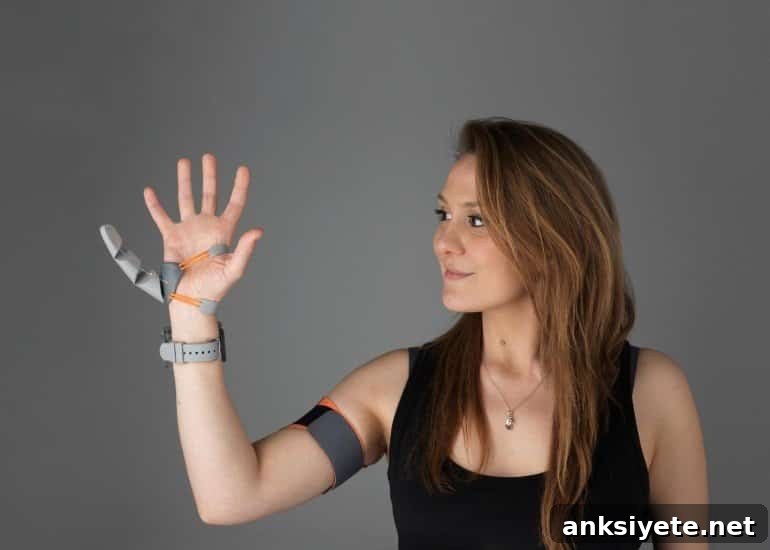
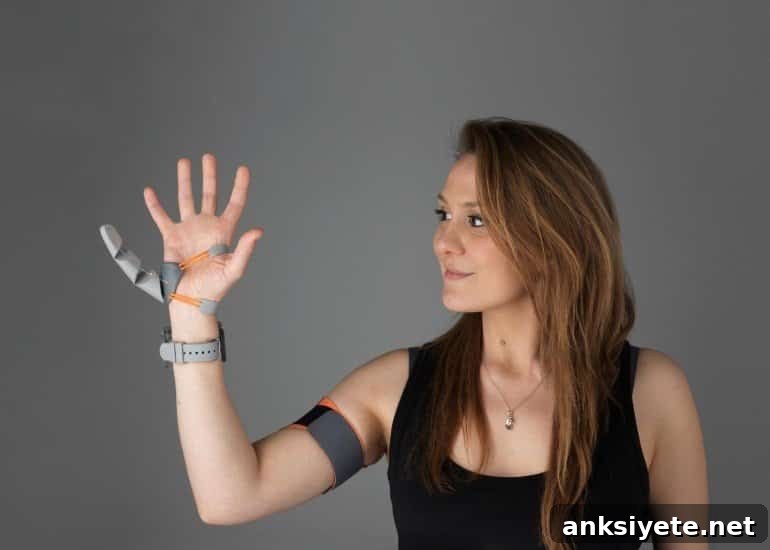
A team from University College London tested a wearable extra thumb designed by Dani Clode, training participants to control it and measuring both behavioral and neural effects. The findings, published in Science Robotics, show that people can rapidly learn to use a robotic extra digit to perform complex one‑handed tasks and that this use can change how the brain represents the augmented hand.
The Third Thumb is a compact, 3D‑printed device that straps to the outer edge of the hand near the little finger and functions as an additional opposable digit. It is controlled wirelessly via pressure sensors placed beneath the user’s big toes; each toe sensor governs different thumb movements, responding instantly to subtle shifts in pressure.
For the study, 20 participants completed a five‑day training program. Each day included lab sessions focused on improving coordination between the biological hand and the robotic thumb, plus encouraged at‑home use for everyday tasks, resulting in two to six hours of wear time per day. A control group of 10 participants wore a static, non‑functional version of the device while following the same training routine.
Training tasks were designed to force cooperation between the hand and the extra digit, converting typical two‑handed actions into one‑handed operations. Examples included picking up and managing multiple small objects such as balls or wine glasses, and assembling a tower of wooden blocks. Participants learned the basic controls quickly and, with practice, improved motor control, dexterity, and hand–thumb coordination. They were able to perform tasks even when attention was divided (for instance, solving a mental arithmetic problem while building) or when vision was blocked.
Designer Dani Clode, who collaborated with the research team, observed that users adapted their natural hand movements to incorporate the augmentation and reported an increasing sense of embodiment: “People can quickly learn to control an augmentation device and use it for their benefit. While using the Third Thumb, people changed their natural hand movements, and they also reported that the robotic thumb felt like part of their own body.”
Before and after training, researchers scanned participants’ brains using functional MRI while the volunteers moved individual fingers. (Participants were not wearing the Third Thumb while in the scanner.) The scans revealed subtle but significant changes specifically in the sensorimotor representation of the hand that had been augmented: the activity patterns associated with individual fingers became more similar to one another, indicating a reduction in the distinctness of each finger’s neural signature.
A subset of participants rescanned a week later showed that many of these neural changes had reduced, suggesting the effects may not be permanent, although further research is needed to determine the time course and permanence of such adaptations.
Paulina Kieliba, first author of the paper, highlighted the broader possibilities and the need for continued research: “Body augmentation could one day be valuable in many settings—helping a surgeon work without an assistant, enabling a factory worker to operate more efficiently, or allowing a person with use of only one hand to accomplish two‑handed tasks. But to realize these benefits, we must continue to study how augmentation devices interact with the brain.”
Professor Tamar Makin, lead author and researcher at the UCL Institute of Cognitive Neuroscience, added that augmentation presents unique challenges for the brain: “Evolution hasn’t prepared us to use an extra body part. To extend our abilities in new and unexpected ways, the brain must adapt its representation of the biological body.”
The study is notable for taking augmentation training out of a purely laboratory setting: it involved multi‑day, prolonged practice and included an untrained comparison group, demonstrating both the feasibility of rapid learning and the value of interdisciplinary collaboration between neuroscientists, designers, and engineers to develop augmentation that aligns with the brain’s learning capacity while maintaining safety.
Funding: The research team at UCL and the University of Oxford received support from the European Research Council, Wellcome, and the Sir Halley Stewart Charitable Trust.
About this robotics research news
Source: UCL
Contact: Chris Lane – UCL
Image: The image is credited to Dani Clode
Original Research: Closed access. “Robotic hand augmentation drives changes in neural body representation” by Dani Clode et al., published in Science Robotics.
Abstract
Robotic hand augmentation drives changes in neural body representation
Augmentation raises both technological challenges and questions about the brain’s capacity to incorporate new effectors. This study evaluated whether motor augmentation with an extra robotic thumb can be learned efficiently and how its use affects the biological hand’s neural representation and function.
Able‑bodied participants trained with a wearable Third Thumb over five days, combining structured lab practice with unstructured daily use. They were challenged to perform normally two‑handed tasks using only the augmented hand, and their performance, kinematics, sense of embodiment, and brain activity were assessed before and after training.
Training led to improved control of the Third Thumb, enhanced dexterity, and better hand–robot coordination, even under increased cognitive load or when vision was occluded. Participants also reported a stronger sense that the device belonged to their body. At the same time, augmentation altered the biological hand’s kinematic synergies and produced a mild convergence of neural activity patterns for individual fingers in sensorimotor cortex when scanned without the device.
Overall, the results show that motor augmentation can be acquired quickly with flexible use and reduced cognitive dependence, but it may also change the neural and behavioral organization of the biological hand. These neurocognitive consequences are important to consider for future augmentation technologies.