
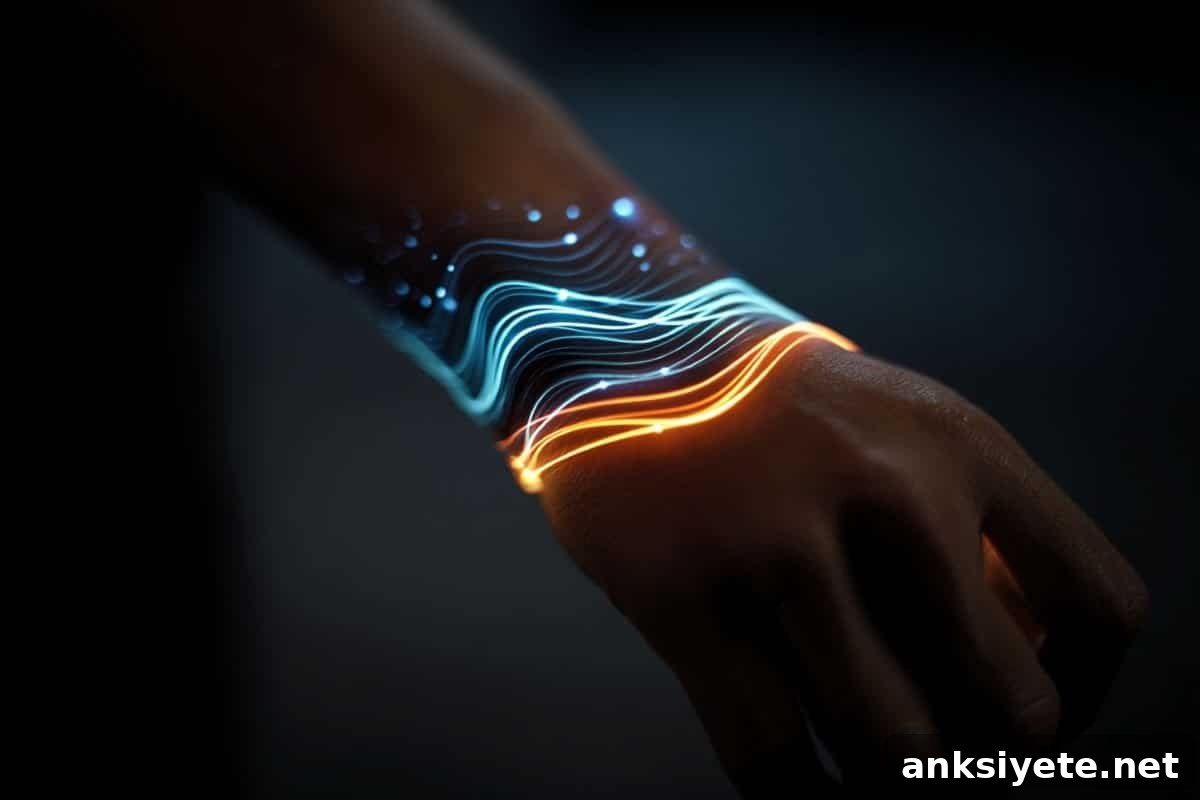
Summary: A recent doctoral study reframes mobile device vibration from a basic alert into a rich channel for expression. The research introduces the concept of “tactons”—structured vibrotactile patterns intentionally designed to convey emotion, provide social support, and represent personal memories—demonstrating how haptic feedback can communicate complex, meaningful content beyond simple on/off notifications.
By treating vibration as an expressive medium rather than merely a technical notification, the study shows how carefully designed tactile patterns can function as a reassuring touch for public speakers, deliver discreet environmental cues for blind and low-vision users, and hold subjective, memory-like qualities for individuals.
Key Facts
- Expressive tactons: The research moves past basic vibration alerts to create tactons—composed sequences of rhythm, intensity, and duration—that participants associated with nuanced emotional states such as reassurance, encouragement, and tension.
- Social support through touch: In remote public speaking experiments, vibrotactile feedback acted like a “digital hand on the shoulder,” helping speakers regulate anxiety and remain focused without relying on visual or auditory cues.
- Tactile memories: Participants were able to translate aspects of personal memories into distinct vibration patterns, suggesting that touch can encode and recall subjective experiences in ways that feel meaningful to the user.
- Inclusive design: Working with blind and low-vision participants, the study developed a tactile vocabulary for perceiving environmental information, offering a private and non-auditory alternative to spoken navigation aids.
Source: Estonian Research Council
Overview of the research
In her doctoral thesis, Yulia Sion explores how vibration—commonly used in mobile devices as a simple alert—can become a meaningful channel that conveys emotion, supports social connection, and represents personal experiences. Using Research through Design methods, the work combines experimental studies, wearable prototypes, and collaborative co-design with end users to develop practical tools and a design framework for expressive vibrotactile feedback.
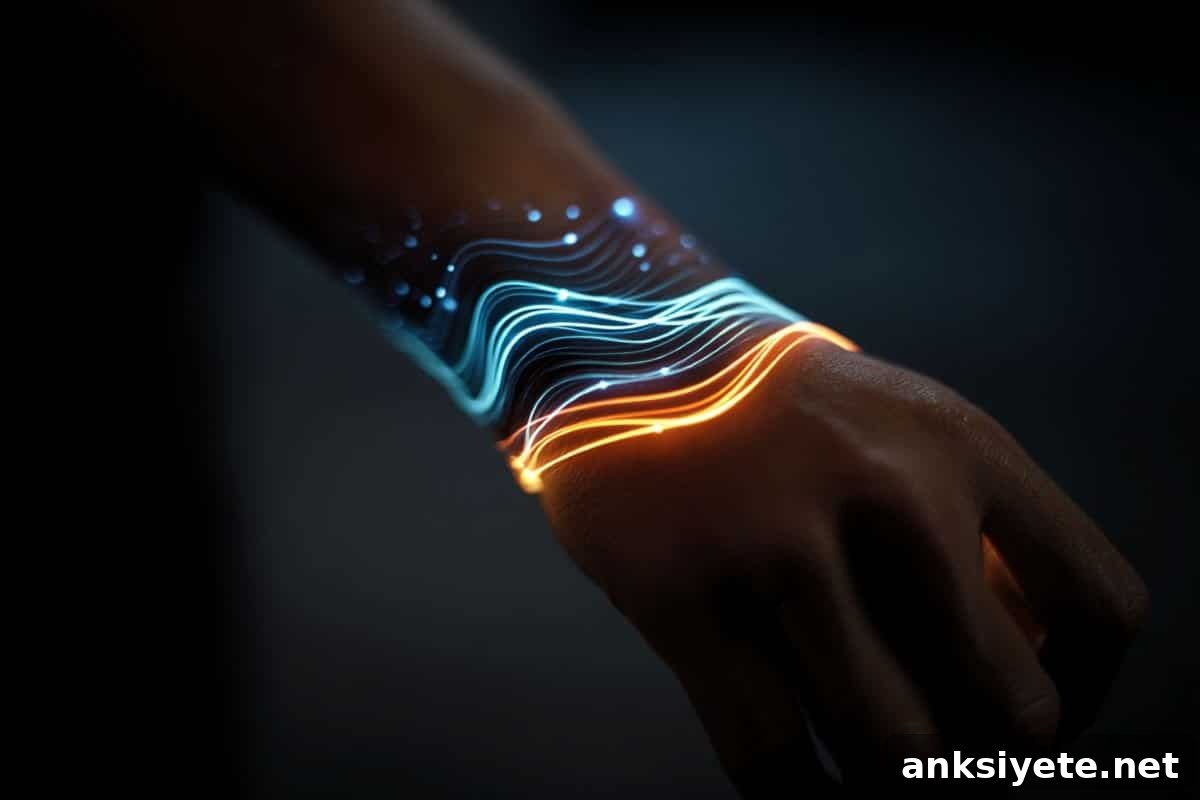
Across contexts such as public speaking, accessibility for blind and low-vision people, and the translation of personal memories into tactile form, the research develops methods for designing expressive vibrotactile patterns and evaluates how people interpret them in realistic situations. The findings show that vibration can carry layered meaning when designers treat its parameters—tempo, amplitude, rhythm, spatial location—as resources for emotional and informational expression.
The meaning of vibration in digital communication
The study demonstrates that vibration can communicate more than notifications. Participants mapped specific tactile sequences to emotional qualities: a gentle, rhythmic pattern was read as reassurance; gradual rising intensity suggested encouragement; abrupt, irregular pulses conveyed tension or urgency. In remote public speaking trials, these patterns were interpreted as social support that helped presenters manage anxiety, keep their attention, and perform under pressure without adding visual or auditory distractions.
In exercises focused on personal memory, individuals translated the tempo and strength of their recollections into distinct vibrotactile forms—for instance, slower, fading waves for calm memories and rapid, high-frequency pulses for excitement. Co-design sessions with blind and low-vision participants produced a set of tactile cues tailored for environmental awareness, showing how tactons can augment or replace audio-based navigation in situations where sound is impractical or intrusive.
A core contribution of the thesis is a practical co-design framework for creating expressive tactons. Instead of treating vibration as a purely technical parameter to be toggled on or off, the framework helps designers map experiential, emotional, and contextual meanings to specific tactile features. Complementing the framework, the research produced wearable prototypes and a haptic design system to support future development and testing.
Helping designers create meaning
This work expands the role of touch in interaction design. While many technologies rely heavily on visual and auditory channels, the research shows that touch can serve as a primary medium—especially when those other senses are overloaded, unavailable, or need to remain unobtrusive. The insights are relevant to accessibility, remote communication, wellbeing technologies, and multisensory storytelling, and they offer a practical path for designers to craft tactile experiences that are emotionally resonant and socially sensitive.
By reconceptualizing vibration as a carrier of meaning rather than a mere signal, the thesis advances approaches for more inclusive and emotionally aware haptic interfaces and provides design tools and empirical evidence that vibrotactile feedback can be both interpretable and impactful.
Key Questions Answered:
A: Yes. The research found that when vibrations are structured—varying in rhythm, intensity, and duration—people instinctively assign social and emotional meanings to them. A gentle, rhythmic pulse can be perceived as a supportive gesture, while a sharp, irregular pattern may signal urgency or stress.
A: Visual and auditory channels can become overloaded or inappropriate in many situations. Vibration offers a private, eyes-free channel that works in noisy environments or in sensitive social contexts where checking a phone or using headphones would be disruptive.
A: Using a co-design framework, participants translated aspects of their memories—such as tempo and intensity—into tactile motifs. Calm memories were often represented by slow, fading waves; exciting memories by rapid, pulsed sequences. The process helps link subjective experience to perceivable haptic features.
Editorial Notes:
- This article was edited by a Neuroscience News editor.
- Referenced journal paper was reviewed in full.
- Additional explanatory context was added by editorial staff to clarify methods and implications.
About this neurotech research news
Author: Mikk Viilukas
Source: Estonian Research Council
Contact: Mikk Viilukas – Estonian Research Council
Image: The image is credited to Neuroscience News