
Researchers reveal that a common method for comparing skull and brain size across species can be misleading when applied to individuals within a species.
Research sometimes uncovers results very different from what was originally intended. Corina Logan’s work provides a clear example. Focusing on the cognitive abilities of the great-tailed grackle (Quiscalus mexicanus), a bird in the blackbird family, Logan—then a junior research fellow at UC Santa Barbara’s SAGE Center for the Study of the Mind—set out to estimate brain size of live grackles using external head measurements rather than invasive procedures.
Her effort instead exposed a broader problem: the standard methods used to compare brain size across species are not necessarily reliable for detecting individual differences within a species, especially for great-tailed grackles. These findings, supported by the National Geographic Society/Waitt Grants Program, are published in the journal PeerJ.
“Brain size is a major topic in evolutionary and cognitive biology,” Logan said. “There’s growing interest in how brain size varies among individuals within a species, and what drives the evolution of larger brains. But to study that variation, researchers need accurate, validated measures of brain size that work for the species and sex under study.”
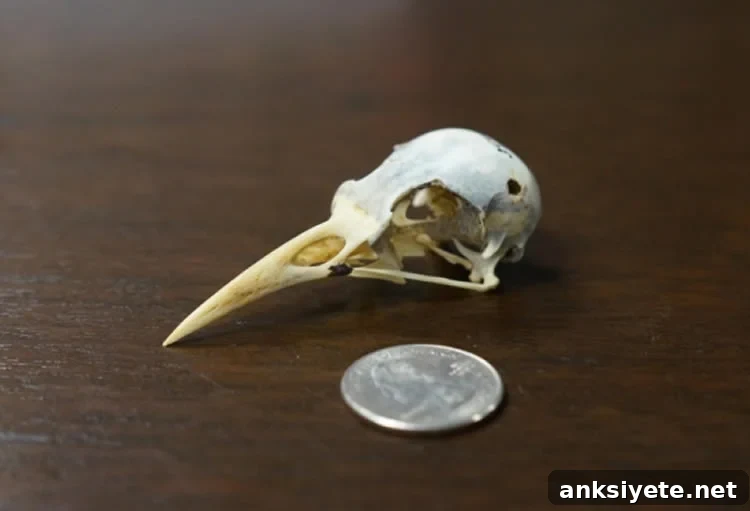
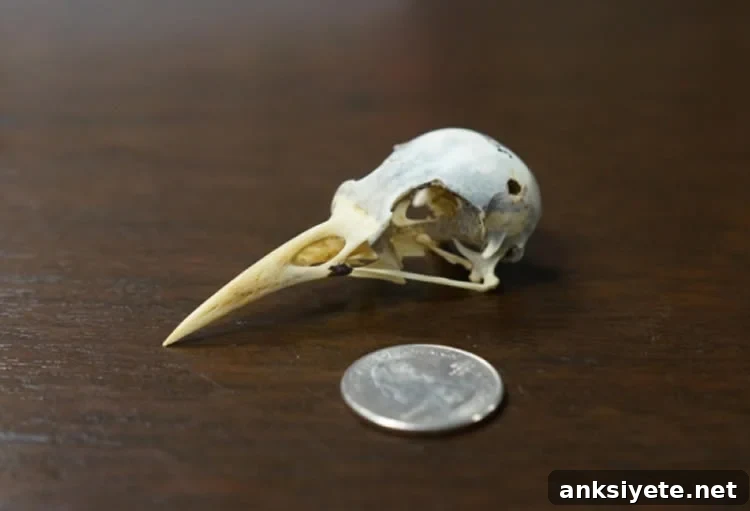
To study brain size in wild birds without harming them, Logan aimed to find a reliable proxy that could be used in the field. She and co-author Christin Palmstrom, an undergraduate biology student at the time, obtained grackle skulls from museum collections and measured them using two approaches: CT scans to calculate endocranial volume (the internal cavity volume that approximates brain size) and caliper measurements of external skull dimensions (length, width and height).
They scanned the skulls and used software to compute endocranial volume from the CT data, then compared those values to estimates derived from the caliper measurements. If external skull dimensions reliably predicted endocranial volume, researchers could use the simpler caliper method in place of CT scanning. Logan expected the two approaches to align closely enough to be interchangeable.
They did not.
External skull measurements failed to predict endocranial volume for great-tailed grackles with sufficient accuracy. Logan found substantial variation in skull shape and internal volume within the species—variation that was especially pronounced in males. As a result, simple external measures could not reliably indicate an individual bird’s brain size.
Beyond that empirical result, Logan’s study highlights a statistical problem: researchers often rely on the Pearson product-moment correlation coefficient to claim two measurement methods agree. A statistically significant correlation, however, does not guarantee precise prediction for individual cases. The Pearson correlation can mask wide variation among individual data points, creating a false impression that two methods are interchangeable.
“People see a significant correlation and assume the methods are interchangeable,” Logan said. “But many correlations are weak in a practical sense. You need to examine prediction accuracy and how much individual predictions overlap.”
To test predictive performance, Logan evaluated whether external skull measurements could predict CT-derived endocranial volumes for new skulls outside the original dataset. The result: prediction intervals for individual skulls overlapped extensively, meaning a new measurement could not be distinguished reliably from others in the sample. In short, external caliper measurements provided little useful information about an individual grackle’s brain size.
These results underscore the need to validate brain-size proxies for each species and sex before using them to study behavioral or evolutionary questions. Logan emphasized that statistical approaches in biology are shifting away from sole reliance on p-values and simple correlations toward methods that expose the finer details of effect sizes and predictive accuracy.
UCSB’s Cheadle Center for Biodiversity and Ecological Restoration (CCBER) played a crucial role by providing access to natural history collections. CCBER coordinated loans of grackle skulls from the Museum of Southwestern Biology and the University of Kansas Biodiversity Institute, supplementing a specimen from the Santa Barbara Museum of Natural History, which allowed the researchers to reach an adequate sample size.
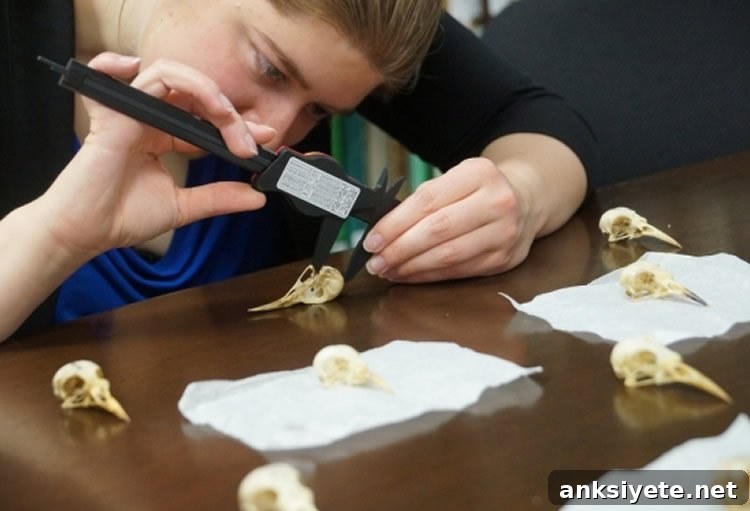
While Logan primarily studies live birds, museum specimens provided an essential complement to fieldwork by allowing precise comparisons between internal and external skull measures. The combined approach revealed that, for great-tailed grackles at least, external skull dimensions are a poor proxy for endocranial volume and cannot detect individual-level differences in brain size.
Source: Andrea Estrada – UC Santa Barbara
Image credit: Sonia Fernandez
Original research: PeerJ article “Can endocranial volume be estimated accurately from external skull measurements in great-tailed grackles (Quiscalus mexicanus)?” by Corina J. Logan and Christin R. Palmstrom. Published online June 11, 2015.
Abstract
Can endocranial volume be estimated accurately from external skull measurements in great-tailed grackles (Quiscalus mexicanus)?
Accurate, validated measures of brain size for individuals in the field are increasingly important for understanding the evolutionary drivers of brain variation. This study evaluated whether endocranial volume, measured by computed tomography (CT) as a proxy for brain size, can be accurately predicted from external skull dimensions or from bead-filling methods in male and female great-tailed grackles. Although females showed higher correlations than males, estimates derived from external measurements or bead fills did not tightly correspond to CT volumes. Prediction intervals for most measurements overlapped extensively, indicating no reliable ability to predict CT-derived volumes from external measures. We conclude that individual differences in endocranial volume cannot be detected accurately using external skull measurements in this species and recommend validating brain-size proxies separately for each species and sex.
“Can endocranial volume be estimated accurately from external skull measurements in great-tailed grackles (Quiscalus mexicanus)?” by Corina J. Logan and Christin R. Palmstrom in PeerJ. Published online June 11, 2015.