
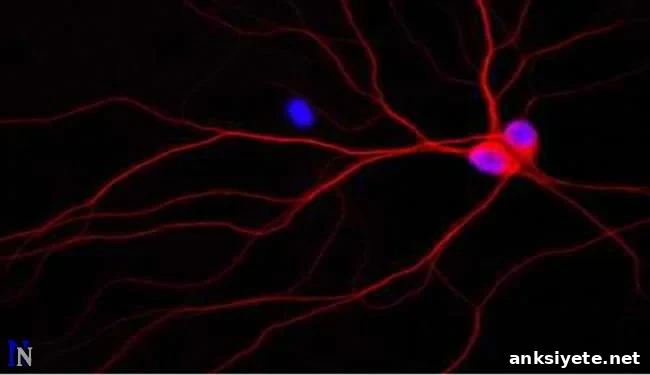
UC Santa Barbara researchers report a new direction in Alzheimer’s disease research with a key discovery about the fate of neurons damaged in Alzheimer’s and related dementias. The findings are published in the online edition of The Journal of Biological Chemistry.
Stuart Feinstein, professor of Molecular, Cellular and Developmental Biology at UCSB, senior author of the study, and co-director of UCSB’s Neuroscience Research Institute, summarized the clinical relevance: “In dementia, the neurons that support thinking and memory stop functioning properly and then die. It is the loss of these neuronal populations that underlies cognitive decline.”
For roughly 30 years Feinstein has investigated the neuronal protein tau using biochemical assays and cultured cell models. Under normal conditions tau is concentrated in axons, the long projections that connect neurons to their targets, often far from the cell body. One of tau’s primary roles is to stabilize microtubules, structural components of the cell’s cytoskeleton that are essential for maintaining neuronal shape, transport, and function.
Previous research has established that a small peptide called amyloid beta can provoke neuronal death and contribute to Alzheimer’s disease, but the precise mechanism has remained unclear. Recent genetic studies indicate that tau is required for amyloid beta to kill neurons, yet how amyloid beta acts on tau has been poorly defined. “Amyloid beta is the bad actor,” Feinstein said. “We know it contributes to disease, but exactly how it does so has been the outstanding question.”
Many Alzheimer’s investigators have focused on the idea that amyloid beta triggers abnormal, excessive phosphorylation of tau—an inappropriate chemical addition of phosphate groups to the protein. “Phosphorylation is a normal regulatory process for many proteins,” Feinstein explained. “It can be controlled and beneficial, or it can occur in the wrong way or at the wrong time.”
Feinstein and his team set out to define the precise nature of any abnormal tau phosphorylation caused by amyloid beta, reasoning that a detailed biochemical map of those modifications could yield specific drug targets. “The better the biochemical understanding of the target, the more precisely a pharmaceutical intervention can be designed,” he said.
The team’s experiments, however, produced an unexpected result. Their initial hypothesis—that amyloid beta would induce large-scale abnormal phosphorylation of tau—proved to be incorrect. Instead of massive phosphorylation, the researchers observed rapid fragmentation of tau following amyloid beta exposure. Tau fragments began to appear within one to two hours after amyloid beta was applied to cultured neuronal cells, and by 24 hours the affected cells were no longer viable.
This observation points to a different model for neuronal death in Alzheimer’s disease. Tau’s best-known function is to regulate the microtubule network of the cytoskeleton. Cells rely on their cytoskeleton to change shape, move organelles, and support many essential processes. Neurons are especially dependent on a functioning cytoskeleton because of their length and the demands of long-distance intracellular transport.
Feinstein suggests that disruption of tau’s structural role — through its fragmentation — could destabilize the neuronal cytoskeleton and lead directly to cell death. “If you destroy tau, an important regulator of microtubules, it is easy to see how that could lead to neuronal loss,” he said. He compared the effect to known anti-cancer drugs that cause cell death by disrupting the cytoskeleton: “In my view, a similar breakdown of scaffolding in neurons could underlie the degeneration we observe in Alzheimer’s.”
Notes about this Alzheimer’s research
The Feinstein laboratory is actively pursuing follow-up experiments to explore the implications of tau fragmentation and to clarify how amyloid beta initiates this process. Understanding the exact biochemical steps that lead from amyloid beta exposure to tau cleavage and cytoskeletal failure could open new avenues for targeted therapies.
Co-authors on the paper include graduate student Jack Reifert and former graduate student DeeAnn Hartung-Cranston. For institutional information and the original press release, see University of California – Santa Barbara.
Contact: Gail Gallessich & George Foulsham
Source: University of California – Santa Barbara press release
Image credit: Jack Reifert, UCSB. Image adapted by Neuroscience News from the UCSB press release.