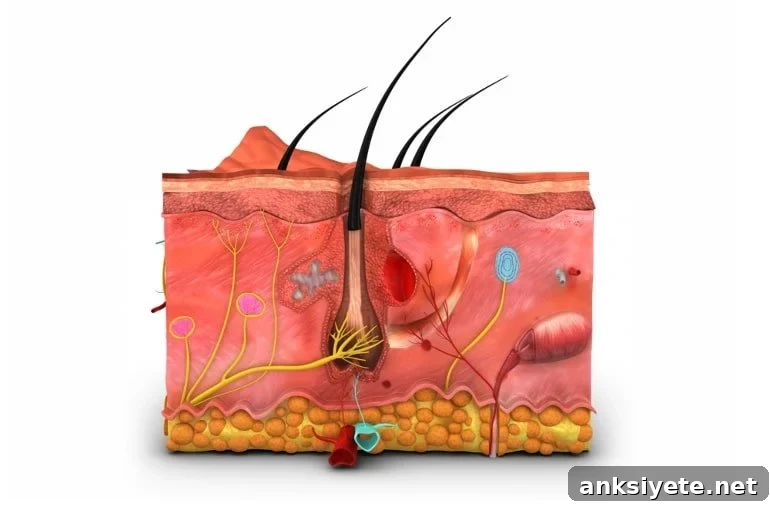
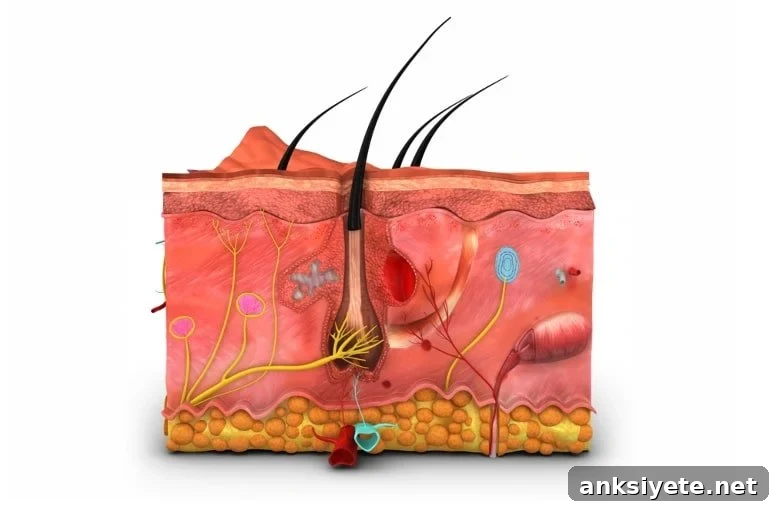
Summary: In mice fed a high‑fat diet, increasing levels of the cytokine TSLP triggered substantial abdominal fat and overall weight loss. The reduction in adipose tissue was not due to eating less or a higher metabolic rate. Instead, TSLP activated immune pathways that caused the skin’s sebaceous glands to secrete energy‑rich sebum, effectively expelling lipids through the skin.
Source: University of Pennsylvania
Treating obese mice with thymic stromal lymphopoietin (TSLP) produced dramatic abdominal fat and body weight loss compared with controls, according to a new study from the Perelman School of Medicine at the University of Pennsylvania published in Science.
Contrary to expectations, the mice that lost weight did not eat less or show higher energy expenditure. Instead, the researchers found that TSLP engaged the immune system to promote lipid release from the skin’s oil‑producing sebaceous glands.
“This was an unexpected discovery: we show that adipose tissue can be reduced by secreting calories from the skin in the form of sebum,” said principal investigator Taku Kambayashi, MD, PhD, an associate professor of Pathology and Laboratory Medicine at Penn. He led the work with Ruth Choa, PhD, a fourth‑year medical student. “To our knowledge, this is the first demonstration of a non‑hormonal immune mechanism that drives this form of lipid loss.”
The animal results suggest the possibility that immune‑driven increases in sebum production could be explored as a new approach to treating obesity in humans.
The hypothesis
TSLP is an epithelial‑derived cytokine involved in allergic diseases such as asthma. Kambayashi’s lab had previously shown that TSLP activates Type 2 immune responses and expands regulatory T cells (Treg). Because Type 2 cells and Tregs are known to influence energy metabolism and insulin sensitivity, the team hypothesized that elevating TSLP might counteract metabolic dysfunction in overweight mice—initially focusing on insulin resistance rather than weight loss itself.
“We expected TSLP might ameliorate insulin resistance without changing body weight,” Kambayashi said. Instead, the treatment produced marked weight loss.
The experiment
To test TSLP’s metabolic effects, the researchers injected obese mice with an adeno‑associated viral vector engineered to raise systemic TSLP levels. Over four weeks, TSLP‑treated mice fed a high‑fat diet lost substantial weight while control animals continued to gain. On average, treated mice dropped from roughly 45 grams to about 25 grams within 28 days.
The weight loss included a pronounced reduction in visceral (abdominal) white adipose tissue, which is linked to higher risks for diabetes, heart disease, and stroke. The treated animals also showed improved blood glucose and fasting insulin levels and had less evidence of fatty liver disease.
Because the outcome was so striking, the team checked whether TSLP had made the mice ill or reduced their appetite. Instead, TSLP‑treated mice ate 20–30 percent more than controls and maintained similar basal metabolic rates, activity levels, and overall energy expenditure.
Key findings
A telling visual clue led investigators to the mechanism: treated mice had noticeably glossier, oilier coats. The researchers shaved both treated and control mice and analyzed extracted fur lipids. The oily residue from TSLP‑treated animals was enriched in sebum‑specific lipids. Sebum, produced by sebocytes in sebaceous glands, is a dense, energy‑containing mixture that contributes to the skin barrier. Histology confirmed that TSLP increased sebum secretion and accelerated sebocyte turnover.
Crucially, mice with defective sebaceous glands (asebia mice) did not lose adipose tissue after TSLP treatment, proving that sebum hypersecretion was necessary for fat loss. The study further showed that TSLP recruits T cells to sebaceous glands and that T cell migration into skin is required for enhanced sebum release. Blocking T cell migration prevented both sebum hypersecretion and subsequent adipose loss.
At baseline, TSLP and T cells helped maintain steady‑state sebum production: mice lacking the TSLP receptor or T cells exhibited lower sebum secretion. Many sebum fatty acids have antimicrobial properties, and the investigators observed reduced levels of sebum‑associated antimicrobial peptides in TSLP‑receptor‑deficient animals, linking the TSLP–sebum axis to skin barrier and immune function.
Implications and next steps
Analysis of human skin gene expression data revealed a positive correlation between TSLP expression and genes associated with sebaceous gland function in healthy individuals, suggesting the TSLP‑sebum relationship exists in humans as well. The authors propose that enhancing sebum secretion through immune modulation could, in principle, promote lipid loss and help treat obesity and related lipid disorders, though additional research is required to evaluate safety and feasibility in people.
“We do not believe sebum production is a routine mechanism for weight control in humans, but it may be possible to harness or amplify this pathway therapeutically,” Kambayashi said.
This research was supported by grants from the National Institutes of Health, the Doris Duke Charitable Foundation, and the University of Pennsylvania Medical Scientist Training Program.
Penn researchers who contributed to this work include: Junichiro Tohyama, Shogo Wada, Hu Meng, Jian Hu, Mariko Okumura, Tanner F. Robertson, Ruth‑Anne Langan Pai, Arben Nace, Christian Hopkins, Elizabeth A. Jacobsen, Malay Haldar, Garret A. FitzGerald, Edward M. Behrens, Andy J. Minn, Patrick Seale, George Cotsarelis, Brian Kim, John T. Seykora, Mingyao Li, and Zoltan Arany.
About this obesity research news
Source: University of Pennsylvania
Contact: Lauren Ingeno – University of Pennsylvania
Image: The image is credited to the researchers
Original research: Closed access. “Thymic stromal lymphopoietin induces adipose loss through sebum hypersecretion” by Ruth Choa et al., Science.
Abstract
Thymic stromal lymphopoietin induces adipose loss through sebum hypersecretion
INTRODUCTION
Obesity and its complications remain major global health challenges. Identifying pathways that regulate adiposity is essential. Recent work shows the immune system can influence adipose tissue and metabolic function: Type 2 immune cells (including ILC2s and eosinophils) and regulatory T cells affect metabolic rate and insulin sensitivity.
RATIONALE
TSLP is an epithelial cytokine expressed at barrier sites such as skin, lung, and gut. Because TSLP activates Type 2 immune responses and expands Treg cells, the investigators tested whether TSLP could counteract obesity and related metabolic disorders.
RESULTS
Mice given a Tslp‑expressing adeno‑associated virus (TSLP‑AAV) showed selective white adipose tissue (WAT) loss and were protected against diet‑induced and genetic obesity, insulin resistance, and nonalcoholic steatohepatitis (NASH).
Unexpectedly, WAT loss did not depend on ILC2s, eosinophils, or Treg cells. Instead, TSLP directly activated CD4+ and CD8+ TCRαβ T cells in an antigen‑independent way. Adoptive transfer of lymph node T cells from TSLP‑AAV mice induced WAT loss in TSLP‑receptor‑deficient recipients, indicating TSLP‑stimulated T cells can drive adipose reduction.
The WAT loss was not linked to reduced food intake, increased fecal caloric loss, or higher energy expenditure. Rather, treated mice developed oily coats; lipid analysis showed sebum enrichment. TSLP promoted sebum secretion and sebocyte turnover, and sebum hypersecretion was necessary for WAT loss, since mice with defective sebaceous glands did not lose adipose tissue after TSLP. T cells migrated to sebaceous glands in response to TSLP, and blocking T cell migration prevented sebum hypersecretion and fat loss.
At steady state, TSLP and T cells regulate basal sebum secretion. Tslpr‑deficient and T cell–deficient mice had reduced sebum output and lower expression of sebum‑associated antimicrobial peptides, indicating a role for endogenous TSLP in skin barrier function. Human skin data showed a positive correlation between TSLP and sebaceous gland gene expression.
CONCLUSION
These findings support a model in which TSLP overexpression causes WAT loss by recruiting skin T cells and driving sebum hypersecretion. The study reveals an unexpected role for adaptive immunity in regulating sebum production and skin barrier maintenance, and it suggests a potential immune‑driven pathway to reduce adipose tissue that warrants further investigation.