
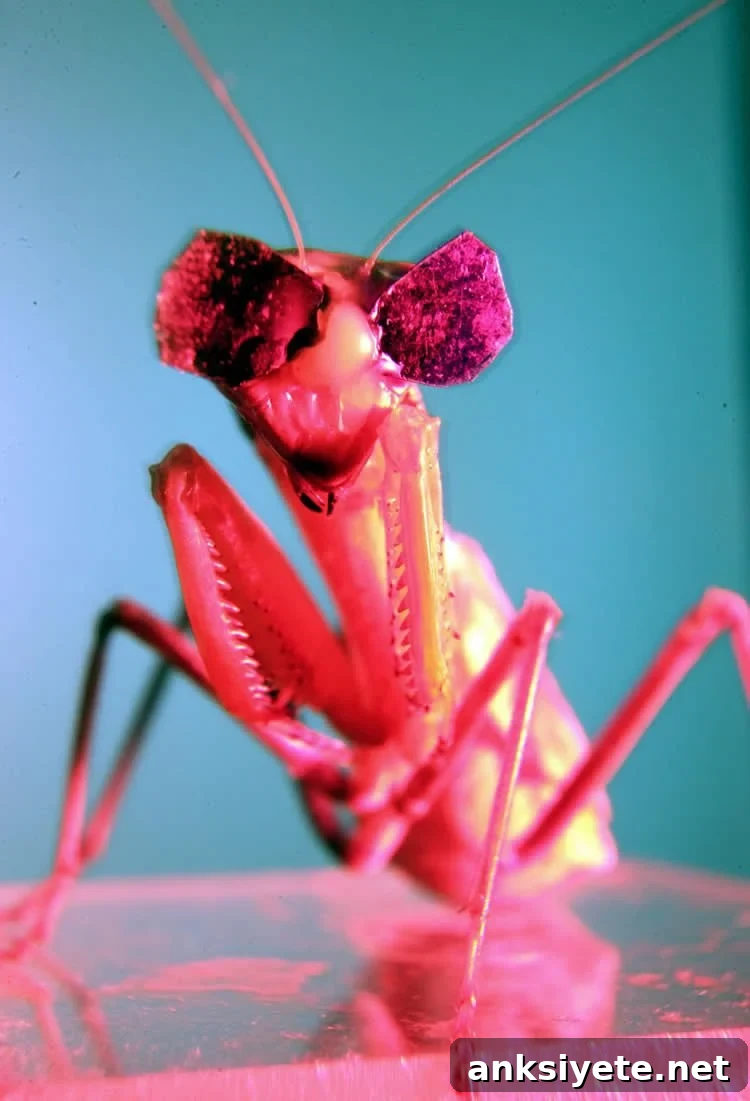
Miniature glasses prove mantises use 3D vision, offering a new model to improve robotic visual perception.
Most of what we know about stereoscopic (3D) vision comes from studies of vertebrates. Today, researchers at Newcastle University publish new evidence in Scientific Reports showing that the praying mantis — an invertebrate — reliably uses stereopsis to judge depth while hunting.
To test mantis binocular vision, the team built a bespoke “insect cinema” and fitted the insects with tiny, custom-made 3D glasses. Because mantises are insensitive to red light, the researchers substituted the standard red/blue anaglyph pair with blue and green lenses and paired these with an LED display tuned to narrow blue and green wavelengths. The result: mantises responded to virtual prey only when the images provided a true stereoscopic cue.
Advancing our understanding of 3D vision
Stereopsis in mantises was first reported in the 1980s by Samuel Rossel, but earlier methods — using prisms and occluders — limited the variety of stimuli that could be presented. The Newcastle team’s anaglyph-based approach gives experimenters precise control over the images seen by each eye, enabling far broader and more flexible tests of insect depth perception.
Lead investigator Jenny Read, Professor of Vision Science, explained that despite their tiny brains, mantises are highly effective visual predators and therefore valuable models for understanding efficient depth-processing strategies. She noted that studying mantis vision can shed light on how stereopsis evolved and may inspire simpler, more efficient algorithms for 3D perception in machines.
In the experiments, mantises were fitted with the miniature glasses affixed with beeswax and shown short animated insects on a computer screen. When the stimuli were presented as conventional 2D images, the mantises typically ignored them. When the same stimuli were altered to produce binocular disparity — making the virtual prey appear in front of the screen — the mantises struck out to capture the target. These behavioral responses confirm that mantises use binocular disparity cues to perceive depth.
Why old-school anaglyphs worked better than polarization
The research team initially tested modern circular-polarization 3D systems commonly used for human viewing. Those systems failed for mantises because the close viewing distance caused substantial crosstalk between the two eye channels, preventing reliable separation of images.
Dr. Vivek Nityananda, a sensory biologist on the team, said that switching to the anaglyph approach — using green and blue filters matched to the mantis spectral sensitivity — produced clear depth illusions. The study therefore provides definitive behavioral evidence for insect stereopsis and demonstrates a practical method for delivering virtual 3D stimuli to small invertebrates.
The team plans to continue investigating the computational rules mantises use to extract depth from binocular images. Understanding these simpler biological algorithms could inform both theories of visual evolution and the development of lightweight, efficient 3D vision systems for robots and computer vision applications.
Funding: The study was funded by the Leverhulme Trust.
Source: Karen Bidewell – Newcastle University
Image Source: Images credited to Newcastle University
Original Research: Full open access research for “Insect stereopsis demonstrated using a 3D insect cinema” by Vivek Nityananda, Ghaith Tarawneh, Ronny Rosner, Judith Nicolas, Stuart Crichton and Jenny Read in Scientific Reports. Published online January 7 2016 doi:10.1038/srep18718
Abstract
Insect stereopsis demonstrated using a 3D insect cinema
Stereopsis — or 3D vision — is a central model for studying perception, but mechanistic insight has largely come from vertebrate systems. Although initial evidence for stereopsis in the praying mantis exists, progress has been constrained by a lack of techniques to present independent binocular stimuli to small invertebrates. To overcome this, the authors built a stereoscopic display system tailored to insects, using miniature anaglyph glasses to deliver separate images to each eye and tested this system on praying mantises. Circular-polarization filtering failed due to excessive crosstalk at the mantises’ close viewing distances, but spectral anaglyph filtering with green and blue channels succeeded in producing clear 3D depth illusions. The study provides definitive behavioral proof of stereopsis in mantises and validates an approach for presenting virtual 3D stimuli to insects, opening new avenues for comparative studies of depth perception and potential algorithms for machine vision.
“Insect stereopsis demonstrated using a 3D insect cinema” by Vivek Nityananda, Ghaith Tarawneh, Ronny Rosner, Judith Nicolas, Stuart Crichton and Jenny Read in Scientific Reports. Published online January 7 2016 doi:10.1038/srep18718