
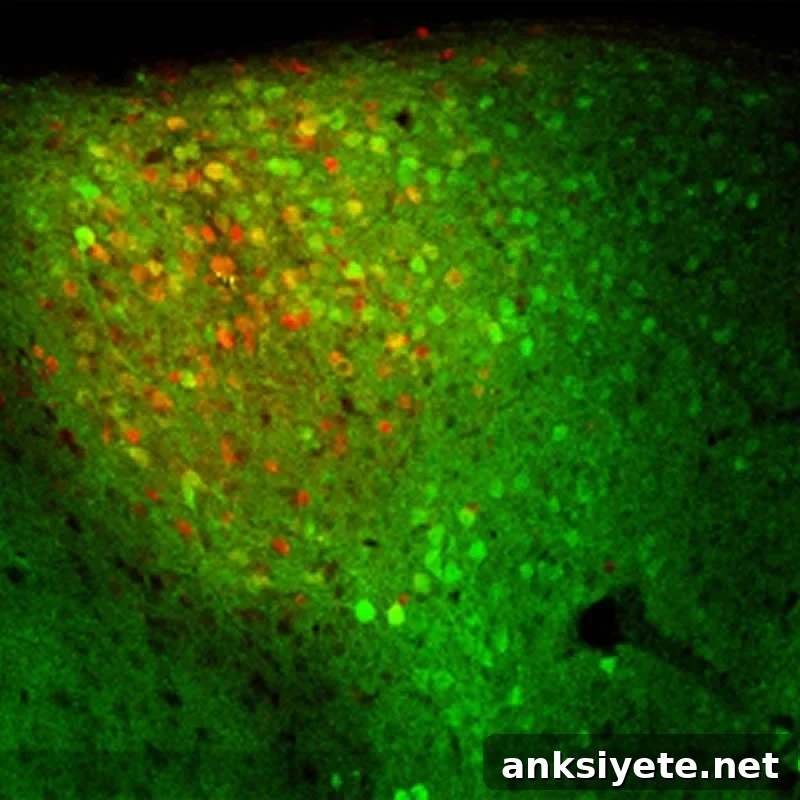
Summary: Fear extinction memories and rewarding feelings are stored in the same genetically defined neurons — those expressing the Ppp1r1b gene in the posterior basolateral amygdala.
Source: MIT
When an anticipated threat fails to occur, the relief you feel is a genuine positive signal. A new mouse study of fear extinction identifies the precise neurons that both encode the loss of fear and represent reward, suggesting why omission of an expected punishment can feel rewarding.
Published Jan. 14 in Neuron, the study from MIT’s Picower Institute for Learning and Memory demonstrates that fear extinction memories and reward signals are stored in Ppp1r1b-expressing neurons located in the posterior basolateral amygdala (pBLA). The pBLA is a brain region known to assign emotional valence — positive or negative value — to memories. The research was led by graduate student Xiangyu Zhang, former graduate student Joshua Kim, and Professor Susumu Tonegawa of the RIKEN‑MIT Laboratory of Neural Circuit Genetics at the Picower Institute and the Howard Hughes Medical Institute.
“Our emotional life constantly balances positive and negative experiences,” Tonegawa said. “Strong memories of danger help us avoid threats, but persistent threat perception can lead to maladaptive states like depression. The brain needs ways to restore a more positive emotional balance.”
Overriding fear with reward
Previous work from Joshua Kim showed that Ppp1r1b-expressing neurons in the basolateral amygdala encode positive valence and compete with a separate population of Rspo2-expressing neurons that encode negative valence. In this follow-up study, Zhang, Kim and Tonegawa tested whether the same competitive dynamic explains fear and fear extinction.
Fear extinction is the process by which a learned fear response is reduced when the feared stimulus no longer predicts harm. In the experiments, mice received mild foot shocks in a chamber and developed a freezing response. The following day, mice were returned to the same chamber without shocks for an extended period; freezing progressively diminished, demonstrating extinction learning. The critical question is whether extinction erases the original fear memory or creates a new memory that suppresses fear.
While mice underwent extinction training, the team monitored activity across BLA cell types. They found that Ppp1r1b neurons increased activity during extinction and retrieval of the extinction memory, while Rspo2 neurons—activated by the shocks—were inhibited during extinction. Conversely, Rspo2 neurons were active during the original aversive experience and suppressed when extinction occurred.
To test whether extinction is stored in Ppp1r1b cells, the researchers used engram-labeling and optogenetic techniques previously developed in their lab. They tagged Ppp1r1b neurons that were active during extinction memory retrieval with channelrhodopsin, a light-sensitive protein. Artificially reactivating those labeled neurons with blue light during a second extinction session accelerated and strengthened extinction. In contrast, optogenetic inhibition of the labeled Ppp1r1b engram cells impaired extinction, because those neurons could no longer suppress Rspo2 fear neurons and the original fear memory regained dominance.
These manipulations fulfill key criteria for a memory engram: the identified Ppp1r1b neurons were activated during learning and reactivated during memory retrieval, and their activity was necessary and sufficient to maintain the extinction memory offline.
Because earlier work had shown Ppp1r1b neurons respond to natural rewards and drive appetitive behavior, the team next compared the same Ppp1r1b population across reward and extinction contexts. Mice received water reward, then food reward, then underwent extinction training and retrieval. The overlap between Ppp1r1b neurons activated by water reward and those activated by extinction retrieval was as large as the overlap between water- and food-activated cells. Functionally, optogenetic activation of extinction-engram Ppp1r1b neurons produced appetitive behavior similar to activating water-responsive Ppp1r1b neurons. Reciprocally, stimulating water-responsive Ppp1r1b neurons facilitated extinction training as effectively as stimulating extinction-engram cells.
These results indicate that fear extinction recruits the brain’s reward circuitry: omission of an expected aversive event functions as a genuine reward signal, and extinction memory is encoded as a form of reward memory within Ppp1r1b neurons in the pBLA.
Implications and future directions
Identifying a genetically defined neuronal population that stores fear extinction has potential therapeutic implications for fear-related disorders such as post-traumatic stress disorder (PTSD) and anxiety. Targeting the mechanisms that engage or strengthen Ppp1r1b extinction engrams could improve treatments that rely on extinction learning, such as exposure therapy.
From a basic science perspective, an important next question is how extinction training specifically recruits Ppp1r1b neurons and how these cells suppress Rspo2 fear neurons at the circuit level. The findings also invite speculation about converse dynamics—whether persistent activation of aversive circuits could suppress reward representations—and whether similar competitive interactions shape other affective processes.
Funding: The work was supported by the RIKEN Brain Science Institute, the Howard Hughes Medical Institute, and the JPB Foundation.
Source:
MIT
Media Contacts:
Press Office – MIT
Image Source:
Image credited to the researchers.
Original Research (closed access):
“Amygdala Reward Neurons Form and Store Fear Extinction Memory.” Xiangyu Zhang, Joshua Kim, Susumu Tonegawa. Neuron. DOI: 10.1016/j.neuron.2019.12.025.
Abstract highlights
• Fear extinction requires formation of new engram cells.
• Fear extinction engram cells are formed and stored in BLA Ppp1r1b+ neurons.
• Fear extinction engram cells and reward cells are functionally interchangeable.
• Omission of expected aversive stimuli is experienced as rewarding.