
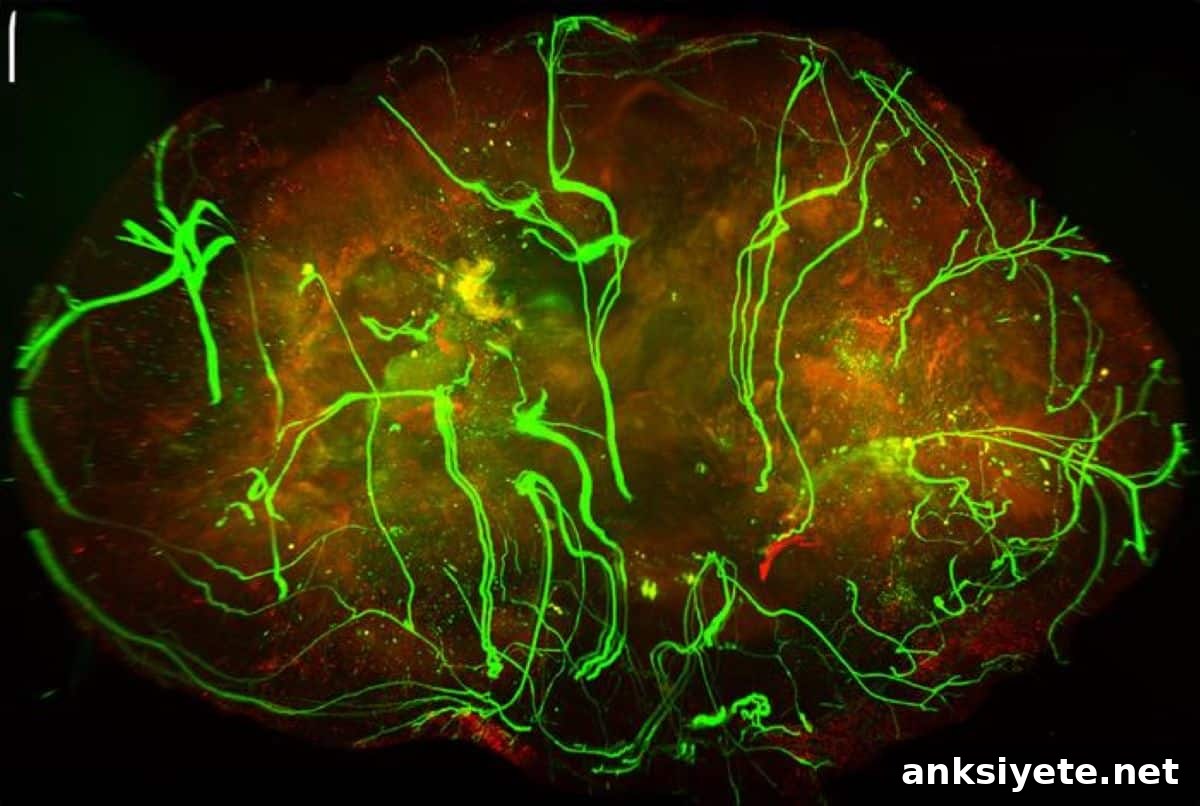
Summary: In the growing field of cancer neuroscience, the nervous system has often been seen as a driver that accelerates tumor progression. New research from Weill Cornell Medicine uncovers a surprising counterpoint: sympathetic nerve fibers that infiltrate melanoma can act as a biological brake, slowing tumor growth by changing local immune behavior.
Using mouse models of cutaneous melanoma, investigators found that sympathetic nerves—part of the fight-or-flight system—release norepinephrine within tumors and activate alpha-adrenergic signaling on immune cells. This local signaling reduces the population of tumor-supportive macrophages, limiting the tumor’s ability to recruit cells that promote its growth.
Key Facts
- Sympathetic nerves act as a brake: Unlike sensory (pain) nerves, which tended to promote melanoma growth, sympathetic axons slowed tumor expansion in the mouse models studied.
- Advanced imaging: Researchers applied whole-mount immuno-labeling to render entire tissue samples optically transparent and map nerve fibers in three dimensions as they enter and spread through melanomas.
- Immune targeting via alpha-adrenergic receptors: The anti-tumor effect is mediated by alpha-adrenergic receptors on macrophages. Activation of these receptors lowers the number and alters the distribution of pro-tumor macrophages.
- Norepinephrine’s local role: Although commonly associated with stress, norepinephrine released by intratumoral sympathetic fibers the study describes works locally to sustain an immune environment that resists tumor support.
- Repurposing opportunity: Drugs that target alpha-adrenergic receptors are already approved and widely used for conditions such as high blood pressure, suggesting a potential faster path to clinical testing if the mechanism translates to humans.
Source: Weill Cornell Medicine
Nerve fibers within melanomas can slow the growth of these tumors, according to new mouse-model research led by Weill Cornell Medicine investigators.
These findings clarify a nuanced role for peripheral nerves in cancer biology and point toward new therapeutic directions that harness nervous-system signaling to shape anti-tumor immunity.
Published April 29 in Neuron, the study mapped peripheral axon invasion and tested how different nerve classes affect melanoma progression. The team observed abundant sympathetic innervation in many tumors. When sympathetic axons were depleted locally, tumors grew faster; when those axons were activated optogenetically, tumors grew more slowly—evidence consistent with a physiological braking mechanism.
The peripheral nervous system includes sensory fibers that convey sensations such as pain and temperature, and sympathetic fibers that transmit signals from the brain to organs and tissues. In skin, sympathetic fibers commonly release norepinephrine, which can influence immune cells and other local targets as part of the stress-response circuitry.
Previous work in cancer neuroscience has often emphasized how nerves drive tumor growth, for example by releasing factors that blunt antitumor immunity. This study adds a more complex view: nerve influence on tumors can be bidirectional and context-dependent. In the melanoma models examined, pain-sensitive nerves supported tumor growth while sympathetic nerves opposed it.
The researchers traced the sympathetic anti-tumor effect to alpha-adrenergic receptor (α-AR) signaling on myeloid cells, specifically macrophages. Tumors commonly reprogram macrophages into an immunosuppressive, tumor-supportive state; activation of α-AR signaling curtailed the number and localization of these pro-tumor macrophages, slowing tumor progression independently of T cell actions.
These mechanistic insights raise the prospect of therapies that either enhance sympathetic signaling within tumors or directly target α-adrenergic receptors on tumor-associated macrophages. Because several α-adrenergic drugs are already approved for cardiovascular uses, translation to clinical testing might proceed more rapidly than with novel molecules—provided the effects observed in mice can be confirmed in human cancers.
Lead investigator Dr. David J. Simon emphasized the need for further basic and translational work to determine how broadly applicable this sympathetic “brake” is across tumor types and in human patients. Ongoing studies will explore how α-adrenergic receptors are activated in human tumors and how that signaling integrates with other immune and stromal cues.
Funding: This research was supported in part by the National Cancer Institute (grants R01CA256188, R01CA272717, P30CA08748, P30CA014520, R37CA300434), the U.S. Department of Defense (grant ME240045), the Fernholz Family Foundation, and the Pershing Square Sohn Cancer Research Alliance.
Key Questions Answered:
A: Not exactly. The study highlights local norepinephrine release from sympathetic fibers inside tumors, not systemic hormonal changes associated with chronic psychological stress. Chronic stress often raises systemic hormones that suppress immune responses; this work focuses on localized neural signaling that can preserve anti-tumor immune activity.
A: It depends on the molecules the nerves release. Sensory pain fibers release factors that can dampen immune detection of the tumor, while sympathetic fibers release norepinephrine, which in this context activates α-adrenergic receptors on macrophages and limits the tumor’s ability to recruit pro-tumor myeloid cells.
A: Because α-adrenergic agents are already approved for other indications, clinical testing could potentially move faster than for brand-new drugs. However, researchers must first confirm that the same sympathetic-immune mechanism exists in human melanomas and determine safe, effective ways to exploit it in patients.
Editorial Notes:
- Article edited by a Neuroscience News editor.
- Journal paper reviewed in full by staff.
- Context and clarifications added by editorial staff for accuracy and readability.
About this neuroscience and cancer research news
Author: Corinne Esposito
Source: Weill Cornell Medicine
Contact: Corinne Esposito – Weill Cornell Medicine
Image credit: Dr. David J. Simon
Original Research: Open access. “A local sympathetic-immune axis inhibits melanoma growth in mice by dictating adrenergic control” by Tingting Liu et al., Neuron. DOI: 10.1016/j.neuron.2026.04.016
Abstract
A local sympathetic-immune axis inhibits melanoma growth in mice by dictating adrenergic control
The nervous system influences tumor progression both directly via intratumoral axons and indirectly through systemic hormones. Contexts in which neural input inhibits tumor growth remain underexplored. Using optical reconstruction of axonal innervation in mouse cutaneous melanoma models, the study reveals progressive sympathetic axon invasion. Local depletion of these axons accelerates tumor growth, while local optogenetic activation slows it, consistent with a physiological growth brake. Although sympathetic signaling is typically linked to β-adrenergic receptor–driven tumor promotion, the experiments show that initial tumor conditions can shift tumors from βAR-driven growth toward α2-AR–driven growth inhibition. Mechanistically, activation of α2-ARs by axons restricts the number and distribution of pro-tumor myeloid cells independent of T cell activity. Together, these data demonstrate context-dependent, bidirectional neural control of tumor progression.