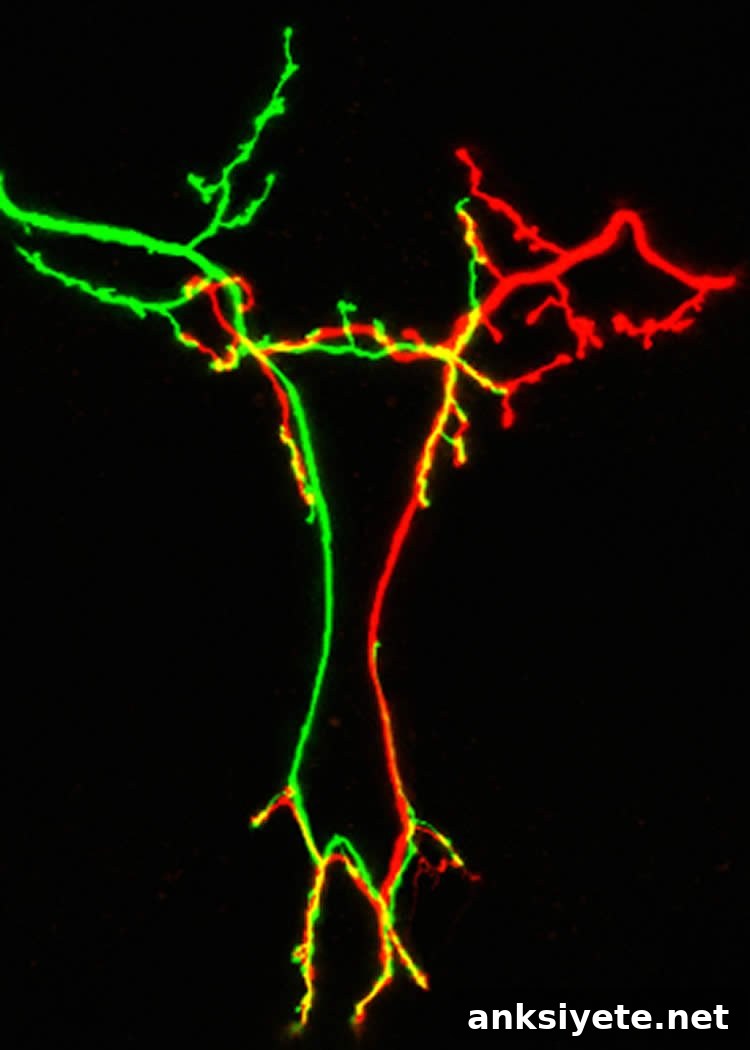
How neurons are created and how they connect to form complex networks remains one of biology’s major mysteries. Research led by Dietmar Schmucker at VIB–KU Leuven sheds light on an important part of this puzzle in a study published in Science. The work identifies a cellular mechanism that helps explain how highly branched neurons establish intricate wiring in the brain. These findings improve our understanding of neural network formation and have potential implications for diagnosing and treating neurological conditions.
Neurons, or nerve cells
Human brains contain roughly 100 billion neurons. Each neuron is built to process and transmit information: slender, branched extensions called dendrites receive incoming electrical signals and convey them to the cell body, while axons transmit signals from the cell body to other neurons. The branching patterns of dendrites and axons, and the precise way they connect with other cells, determine how information flows through neural circuits.
The brain’s wiring is extraordinarily complex. Scientists have characterized many of the molecular cues that guide one neuron to connect in a straight, linear fashion to another. However, far fewer mechanisms are known that explain how a single neuron’s many branches form distinct connections and avoid inappropriate contacts inside the same cell’s arbor.
How nerve cell connections are specified
Schmucker’s earlier research in Drosophila (fruit flies) identified a protein called Dscam1 that plays a central role in neuronal identity. A single Dscam1 gene can produce thousands of slightly different protein variants, or isoforms, through alternative splicing. The particular combination of Dscam1 isoforms expressed on a neuron’s surface gives that neuron a unique molecular signature, which in turn helps determine whether two neuronal processes will recognize and avoid one another or form synaptic contacts.
Recent experiments from members of Schmucker’s lab, including Haihuai He and Yoshiaki Kise, investigated how Dscam1 isoform diversity is distributed within individual neurons. They found that different branches of a single axon can display distinct sets of Dscam1 isoforms. This branch-specific distribution prevents inappropriate self-contact between collaterals and allows a single neuron to establish multiple, independently controlled connections. Without such compartmentalized isoform expression, neurons would be more likely to form only simple linear connections, limiting the complexity of neuronal networks.
These results provide the first mechanistic explanation for why diverse sets of the same protein’s isoforms can coexist within one neuron, and how that molecular diversity contributes to the elaboration of complex neural wiring. The findings reveal a cell-intrinsic strategy neurons use to pattern their own arbors and ensure precise connectivity within dense circuits.
Clinical relevance and broader implications
Although the experiments were performed in fruit flies, the principles uncovered by this study have broader relevance for vertebrate and human brains because many fundamental mechanisms of neuronal development are conserved across species. A better understanding of how neurons establish branch-specific identities and avoid inappropriate self-connections can help clarify the developmental origins of neurodevelopmental disorders, including forms of autism and other conditions linked to altered connectivity.
Detailed knowledge of how neurons wire themselves is also important for regenerative medicine. If stem cell–based therapies are to be used safely to repair the nervous system, researchers will need reliable ways to ensure transplanted neurons integrate correctly into existing circuits. Insights into the molecular logic of branch-specific wiring and isoform diversity may guide strategies to promote appropriate connectivity and minimize maladaptive wiring after transplantation.
This research was carried out by the team led by Dietmar Schmucker, who heads a laboratory at the VIB Vesalius Research Center, KU Leuven (the Flemish Institute for Biotechnology and the Catholic University of Leuven).
Funding and fellowships that supported the work included contributions from VIB start-up funding, FWO, BELSPO IUAP VII-20, JSPS Postdoctoral Fellowship, HFSP Long-Term Fellowship, FWO PhD Fellowship, Swiss National Science Foundation Postdoctoral Fellowship, and the Boehringer Ingelheim Fonds PhD Fellowship.
Contact: Dietmar Schmucker – VIB (the Flanders Institute for Biotechnology)
Source: VIB press release
Image source: Image credited to VIB (the Flanders Institute for Biotechnology), adapted from the press release
Original research: “Cell-intrinsic requirement of Dscam1 isoform diversity for axon collateral formation” by Haihuai He, Yoshiaki Kise, Azadeh Izadifar, Olivier Urwyler, Derya Ayaz, Akhila Parthasarthy, Bing Yan, Maria-Luise Erfurth, Dan Dascenco, and Dietmar Schmucker, published online in Science (May 15, 2014), DOI: 10.1126/science.1251852.