
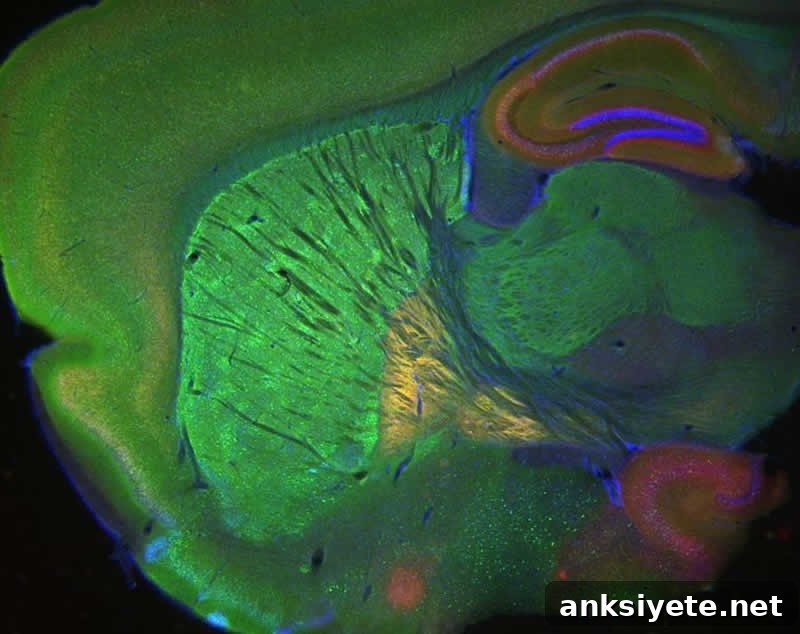
Researchers led by Vanderbilt University have identified cannabinoid receptors in the central nucleus of the amygdala, a key brain region that controls anxiety and the fight-or-flight response.
In a mouse model study published in the journal Neuron, the team reports the first clear demonstration of cannabinoid receptors in the central nucleus of the amygdala and provides new evidence that neurons in this region synthesize and release their own natural endocannabinoids. These findings help clarify how both natural and cannabis-derived cannabinoids can influence emotional regulation, stress responses, and anxiety.
The research was led by Sachin Patel, M.D., Ph.D., professor of Psychiatry and of Molecular Physiology and Biophysics at Vanderbilt University, with graduate student Teniel Ramikie as first author. Using high-affinity antibodies and multiple microscopy techniques—including electron microscopy capable of visualizing individual synapses—the investigators mapped cannabinoid receptor localization at a fine structural level and demonstrated mechanisms of endocannabinoid mobilization at glutamatergic synapses within the central amygdala.
The results build on previous work suggesting important roles for the endocannabinoid system in anxiety and stress regulation. Key points highlighted by the research and prior studies include:
- The endocannabinoid system acts as a regulatory buffer for emotional and stress-related signaling, often by reducing excitatory glutamate transmission in stress-sensitive brain circuits.
- Chronic stress or acute severe trauma can reduce both endocannabinoid production and receptor responsiveness, diminishing this buffering effect and thereby increasing anxiety.
- Although exogenous cannabinoids from marijuana can acutely reduce anxiety for some users, prolonged or heavy cannabis exposure can down-regulate cannabinoid receptors, potentially heightening anxiety over time and contributing to a cycle of increased use and dependence in vulnerable individuals.
By demonstrating the presence of cannabinoid receptors and local endocannabinoid mobilization in the central nucleus of the amygdala, this study provides important anatomical and mechanistic context for how cannabis and the endogenous cannabinoid system influence emotional behavior. The authors emphasize that understanding where receptors are located, how they function, and how neurons produce endocannabinoids is essential for examining how stress, developmental stage, and chronic cannabis use alter cellular communication in the amygdala.
The study used highly specific antibodies to label cannabinoid receptors (CB1) and applied electron microscopy to visualize receptor localization at the synapse level. These methods made it possible to observe receptor distribution and link receptor presence to functional mechanisms of endocannabinoid release and signaling at central amygdala glutamatergic synapses. Such cellular- and synapse-level detail is critical to understanding how the endocannabinoid system controls excitatory transmission involved in stress and anxiety responses.
Implications of this work are broad. As marijuana legalization increases and more people—including adolescents with developing brains—are exposed to cannabis, these findings highlight the need for detailed knowledge about how exogenous cannabinoids interact with endogenous systems that regulate emotional behavior. The research points to potential pathways by which stress, trauma, and chronic cannabis exposure could alter receptor function and endocannabinoid signaling, with consequences for anxiety and risk of problematic use.
The international research team included scientists from Hokkaido University (Sapporo, Japan), the Hungarian Academy of Sciences (Budapest), and Indiana University (Bloomington). Funding support for the study included National Institutes of Health grants MH090412, DA011322, and DA021696.
Contact: Bill Snyder – Vanderbilt University
Source: Vanderbilt University press release
Image Source: Image credited to NIH and in the public domain.
Original Research: Abstract for “Multiple Mechanistically Distinct Modes of Endocannabinoid Mobilization at Central Amygdala Glutamatergic Synapses” by Teniel S. Ramikie, Rita Nyilas, Rebecca J. Bluett, Joyonna C. Gamble-George, Nolan D. Hartley, Ken Mackie, Masahiko Watanabe, István Katona, and Sachin Patel in Neuron. Published online March 5, 2014. doi:10.1016/j.neuron.2014.01.012