
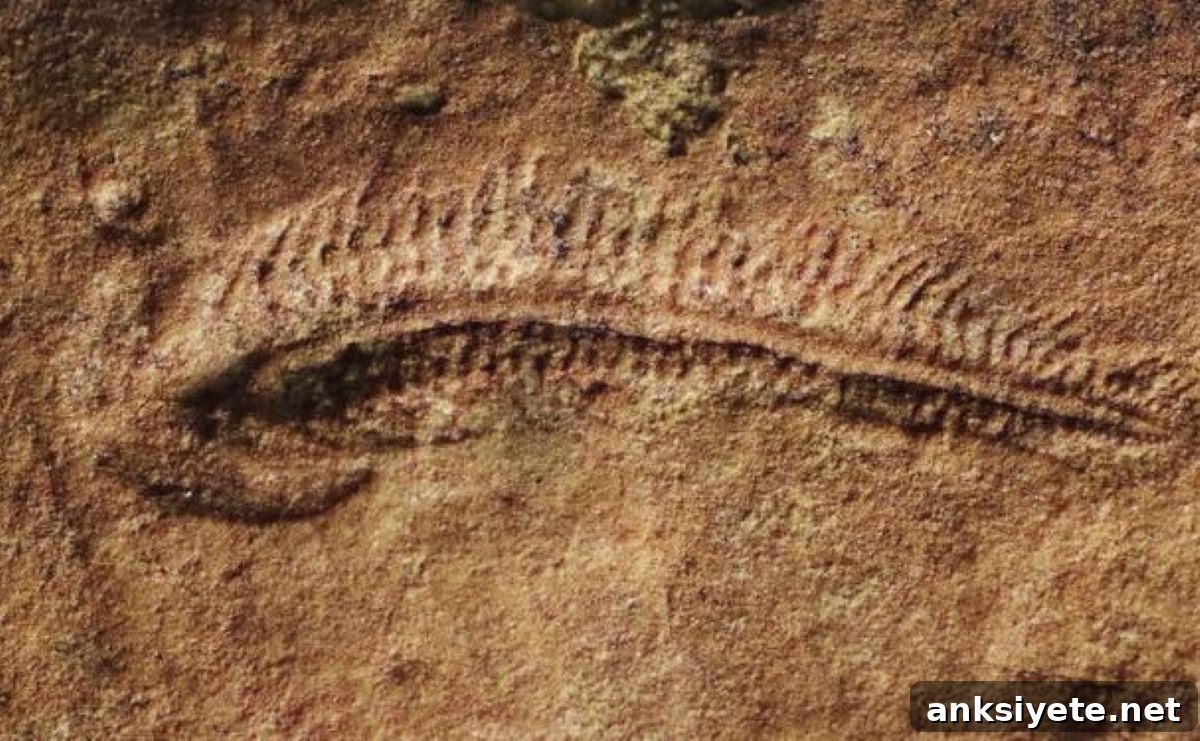
Summary: An international team of paleontologists has identified the earliest known example of population-level “handedness” in the animal kingdom. By analyzing more than 100 exceptionally preserved fossils of the Ediacaran organism Spriggina floundersi, researchers found a consistent, population-wide bias for bending to the right in life. These results indicate that lateralized behavior—and by implication, asymmetry in neural organization—arose far earlier in animal evolution than previously recognized.
Key Facts
- The rise of bilateral symmetry: Spriggina floundersi lived during the late Ediacaran Period, around 550 million years ago. It is among the earliest known animals to show bilateral symmetry—a body plan with a distinct front and back, left and right sides, and top and bottom—that later became widespread among animals.
- Mirror-image fossil impressions: Fossils from sandstone beds preserve mirror-image negatives of the original animals. In these specimens, impressions that curve left in the rock indicate that the living animal had bent to its right, revealing behavior rather than anatomical asymmetry.
- Population-level lateralization: Researchers found roughly twice as many left-curved impressions as right-curved ones. Since the rock preserves a mirrored imprint, this pattern demonstrates a consistent population preference for rightward bending—effectively a form of handedness in a handless organism.
- Implications for nervous system complexity: In modern animals, side preferences are linked to brain lateralization and specialized neural processing. The rightward bias in Spriggina suggests it may have had a comparatively complex, lateralized nervous system and sensory capabilities for its time.
- Nilpena’s exceptional preservation: These fossils come from Nilpena Ediacara National Park in South Australia, where storm-driven sedimentation rapidly buried seafloor communities and preserved behavioral snapshots of benthic organisms half a billion years ago.
Source: AMNH
Scientists report potentially the oldest evidence of “right-handedness” in animals, dating back over 500 million years.
The study focuses on Spriggina floundersi, a worm-like Ediacaran animal that inhabited shallow seafloors roughly 550 million years ago. New research published in Scientific Reports and led by investigators from the American Museum of Natural History, Florida State University, Harvard University, and the University of California, Riverside reveals that many individuals of this species consistently bent toward one side while moving, indicating a population-wide behavioral bias.
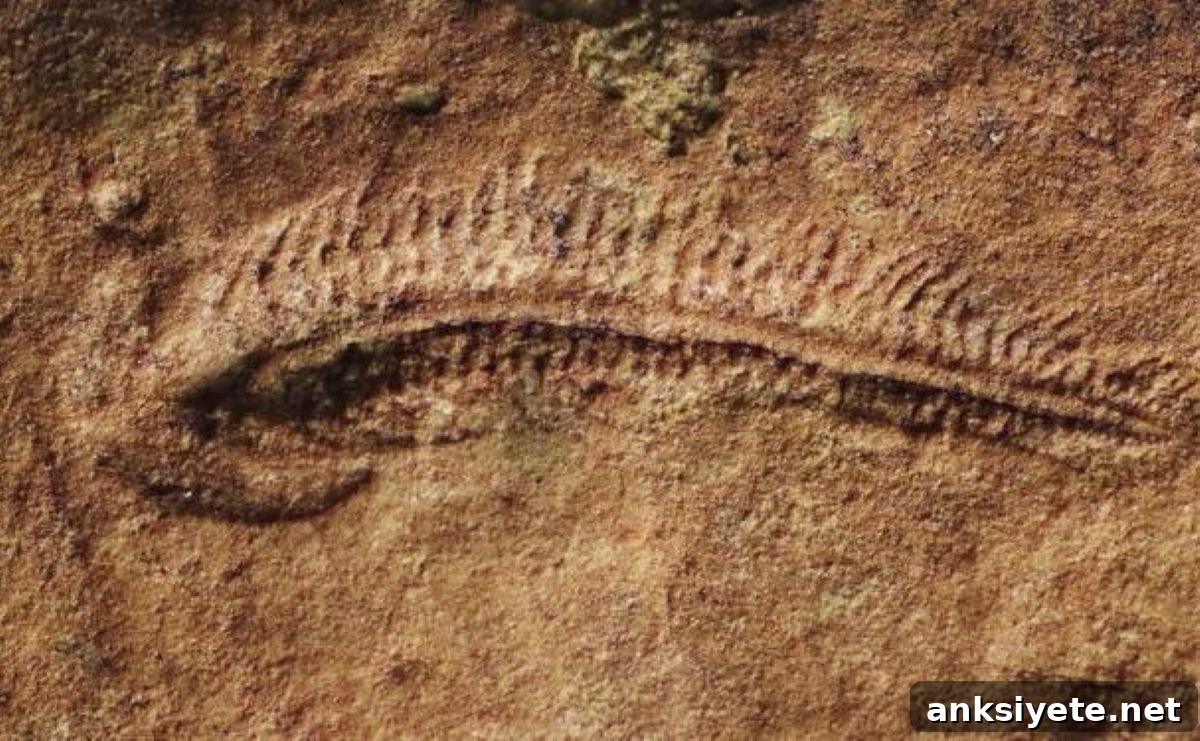
The pattern of asymmetry recorded in these fossils offers a rare behavioral window into Ediacaran life. Instead of interpreting variation as random taphonomic distortion, the researchers tested whether bending directions were biologically consistent across individuals and beds—and found a clear, non-random bias.
“Most people think of handedness in terms of how we use our hands or feet, but this is a behavioral lateralization in a creature without appendages,” said Scott Evans, assistant curator of invertebrate paleontology at the American Museum of Natural History and lead author of the study. “That such a bias existed in the Ediacaran indicates deep evolutionary roots for left-right specialization.”
The Flinders Ranges of South Australia, including the Nilpena site, preserve some of the richest Ediacaran fossil beds known. Rapid burial by storm-deposited sand and silt preserved whole communities in life positions, allowing paleontologists to study not just body shapes but aspects of behavior, such as movement and orientation.
To test for lateralization, the team examined morphological variation in over 100 well-preserved Spriggina specimens from Nilpena and museum collections in Adelaide. They documented the direction and nature of body bends and controlled for potential biases introduced by sedimentary processes or deformation.
Their analysis revealed that approximately two-thirds of specimens recorded leftward curvature in the rock—equivalent to rightward bending in the living animal. This consistent bias across multiple bedding planes and museum collections supports the interpretation of true behavioral handedness rather than random post-burial distortion.
Coauthor Mary Droser of the University of California, Riverside noted, “This finding reminds us that many biological traits common in modern animals have very ancient origins. Lateralized behavior appears to have been an advantageous and persistent feature long before the Cambrian explosion.”
The researchers argue that behavioral handedness implies neural specialization. In extant animals, lateralized behavior often accompanies asymmetric brain or nervous system organization, enabling more efficient processing and coordinated actions. If Spriggina possessed a similar arrangement, it would indicate advanced sensory and motor capabilities in one of Earth’s earliest bilaterians.
Other contributors to the study include Jenson Webb, Ian V. Hughes, and William Parker. Funding for this work included support from a NASA Exobiology grant (#80NSSC19K0472).
Key Questions Answered:
A: When Spriggina individuals were rapidly buried by storm sediment, they left mirror-image negative impressions in the mud that later lithified. Because these impressions are reversed, a leftward curve preserved in the rock corresponds to a rightward bend in the living animal. By tallying the directions across many specimens, the researchers found a clear population-level bias.
A: Behavioral lateralization reflects underlying neural asymmetry in many modern animals—the left and right sides of the nervous system often specialize for different tasks. Finding a consistent side preference in an Ediacaran organism indicates that neural lateralization evolved early and was already associated with behavioral advantages well before the Phanerozoic.
A: The Ediacaran Period (about 635–538 million years ago) marks a transition from microscopic life to large, multicellular organisms with more complex behaviors. Nilpena Ediacara National Park preserves exceptional bedding planes where storm events rapidly buried intact seafloor communities, creating rare snapshots of life and behavior from the Ediacaran.
Editorial Notes:
- This article was edited by a Neuroscience News editor.
- Journal paper reviewed in full.
- Additional context added by our staff.
About this evolutionary neuroscience research news
Author: Kendra Snyder
Source: American Museum of Natural History
Contact: Kendra Snyder – American Museum of Natural History
Image credit: Scott Evans / ©AMNH
Original Research: Open access. “Earliest evidence of behavioural handedness in the Ediacaran motile bilaterian Spriggina floundersi” by Scott D. Evans, Jenson Webb, Ian V. Hughes, William Parker & Mary L. Droser. DOI: 10.1038/s41598-026-53857-x
Abstract
Earliest evidence of behavioural handedness in the Ediacaran motile bilaterian Spriggina floundersi
Ediacaran fossils preserve some of the oldest macroscopic animal communities. Taxonomic placement of many Ediacaran forms remains debated, but ecological and behavioral characters offer critical insight. In this study we analyze Spriggina floundersi specimens from the Ediacara Member of the Flinders Ranges, including Nilpena Ediacara National Park and South Australian Museum collections, and document substantial morphological variation.
Fossils preserved in situ on discrete bedding planes show no consistent external orientation that would indicate deformation by currents or compaction. Instead, variation in body curvature appears to reflect biological behavior. Our results support motility in Spriggina, involving bending along the long axis, propagation of pedal-like waves, vertical adjustment of the anterior region, and horizontal manipulation of repeated units. A statistically significant excess of specimens are bent left in the rock (right in life), inconsistent with anatomical asymmetry and best explained as behavioral handedness.
These findings suggest Spriggina was a bilaterally symmetrical, possibly segmented, benthic organism with behavioral and neural characters more complex than typically assumed for Ediacaran taxa. Such traits point to major animal innovations that predate the Cambrian and indicate that lateralized behavior and neural specialization were already present in early bilaterians.