
Summary: Speech sounds evoke similar neural responses and activate the same auditory brain regions in humans, macaque monkeys, and guinea pigs.
Source: University of Pittsburgh
Researchers at the University of Pittsburgh report in the journal eNeuro that the brain’s electrical responses to speech—known as frequency-following responses (FFRs)—are comparable across humans, macaques, and guinea pigs, and that these responses involve the auditory cortex as well as subcortical structures. This discovery refines our understanding of how speech is encoded in the brain and could improve diagnosis of auditory processing disorders.
Frequency-following responses are precise, time-locked electrical signals the brain produces in response to sound. Clinicians commonly record FFRs using small electrodes on the scalp to screen hearing in newborns and to detect potential speech and language disorders, including dyslexia and autism-related auditory processing problems. While FFRs are valuable clinically, traditional interpretations have been limited by uncertainty about where exactly in the brain these signals are generated.
“Current clinical tests can indicate that something in auditory processing is atypical, but they often cannot identify the source of the problem,” said co-corresponding author Bharath Chandrasekaran, Ph.D., professor and vice chair for research in the Department of Communication Science and Disorders at Pitt’s School of Health and Rehabilitation Sciences. “Clarifying where FFRs originate will help create more specific markers for speech impairments and enhance diagnostic precision.”
FFRs appear on an electroencephalogram (EEG) as an electrical waveform that closely mirrors the acoustic stimulus. When a newborn’s brain produces an FFR in response to sounds presented through tiny earphones, it indicates that the neural pathway from the ear to higher auditory centers in the cortex is functioning. Clinicians also use the similarity between the recorded FFR and the original sound to assess how faithfully the auditory system encodes speech: the closer the match, the stronger the auditory encoding; the greater the discrepancy, the more likely an auditory processing deficit.
Historically, scientists believed FFRs originated mainly in the brainstem and midbrain—deep subcortical structures—and then propagated outward to the cortex and scalp. Using a combination of scalp EEG recordings and intracranial electrodes placed directly on or within the skull, the Pitt team demonstrated that this picture is incomplete. Their data show robust FFR generation within the auditory cortex itself—the area of cortex located near the temples responsible for processing complex sounds—across species, and indicate that cortical sources contribute substantially to the signals observed at the scalp.
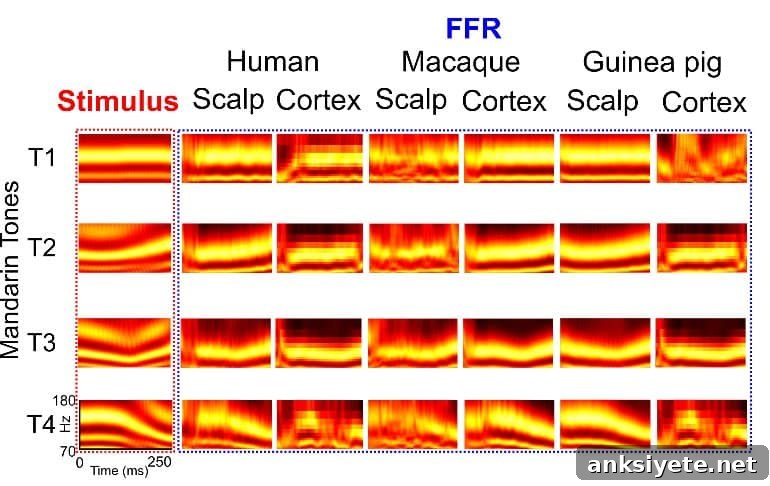
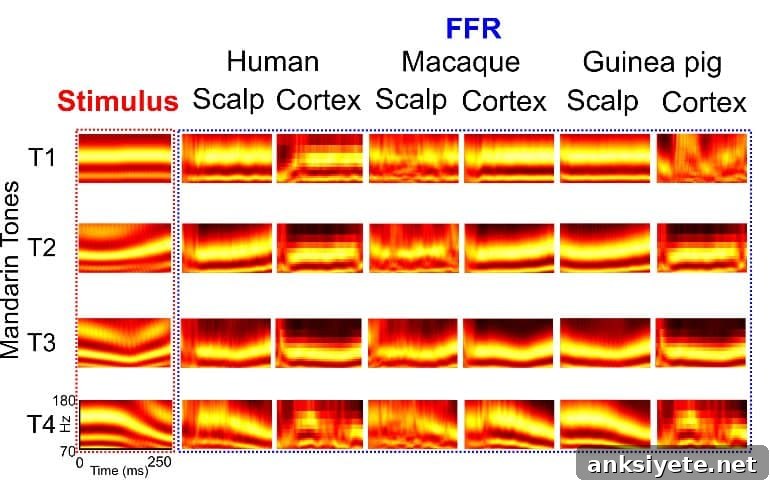
The researchers tested responses to four tonal variants of the Mandarin syllable “yi.” Even though the human participants spoke English and were unfamiliar with Mandarin, their cortical and scalp-recorded FFRs were remarkably similar to those recorded in macaques and guinea pigs—animals whose hearing range and sensitivity align closely with humans. This cross-species similarity supports using animal models to investigate the detailed neural circuitry of speech processing.
“Identifying conserved FFR patterns across species opens the door to detailed studies of cortical circuitry involved in sound processing,” said lead author Nike Gnanateja Gurindapalli, Ph.D., a postdoctoral fellow at Pitt. “Animal models let us probe mechanisms and plasticity at a level of resolution not possible in humans, which can inform noninvasive clinical tools for diagnosing auditory impairments.”
Because FFRs were often assumed to reflect only passive subcortical activity, clinical recordings typically do not control for attention or alertness. The discovery that cortical ensembles contribute to FFRs means that cognitive state and cortical dynamics may influence these measures. This insight suggests clinicians and researchers should reconsider recording protocols and interpretation of FFRs when using them as biomarkers of auditory function.
Communication disorders affect an estimated 5% to 10% of Americans. Greater clarity about the cortical and subcortical components of FFRs promises to advance rapid, noninvasive diagnostics that can distinguish different kinds of auditory processing deficits and guide targeted interventions.
About this auditory neuroscience research news
Author: Press Office
Source: University of Pittsburgh
Contact: Press Office – University of Pittsburgh
Image: The image is credited to Nike Gnanateja Gurindapalli
Original Research: Closed access. “Frequency-following responses to speech sounds are highly conserved across species and contain cortical contributions” by Bharath Chandrasekaran et al., eNeuro.
Abstract
Frequency-following responses to speech sounds are highly conserved across species and contain cortical contributions
Time-varying pitch provides critical cues for speech perception. Scalp-recorded frequency-following responses (FFRs) have been widely used to study how the auditory system tracks time-varying pitch; these signals were long attributed primarily to phase-locked activity in subcortical auditory regions. Recent evidence, however, suggests that auditory cortical ensembles also contribute to scalp-recorded FFRs, and the current work clarifies key properties and laminar sources of cortical FFRs.
Using direct intracortical recordings in humans alongside complementary intra- and extracranial recordings in macaques and guinea pigs, the study identifies robust cortical FFRs across species. Representational similarity analysis served as a translational bridge to compare human and animal models. Laminar recordings in animals indicate that cortical FFRs emerge mainly from thalamorecipient layers of auditory cortex and that these cortical sources materially contribute to scalp-recorded signals through volume conduction.
These findings provide a foundation for future research into the role of cortical FFRs in auditory perception and plasticity and support refining models of subcortical auditory processing to account for cortical contributions.
Significance Statement
FFRs to speech are scalp-recorded signals used to evaluate the fidelity of auditory encoding. While FFRs have historically informed theories of subcortical processing and plasticity, cortical contributions have been increasingly reported and debated. By combining extra- and intracranial recordings within the same subjects, this work demonstrates that cortical FFRs contribute to scalp-recorded responses and exhibit properties distinct from subcortical FFRs. These results argue for revising existing models and for careful separation of cortical and subcortical components when using FFRs to study auditory function and dysfunction.