
Summary: Noradrenaline reduces immune effectiveness by blocking leukocyte movement through tissues.
Source: Cell Press
The neurotransmitter noradrenaline, a central mediator of the sympathetic “fight-or-flight” response, can rapidly weaken immune defenses by stopping the movement of multiple types of white blood cells within tissues, researchers report in the journal Immunity.
In mouse models of infection and cancer the effect was fast and temporary, but whether the same process occurs across different human conditions remains to be determined.
“We found that stress signals can make immune cells stop moving and prevent them from reaching and fighting disease,” says senior author Scott Mueller from the University of Melbourne’s Peter Doherty Institute for Infection and Immunity. “This is a new insight: stress-related neurotransmitters can switch off immune cell mobility in tissues.”
The sympathetic nervous system (SNS) orchestrates physiological changes that prepare the body to respond to threats. Most organs, including lymph nodes and the spleen, receive sympathetic innervation. Although SNS activation is linked to suppressed immunity, the specific mechanisms were not well understood.
The team proposed that adrenergic signals from the SNS might directly alter how T cells and other leukocytes move through tissues, producing rapid changes during acute stress.
White blood cells circulate continually and are highly motile within tissues, where they search for and eliminate infections and cancer cells. Effective immune protection depends on this tissue migration, yet how leukocytes integrate multiple local signals to navigate has been unclear.
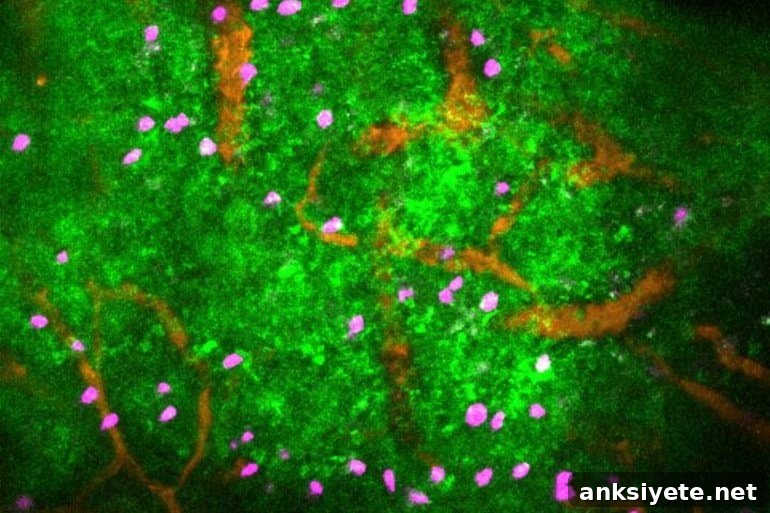
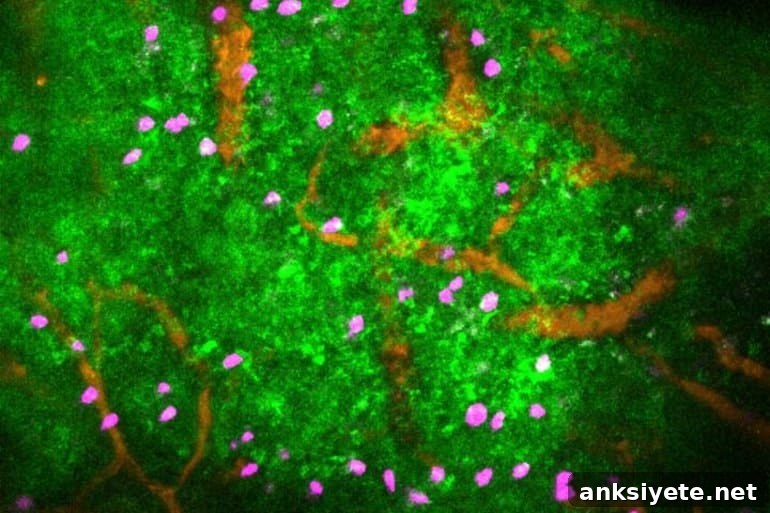
Using advanced intravital imaging, the researchers watched T cells in mouse lymph nodes. Within minutes of noradrenaline exposure, previously active T cells stopped migrating and retracted their protrusions. The arrest in movement was transient, generally lasting about 45–60 minutes. Directly applying noradrenaline to lymph nodes in living mice produced the same rapid halt.
Infusions of noradrenaline—similar to doses used clinically in septic shock—also stopped leukocyte motion in mice, suggesting that therapeutic noradrenaline might unintentionally impair immune cell function in some contexts.
“We were surprised by how quickly and dramatically SNS signals could switch off cell movement,” Mueller says. “Because cell motility is essential for immune cells to reach infections or tumors, this rapid ‘off’ signal was unexpected and important.”
Further experiments showed that SNS activation impeded the migration not only of T cells but also of B cells and dendritic cells across tissues such as skin and liver. The researchers present evidence that these effects arise from adrenergic-induced vasoconstriction, which lowers local blood flow and oxygen levels. Reduced tissue oxygen triggers increased calcium signaling inside leukocytes, and this calcium response correlates with halted motility. Providing extra oxygen reversed the motility block, indicating a link between local oxygenation and leukocyte movement.
“Our data indicate that a key consequence of SNS-driven vascular changes is rapid sensing of oxygen fluctuations by leukocytes, leading to immediate inhibition of movement,” Mueller explains. “This mechanism helps explain the well-documented association between stress and weakened immunity.”
Importantly, SNS signaling reduced protective immune responses in multiple mouse disease models. Adrenergic stimulation curtailed T cell proliferation and expansion in lymph nodes and spleen and decreased recruitment of virus-specific T cells to infected skin during herpes simplex virus 1 infection. Comparable impairments appeared in mice bearing melanoma and in mice infected with a malaria parasite, indicating that SNS-driven motility loss can hinder anti-viral, anti-parasitic, and anti-tumor immunity.
“These findings suggest that tissue-level SNS activity can shape immune outcomes across diverse diseases,” says Mueller. “Understanding how adrenergic receptor signals act on cells and the vasculature could guide strategies to improve treatments for infections and cancer.”
How these mechanisms translate to humans remains an open question. Elevated SNS activity occurs in people with conditions such as obesity and heart failure, and psychological stress can provoke blood vessel constriction in individuals with cardiovascular disease. In these settings, impaired leukocyte motility and function could be an underrecognized contributor to poor immune outcomes.
The results also raise considerations for patients treated with SNS-activating drugs for conditions like heart failure, sepsis, asthma, or severe allergic reactions, where adrenergic therapies might influence immune cell behavior.
The researchers plan to investigate the detailed molecular steps linking SNS activation, vascular changes, oxygen sensing, and leukocyte calcium signaling, and to test whether blocking sympathetic pathways—such as with beta blockers—can improve vaccine responses or cancer therapies when stress impairs immunity.
Funding: This research was supported by the National Health and Medical Research Council of Australia and the Australian Research Council.
About this stress research news
Source: Cell Press
Contact: Carly Britton – Cell Press
Image: The image is credited to Scott Mueller
Original Research: Closed access.
“Adrenergic regulation of the vasculature impairs leukocyte interstitial migration and suppresses immune responses” by Scott Mueller et al. Immunity
Abstract
Adrenergic regulation of the vasculature impairs leukocyte interstitial migration and suppresses immune responses
Highlights
- • Activation of the sympathetic nervous system halts leukocyte movement within tissues
- • Noradrenaline triggers adrenergic signaling that reduces lymph node blood flow
- • Lower tissue oxygenation initiates calcium signaling that controls leukocyte motility
- • Disrupted leukocyte migration contributes to weakened immune responses
Summary
The sympathetic nervous system uses noradrenaline to regulate many body functions. SNS activation during psychological or physical stress is commonly associated with reduced immunity.
This study examined how adrenergic signals affect leukocyte behavior. Intravital two-photon imaging showed that injected noradrenaline transiently inhibited CD8+ and CD4+ T cell movement in tissues. The inhibition did not require β-adrenergic receptor expression on hematopoietic cells. Instead, chemogenetic SNS activation or pharmacological adrenergic agonists caused vasoconstriction and reduced local blood flow, producing abrupt hypoxia that triggered rapid calcium signaling in leukocytes and arrested their motility. Supplementing oxygen reversed these effects.
Adrenergic treatment also impaired T cell responses to viral and parasitic infections and weakened anti-tumor immunity. Overall, SNS activation can suppress leukocyte mobility, offering a mechanistic explanation for how adrenergic signaling links stress to compromised immune function.