
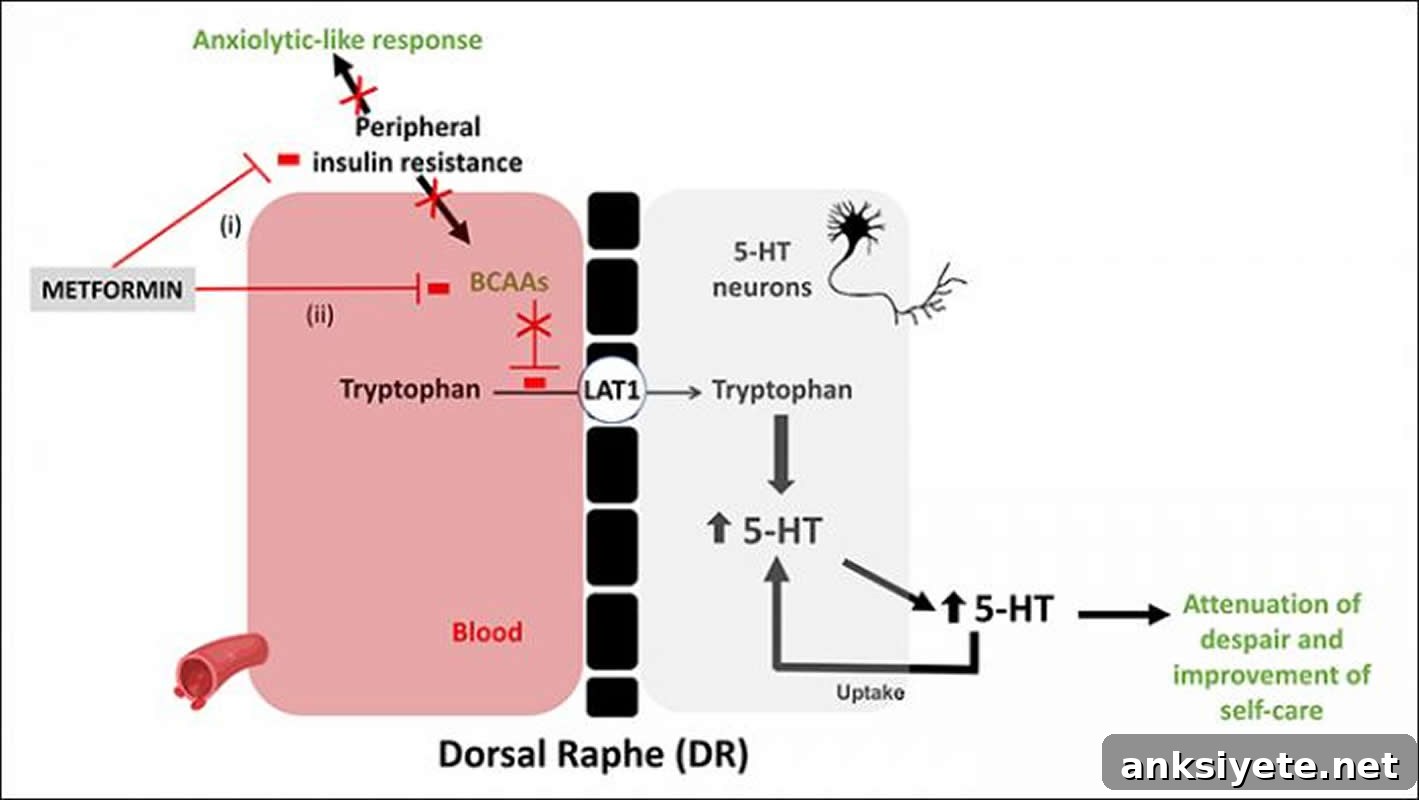
Summary: Metformin, a widely used diabetes medication, shows potential to reduce anxiety- and depression-like behaviors by increasing serotonin availability in the brain.
Source: SfN
New research reports that the antidiabetic drug metformin lowers anxiety-like behavior in male mice by boosting serotonin signaling in the brain, suggesting possible benefits for patients with combined metabolic and mood disorders.
People with diabetes and insulin resistance face a higher risk of mood disorders, including anxiety and depression. The biological links between metabolic dysfunction and mood disturbances are complex, but growing evidence points to the neurotransmitter serotonin as a key mediator. Serotonin availability in the brain depends in part on the transport of its precursor, tryptophan, and this transport can be influenced by levels of other circulating amino acids.
In the study, male mice fed a high-fat diet (HFD) developed metabolic features similar to insulin resistance and showed elevated blood levels of branched-chain amino acids (BCAAs). The researchers found that chronic treatment with metformin normalized these metabolic measures and reduced circulating BCAA concentrations. Importantly, metformin treatment was associated with enhanced serotonin neuron activity and higher extracellular serotonin in the hippocampus, a brain region critically involved in mood and anxiety regulation. Behaviorally, metformin reduced anxiety-like and depression-like responses in the HFD-fed mice.
Source:
SfN
Media Contacts:
David Barnstone – SfN
Image Source:
The image is credited to Zemdegs et al., JNeurosci (2019).
Original Research: Closed access
“Metformin promotes anxiolytic and antidepressant-like responses in insulin-resistant mice by decreasing circulating branched-chain amino acids”. J Zemdegs, H Martin, H Pintana, S Bullich, S Manta, MA Marqués, C Moro, S Layé, F Ducrocq, N Chattipakorn, SC Chattipakorn, C Rampon, L Pénicaud, X Fioramonti and BP Guiard.
Journal of Neuroscience. doi:10.1523/JNEUROSCI.2904-18.2019
Abstract
Metformin promotes anxiolytic and antidepressant-like responses in insulin-resistant mice by decreasing circulating branched-chain amino acids
Epidemiological data link insulin resistance, a core feature of type 2 diabetes, with an elevated risk of major depression. This study examined whether metformin, an insulin-sensitizing oral medication, can reverse mood-related deficits in a mouse model of diet-induced metabolic dysfunction. Male mice fed a high-fat diet developed peripheral metabolic disturbances consistent with insulin resistance and showed higher circulating levels of branched-chain amino acids (BCAAs). Chronic metformin treatment normalized both metabolic parameters and BCAA concentrations.
Because BCAAs are known to influence the uptake of tryptophan—the precursor for serotonin—into the brain, the study assessed serotonin system function. High-fat diet mice displayed reduced electrical activity of dorsal raphe serotonin (5-HT) neurons and lower extracellular serotonin levels in the hippocampus, accompanied by increased anxiety-like behaviors. Metformin restored 5-HT neuron excitability, elevated hippocampal serotonin, and reduced anxiety-like and depression-like behaviors; these antidepressant-like effects resembled those seen with fluoxetine in some measures.
To explore the role of BCAAs directly, the researchers tested a modified high-fat diet with a 50% reduction in BCAA content. Lowering dietary BCAAs did not correct the metabolic impairments, but it produced antidepressant-like behavioral effects and enhanced responses to fluoxetine. Together, the data suggest metformin may exert mood-related benefits by reducing circulating BCAA levels, thereby promoting tryptophan entry into the brain and supporting serotonergic neurotransmission in the hippocampus.
The findings raise the possibility that dietary strategies low in BCAAs, alone or as adjuncts to antidepressant medication, might relieve depressive symptoms in individuals with metabolic comorbidities.
Significance statement:
Insulin resistance associates with higher incidence of anxiety and depression in humans, and similar links are observed in rodents fed a high-fat diet. This study shows that metformin reduces circulating branched-chain amino acids, enhances hippocampal serotonergic signaling, and produces anxiolytic and antidepressant-like effects in insulin-resistant mice. A diet reduced in BCAAs had comparable behavioral benefits. These results point to metformin—and possibly dietary BCAA reduction—as potential adjunct strategies to improve mood symptoms in patients with metabolic disorders.