
Umbilical cord blood cells combined with a growth factor show promise in animal models of chronic traumatic brain injury
Traumatic brain injury (TBI) affects nearly two million Americans each year, including many military service members and veterans, and can cause long-term motor, cognitive, behavioral and intellectual impairments. Effective clinical treatments remain limited, and long-term recovery is often incomplete. New preclinical research from the Center of Excellence for Aging and Brain Repair at the USF Health Morsani College of Medicine, University of South Florida, suggests a combination therapy may more effectively reduce damage and improve motor outcomes after chronic TBI.
In controlled laboratory studies using rats with experimentally induced chronic TBI, researchers compared several therapeutic approaches given alone and in combination. The study evaluated human umbilical cord blood cells (hUCB or hUBCs) and granulocyte colony-stimulating factor (G-CSF), a hematopoietic growth factor that mobilizes stem cells, both as monotherapies and as a combined treatment. Results showed that the combination of hUCB and G-CSF produced greater therapeutic benefit than either treatment alone or saline controls.
The investigators report that chronic TBI is frequently accompanied by prolonged secondary molecular damage, including persistent neuroinflammation that contributes to neuronal cell loss and blocks endogenous repair mechanisms. Prior studies have suggested complementary roles for the two therapies tested: G-CSF can mobilize bone marrow–derived stem cells and support their migration into injured brain tissue, while umbilical cord blood cells have been shown to reduce inflammation and support cell survival and growth.
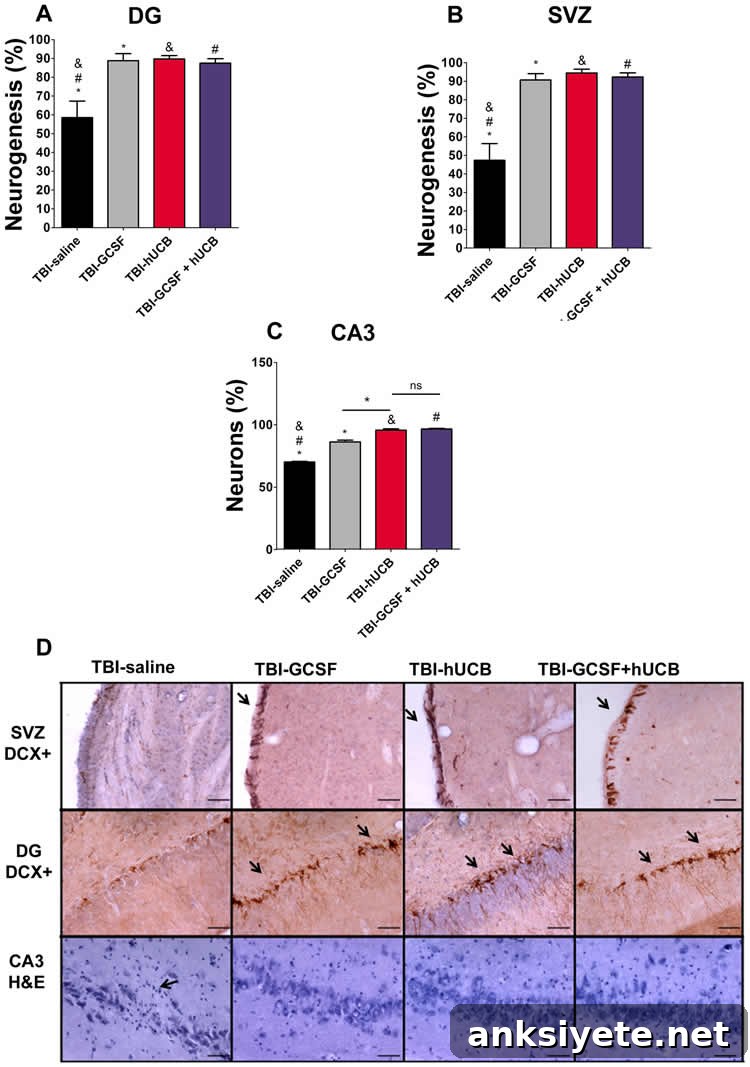
In this series of preclinical experiments, hUCB alone produced robust and sustained improvements in motor function and reduced histopathological damage. G-CSF alone offered more modest, short-lived benefits. However, the combined hUCB+G-CSF treatment yielded the most pronounced motor recovery and the greatest reduction in neuronal cell loss within the hippocampus, an area vital for learning, memory and motor coordination. The combined therapy also appeared to preserve endogenous neurogenesis that is typically impaired after chronic TBI.
Immune interactions within the central nervous system are a critical factor in the progression of many neurological disorders, and the study highlights how immune activation following injury can either support repair or drive further degeneration. Inflammatory markers such as elevated MHCII-positive cells have been associated with neurodegeneration and cognitive decline after TBI. By reducing neuroinflammation and promoting a reparative environment, the combination of hUCB and G-CSF may help shift the post-injury response toward recovery.
Lead author Cesar V. Borlongan, PhD, professor of neurosurgery and director of the USF Center of Excellence for Aging and Brain Repair, emphasized that the synergy observed between the cell therapy and the growth factor suggests complementary mechanisms of action. Paul R. Sanberg, distinguished professor at USF and principal investigator on the Department of Defense–funded project, noted that while the stem cells may exert broader biological effects, pairing them with G-CSF produced the most effective reduction in TBI-related behavioral deficits in these animal models.
The research team concluded that further investigation of this combination strategy is warranted. Future studies should clarify the mechanisms underlying the observed synergy, extend assessments beyond motor outcomes to include detailed cognitive testing, and refine dosing and timing parameters to maximize therapeutic benefit. These preclinical findings provide a rationale for continued translational research to determine whether a similar approach could eventually benefit people living with chronic TBI, including military veterans.
The study was supported by the Department of Defense (grant W81XWH-11-1-0634). Disclosure: CVB and PRS serve as consultant and founder, respectively, of Saneron CCEL Therapeutics, Inc., which provided the cord blood.
Contact: Anne DeLotto Baier – USF
Source: USF press release summarizing the published research
Image Source: Image credited to Acosta et al./PLOS ONE and adapted from the open access research paper.
Original Research: Combination Therapy of Human Umbilical Cord Blood Cells and Granulocyte Colony Stimulating Factor Reduces Histopathological and Motor Impairments in an Experimental Model of Chronic Traumatic Brain Injury by Acosta SA et al., published in PLOS ONE.