Summary: Rare mutations in the gene for the serotonin 2C receptor are implicated in severe obesity and associated maladaptive behaviors in both people and animal models.
Source: Baylor College of Medicine
A collaborative study led by researchers at Baylor College of Medicine, the University of Cambridge and the University of Exeter Medical School identifies the serotonin 2C receptor gene as a new contributor to severe obesity and related behavioral changes.
The research shows that rare, mostly loss-of-function variants in the serotonin 2C receptor gene (HTR2C) are linked to extreme appetite, weight gain and certain maladaptive behaviors in humans, and that these effects are recapitulated in animal models. The findings, published in Nature Medicine, have implications for diagnosis and potential targeted treatments.
Serotonin is a neurotransmitter that communicates between brain cells by binding to specific serotonin receptors. These receptors participate in regulating mood, appetite and social behaviors. According to co-corresponding author Dr. Yong Xu, professor of pediatrics—nutrition and molecular and cellular biology at Baylor, disruption of this signaling at the serotonin 2C receptor alters circuits that control feeding and behavior.
The study combined complementary strengths: the Xu laboratory conducted genetic and mechanistic studies in animal models, while the lab of Dr. I. Sadaf Farooqi at the University of Cambridge focused on human genetics. Together the teams traced the impact of HTR2C variants from human patients to engineered mouse models, building a coherent picture of how receptor dysfunction produces physiological and behavioral changes.
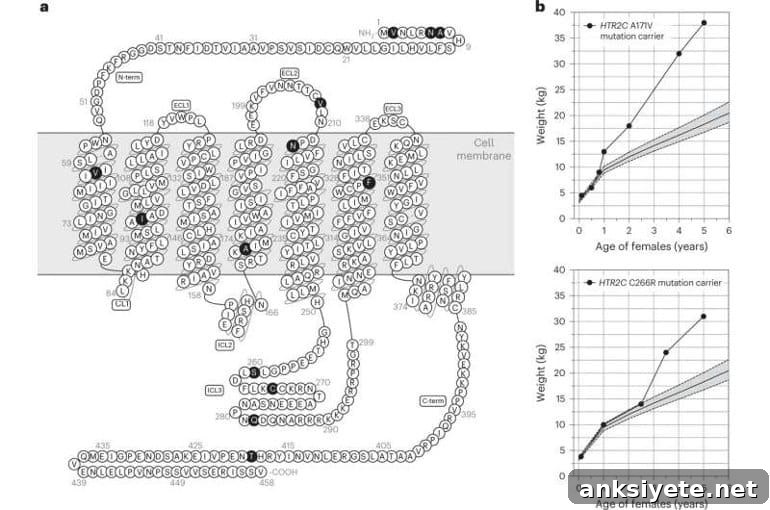
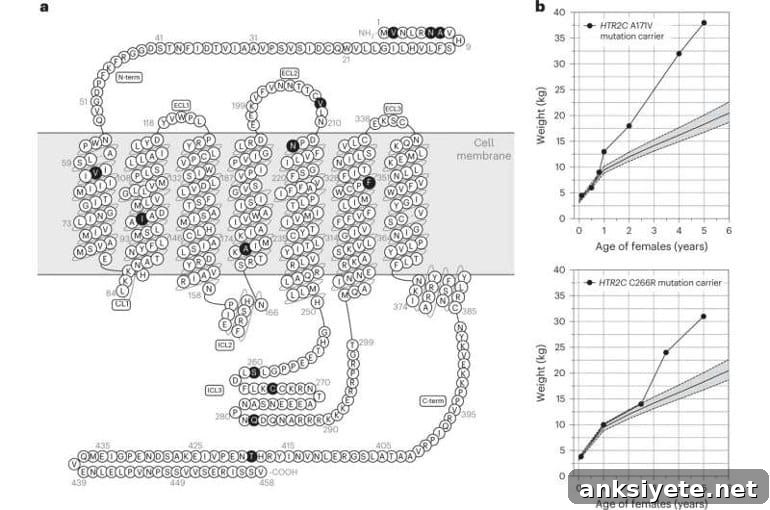
Initial genetic screening of people with severe, early-onset obesity revealed 13 rare variants in the HTR2C gene across 19 unrelated individuals (3 males and 16 females). Functional testing in cells showed that 11 of these variants cause loss of receptor function. Clinically, carriers displayed hyperphagia—an abnormally increased appetite—and varying degrees of maladaptive behavior, including emotional lability, which can present as rapid, exaggerated shifts in mood such as episodes of uncontrollable laughing or crying and increased irritability.
To confirm causality, researchers introduced a human loss-of-function HTR2C variant into mice. Male knock-in mice developed obesity and showed reduced social exploration; female heterozygous mice displayed similar but milder deficits. These parallel findings in animals strengthen the argument that HTR2C loss-of-function variants contribute directly to overeating and to behavioral changes.
Mechanistic experiments revealed how receptor loss impairs energy balance. The serotonin 2C receptor is required to sustain normal firing of proopiomelanocortin (POMC) neurons in the hypothalamus—cells that suppress appetite. When receptor function is lost, POMC neuron activity is reduced, removing an important brake on feeding and leading to overeating and weight gain.
Behavioral studies in the engineered mice also linked receptor dysfunction to social and emotional changes. Mutant animals showed decreased sociability and increased aggression, establishing a previously underappreciated role for the serotonin 2C receptor in maintaining normal social behavior and temper control. The research team notes that further work is needed to map the precise neural circuits that connect receptor signaling to these behavioral outcomes.
From a clinical perspective, the authors recommend including HTR2C in diagnostic gene panels for severe childhood-onset obesity, given the clear association between variants and early, severe weight gain. The work also points toward therapeutic strategies that bypass the defective receptor: for example, drugs that act downstream on melanocortin pathways, such as melanocortin receptor agonists, might restore appetite control in affected individuals. Additional studies are required to evaluate safety and efficacy of such targeted treatments.
About this neuroscience research news
Author: Press Office
Source: Baylor College of Medicine
Contact: Press Office – Baylor College of Medicine
Image: Image credited to the researchers
Original Research: Open access. “Human loss-of-function variants in the serotonin 2C receptor associated with obesity and maladaptive behavior” by Yong Xu et al., Nature Medicine.
Abstract
Human loss-of-function variants in the serotonin 2C receptor associated with obesity and maladaptive behavior
Serotonin reuptake inhibitors and receptor agonists are commonly used to treat conditions such as obesity, anxiety and depression. This study evaluated the role of the serotonin 2C receptor (5-HT2CR) in controlling weight and behavior.
Exome sequencing of 2,548 individuals with severe obesity and 1,117 controls identified 13 rare HTR2C variants in 19 unrelated people. Functional assays in HEK293 cells showed that 11 variants cause loss of receptor function. All variant carriers reported hyperphagia and displayed some level of maladaptive behavior.
Mice engineered to carry a human loss-of-function HTR2C variant developed obesity and reduced social exploratory behavior; female heterozygotes had similar but less severe changes. Using the 5-HT2CR agonist lorcaserin, researchers demonstrated that depolarization of appetite-suppressing POMC neurons is impaired in knock-in mice, linking receptor dysfunction to reduced neuronal activity and increased feeding.
The findings establish 5-HT2CR as a regulator of human appetite, body weight and certain behaviors. The authors suggest that melanocortin receptor agonists may be a promising treatment avenue for severe obesity in individuals with HTR2C variants and recommend including HTR2C in diagnostic gene panels for severe childhood-onset obesity.