
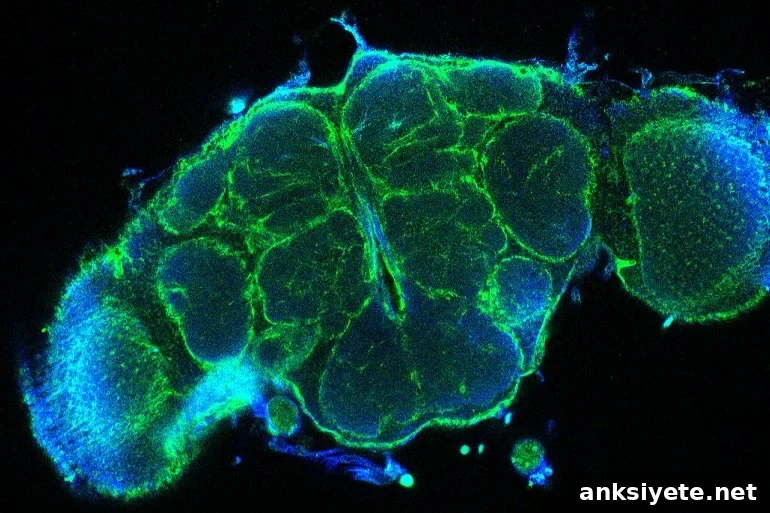
Summary: In fruit flies, researchers have identified a second internal barrier in the brain where a specialized layer of glial cells creates a physical and molecular separation between distinct functional compartments.
Source: University of Münster
Neurons in the brain form intricate networks and communicate at specialized contact points called synapses. To function reliably, neurons depend on a stable and controlled environment. The blood-brain barrier provides this protection by maintaining nutrient balance and preventing harmful substances from reaching neural tissue—a principle that applies across the animal kingdom, including humans.
Researchers at the Institute of Neuro- and Behavioral Biology at the University of Münster, led by Nicole Pogodalla and Prof. Dr. Christian Klämbt, have now demonstrated that insect brains possess an additional internal barrier. In fruit fly larvae, a layer of glial cells establishes a separate diffusion boundary that keeps different brain compartments distinct, supporting consistent neural function.
This discovery was reported in the peer-reviewed journal Nature Communications.
The team studied Drosophila melanogaster larvae to investigate how glial cells contribute to brain organization. During early development glia guide the formation of neuronal networks, and in the mature nervous system they help regulate signal transmission. In many invertebrates and some primitive vertebrates, glial cells also form the external blood-brain barrier. The Münster group focused on the less-explored role of glia inside the brain.
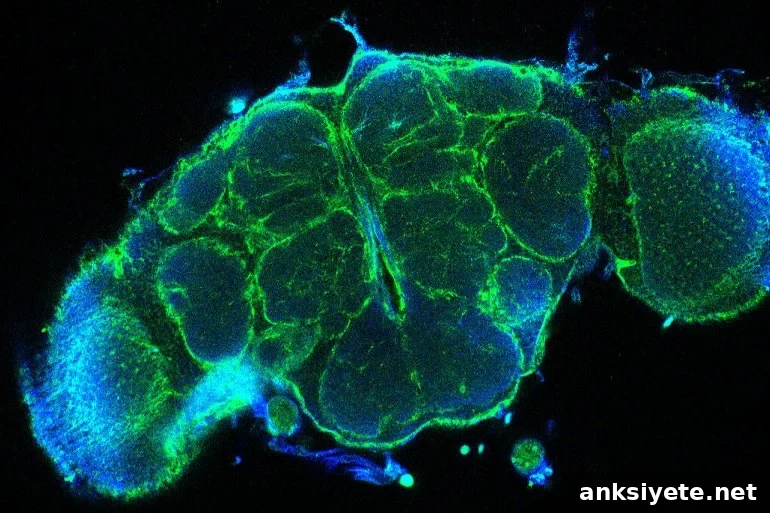
Within the fly brain, synapses and dendrites are concentrated in a central region known as the neuropil. This neuropil is separated from the surrounding layer that contains neuronal cell bodies by a specific subset of glial cells called ensheathing glia. Using a novel combination of techniques—including dye injections into live larval brains and targeted ablation of specific glial cell types—the researchers demonstrated that these ensheathing glia create a functional diffusion barrier that controls how molecules spread between compartments.
Because most biological barriers are formed by polarized cells with distinct “upper” and “lower” membrane domains, the team examined whether ensheathing glia exhibit polarity. High-resolution confocal imaging, electron microscopy and molecular-genetic tools revealed that these glial cells are indeed polarized: they display distinct molecular compositions across their membranes and are associated with a specialized extracellular matrix at the interface between neuropil and cortex.
This polarity is biologically significant. When polarity is disrupted, ensheathing glia change shape and lose their proper organization, which in turn impairs larval behavior. Larvae lacking functional ensheathing glia, or carrying mutations that disturb glial polarity, show reduced crawling speed and other locomotor abnormalities, indicating that the barrier formed by polarized glia is essential for normal nervous system performance.
The study also details how extracellular matrix components, membrane lipids and membrane proteins, together with the underlying cytoskeleton, contribute to the formation and maintenance of the barrier properties of ensheathing glia. These structural and molecular features work in concert to compartmentalize the brain and preserve an environment suitable for reliable synaptic function.
About this neuroscience research news
Author: Press Office
Source: University of Münster
Contact: Press Office – University of Münster
Image: The image is credited to WWU – Nicole Pogodalla and Christian Klämbt
Original Research: Open access. “Drosophila ßHeavy-Spectrin is required in polarized ensheathing glia that form a diffusion-barrier around the neuropil” by Nicole Pogodalla et al., published in Nature Communications.
Abstract
Drosophila ßHeavy-Spectrin is required in polarized ensheathing glia that form a diffusion-barrier around the neuropil
In the central nervous system (CNS), distinct functional tasks are often organized into separate compartments. In the Drosophila CNS, synapses and dendrites cluster within defined neuropil regions. The neuropil is delineated from neuronal cell bodies by ensheathing glia, which, as demonstrated by dye injection experiments, contribute to the formation of an internal diffusion barrier.
Ensheathing glia are polarized: their basolateral plasma membrane is enriched in phosphatidylinositol-(3,4,5)-triphosphate (PIP3) and the Na+/K+-ATPase subunit Nervana2 (Nrv2), and this domain interfaces with an extracellular matrix assembled at the neuropil–cortex boundary. The apical plasma membrane faces the neuropil and is enriched in phosphatidylinositol-(4,5)-bisphosphate (PIP2), supported by a submembranous ßHeavy-spectrin cytoskeleton.
Mutations in ßHeavy-spectrin disrupt ensheathing glial polarity, causing mislocalization of PIP2 and Nrv2 and leading to altered locomotion. Larvae with genetically or experimentally compromised ensheathing glia display similar behavioral defects, underscoring that polarized glia create distinct neural compartments and are essential for proper nervous system function.