
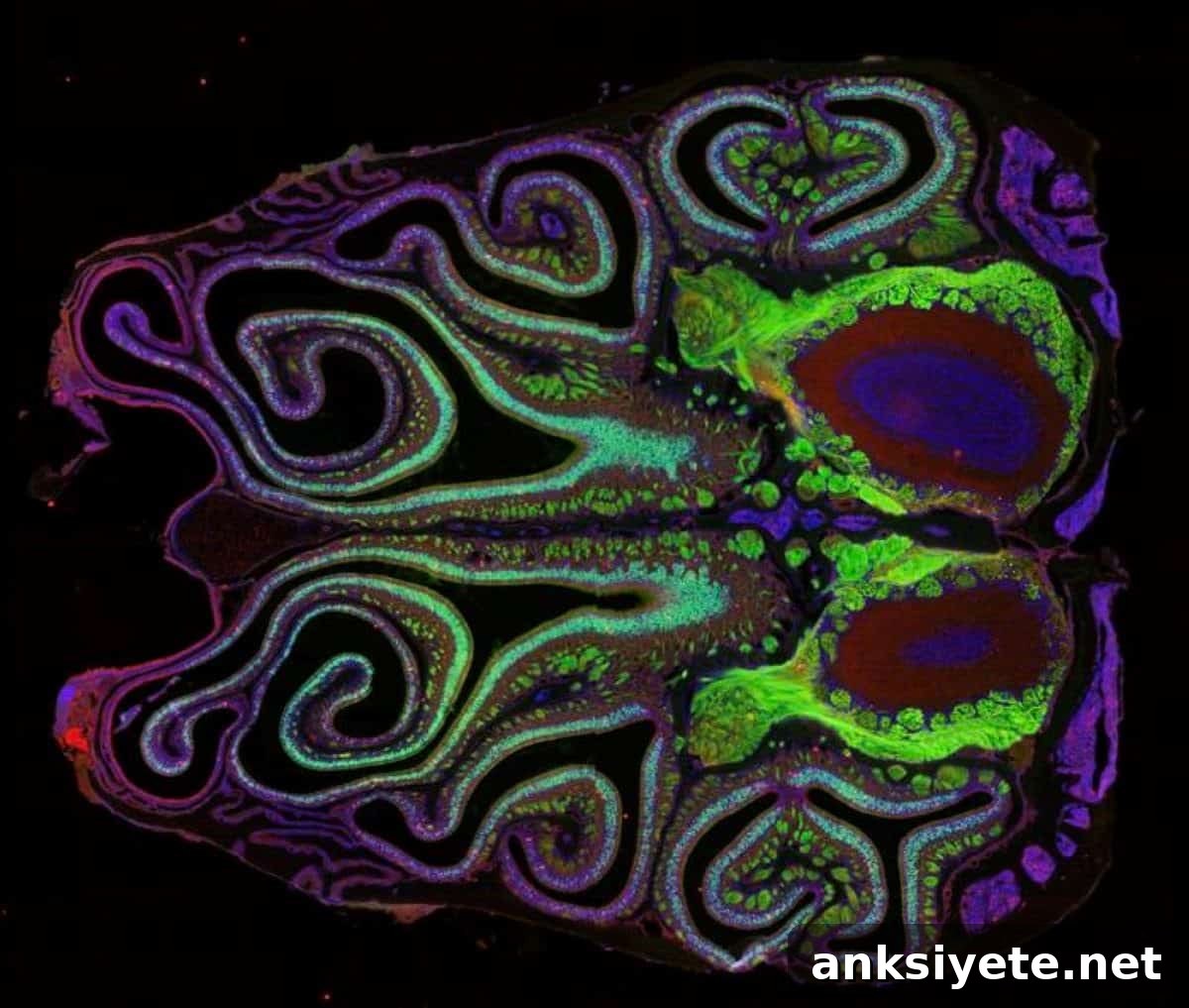
Summary: For more than three decades, the sense of smell has remained neuroscience’s “black box.” While vision, hearing, and touch have clearly defined maps, researchers long believed the olfactory system lacked a precise spatial organization.
A major new study overturns that view. By applying large-scale genetic sequencing and spatial transcriptomics, researchers have shown that the olfactory epithelium is not random at all but is arranged into highly consistent horizontal stripes. This detailed “smell map” aligns with patterns in the brain’s olfactory bulb and lays essential groundwork for future therapies to treat smell loss.
Key Facts
- The “Stripe” Discovery: Rather than being scattered randomly, the more than 1,000 types of olfactory receptors in mice are expressed in tight, overlapping horizontal stripes running from the top to the bottom of the nose.
- Spatial Guidance by Retinoic Acid: A gradient of retinoic acid functions as a positional cue, instructing neurons which receptor to express according to their dorsoventral location in the olfactory epithelium.
- Map Correspondence with the Brain: The receptor map in the nose corresponds directly to the sensory maps in the olfactory bulb, creating a coordinated nose-to-brain architecture similar to how the retina aligns with visual centers.
- Large-Scale Data: This analysis examined roughly 5.5 million olfactory sensory neurons from more than 300 mice using single-cell sequencing combined with spatial transcriptomics, making it one of the most extensive neural-mapping efforts to date.
- Clinical Relevance: Understanding this spatial code is a prerequisite for developing interventions—such as stem cell approaches or neural interfaces—to restore smell (anosmia), a condition that affects safety, nutrition, and mental health.
Source: Harvard
Why smell matters: Smell shapes everyday experience, warning us of hazards, enhancing flavor, and triggering memories and emotions. Yet, compared with other senses, our understanding of olfaction has lagged behind.
Sandeep (Robert) Datta, a professor of neurobiology at the Blavatnik Institute, Harvard Medical School, describes olfaction as “super-mysterious.” To resolve that mystery, Datta and colleagues set out to map how the many receptor types are arranged across the olfactory epithelium.
The team’s work in mice produced the first high-resolution map showing that neurons expressing specific receptors are not randomly distributed but are organized into reproducible horizontal bands. Each receptor type shows a unique average dorsoventral position within the epithelium.
“These results bring order to a system previously thought to be unordered,” Datta said, noting the discovery changes how scientists conceptualize olfactory coding.
Importantly, the nasal receptor map aligns with sensory maps in the olfactory bulb, providing mechanistic clues about how odor information is transmitted and processed by the brain.
Datta emphasizes that mapping this organization is essential for devising treatments for smell loss. “We cannot fix smell without first understanding how it is organized at a basic level,” he said.
The study was published April 28 in Cell.
A missing map, now found
Other sensory systems—vision, hearing, and touch—have well-defined peripheral maps that correspond to brain maps. Olfaction had been an exception. Early studies identified only broad zones of receptor expression and led many to assume receptor choice was effectively random across the epithelium.
Part of the difficulty stems from scale and complexity: mice possess about 20 million olfactory neurons and over a thousand receptor types, whereas other systems use far fewer receptor classes. Until recently, technologies lacked the resolution to detect fine-grained spatial ordering.
As genetic sequencing and spatial profiling advanced, Datta’s team reexamined the system at much greater scale and resolution.
Unveiling the organizational code
Combining single-cell RNA sequencing with spatial transcriptomics, the researchers profiled roughly 5.5 million olfactory sensory neurons from over 300 mice. Single-cell sequencing identified which receptors each neuron expressed; spatial methods located where those neurons resided within the nasal tissue.
At this scale, a clear pattern emerged: receptor expression formed precise, overlapping horizontal stripes along the dorsoventral axis of the olfactory epithelium. The pattern was consistent across animals and paralleled the layout found in the olfactory bulb.
Mechanistically, a dorsoventral gradient of retinoic acid explained how neurons adopt their positional identities. The gradient drives a transcriptional program—encompassing transcription factors and axon guidance molecules—that maps physical location to receptor choice. Experimentally altering retinoic acid levels shifted the receptor map, confirming its instructive role.
Datta notes that a companion study from the laboratory of Catherine Dulac, published in the same issue of Cell, reported consistent observations.
Implications and next steps
The research team is now investigating why receptor types are arranged in the particular order they observed and to what extent this spatial code is conserved in humans. Understanding conservation across species is critical for translating findings into clinical therapies.
By revealing how the olfactory system organizes hundreds of discrete sensory channels into a coherent map, this work provides the essential wiring diagram needed for approaches to regenerate or replace olfactory neurons and restore smell. Restoring olfaction has implications beyond sensory pleasure—loss of smell is linked to decreased safety and an elevated risk of depression.
“Smell profoundly affects human health and well-being. Without a detailed map, efforts to restore it are likely to fail,” Datta said.
Authorship, funding, disclosures
Additional authors include David Brann, Tatsuya Tsukahara, Cyrus Tau, Dennis Kalloor, Rylin Lubash, Lakshanyaa Kannan, Nell Klimpert, Mihaly Kollo, Martin Escamilla-Del-Arenal, Bogdan Bintu, Andreas Schaefer, Alexander Fleischmann, and Thomas Bozza.
Funding: This work was supported by the National Institutes of Health (grants R01DC021669, R01DC021422, R01DC021965, and F31DC019017), the Yang Tan Collective at Harvard, and a National Science Foundation Graduate Research Fellowship.
Key Questions Answered:
A: The olfactory system’s complexity obscured its organization. Mice have many more receptor types than systems like color vision, and until large-scale sequencing and spatial profiling were possible, the subtle dorsoventral patterns could not be resolved. To earlier methods the tissue appeared disordered.
A: Yes. The horizontal stripes indicate that particular receptor classes are preferentially located at specific dorsoventral positions. This spatial organization likely helps the brain parse complex odor mixtures by pre-sorting inputs before they reach the olfactory bulb.
A: It could. By revealing the positional rules that govern receptor expression and neural wiring, the map offers the structural information necessary to guide regeneration of olfactory neurons in the correct locations—an important step toward restoring functional smell.
Editorial Notes:
- This article was edited by a Neuroscience News editor.
- The journal paper was reviewed in full.
- Additional context was added by staff editors.
About this olfaction and brain mapping research news
Author: Katie Brace
Source: Harvard Medical School
Contact: Katie Brace – Harvard Medical School
Image: The image is credited to Datta Lab
Original Research: Closed access.
“A spatial code governs olfactory receptor choice and aligns sensory maps in the nose and brain” by David H. Brann, Tatsuya Tsukahara, Cyrus Tau, Dennis Kalloor, Rylin Lubash, Lakshanyaa Thamarai Kannan, Nell Klimpert, Mihaly Kollo, Martín Escamilla-Del-Arenal, Bogdan Bintu, Andreas Schaefer, Alexander Fleischmann, Thomas Bozza, and Sandeep Robert Datta. Cell
DOI:10.1016/j.cell.2026.03.051
Abstract
A spatial code governs olfactory receptor choice and aligns sensory maps in the nose and brain
While many peripheral sensory systems are organized by precise topographical maps, mouse olfactory sensory neurons (OSNs) were long thought to select from roughly 1,100 olfactory receptors (ORs) at random, with only a few broad zones influencing receptor choice. This study reveals that each OR is expressed at a characteristic mean dorsoventral position, creating a stereotyped receptor map across the olfactory epithelium. OSN dorsoventral identities are defined by a coherent transcriptional program—comprising transcription factors and axon guidance molecules—driven by a dorsoventral gradient of retinoic acid signaling. This gradient converts physical location into a spatially appropriate distribution of OR choices and aligns peripheral receptor maps with those in the brain. Consequently, spatial order in the olfactory system emerges from a continuously varying transcriptional code that precisely organizes the numerous discrete channels responsible for sensing odors.