
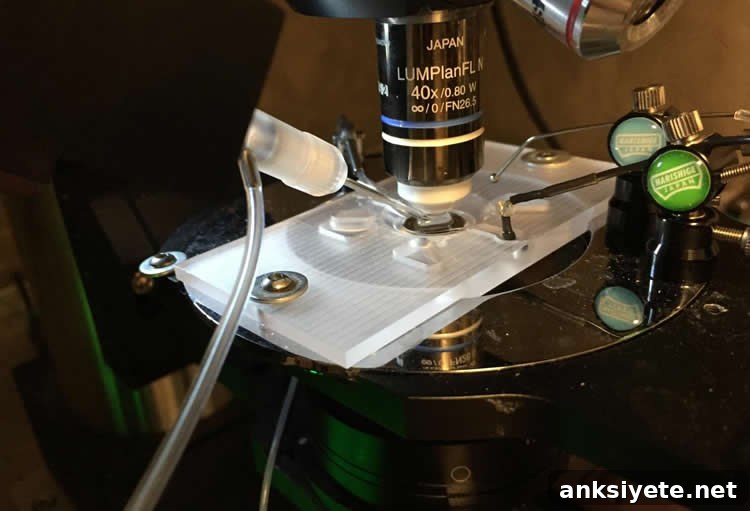
Robotic Cleaning Technique Automates Patch-Clamp Recordings
Summary: Researchers report a new robotic cleaning method that allows patch-clamp pipettes to be reused for up to 11 recordings, enabling greater automation in neuroscience experiments.
Source: Georgia Institute of Technology
A newly developed robotic cleaning process for patch-clamp pipettes could significantly increase automation in neuroscience laboratories, speeding up recordings of neuronal activity and expanding the scale of experiments.
Patch-clamp recording is a foundational technique for measuring electrical activity in individual neurons and other cells. It requires a glass pipette with a tip on the order of one micron to form a tight seal with a cell membrane, allowing direct electrical access to the cell interior. Traditionally, researchers replace pipettes between recordings because debris and residue can prevent reliable seals, making patch-clamping labor-intensive and low-throughput.
Researchers at the Georgia Institute of Technology report a robotic cleaning method that enables pipettes to be cleaned and reused immediately, shortening the time between recordings and permitting sequential, unattended measurements. The innovation can keep a pipette functional through at least 11 consecutive recordings with performance comparable to a fresh pipette, and the team expects further refinements may extend that number substantially.
“This is a step toward transforming robotic methods in neuroscience,” said Craig Forest, associate professor in Georgia Tech’s George W. Woodruff School of Mechanical Engineering. “We aim to load samples, start the system, and let it record dozens — or even hundreds — of cells without constant human oversight. That level of automation has already reshaped other areas of biology; bringing it to patch-clamp electrophysiology could dramatically expand how we study brain function.”
Supported by the National Institutes of Health and the Allen Institute for Brain Science, the work was published in Scientific Reports. Building on earlier automated advances from the same lab, the team demonstrated what they believe is the first robot capable of performing sequential patch-clamp recordings in cell culture, brain slices, and in living animals without an operator present.
The robotic system, nicknamed “patcherBot,” combines automated pipette positioning with an integrated cleaning routine. Graduate research assistant Ilya Kolb led the effort to test cleaning agents that could be applied in an automated workflow. After screening multiple options, he identified a commercially available laboratory detergent, Alconox, as effective for removing cellular debris and restoring pipette performance.
The cleaning cycle is incorporated into the Autopatcher software that controls pipette movement. After each recording, the robot dips the pipette tip into a detergent well, creates a controlled flow to flush material from the glass, and then moves the pipette to a separate rinse well. The entire process takes about one minute, a pace comparable to or faster than a skilled technician performing the same steps by hand.
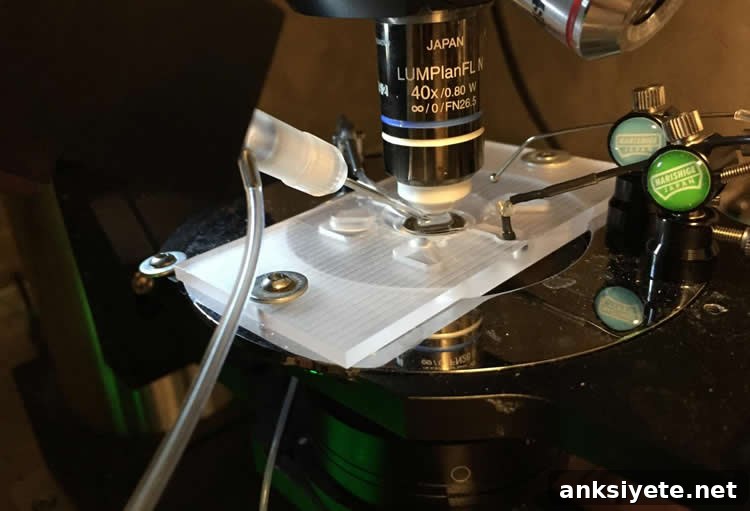
The team directly compared recordings from fresh pipettes with recordings from pipettes that had been used and cleaned multiple times. “When we patch with a fresh pipette and when we patch with a pipette that has been used and cleaned 11 times, the results are essentially indistinguishable,” Kolb reported. They observed some decline in performance after about 14 cycles, but believe further engineering could push the useful lifespan of a single pipette to dozens of recordings.
Collaborators at Emory University evaluated whether any residual detergent remaining after cleaning could affect living cells. Mass spectrometry and pharmacological testing showed undetectable or negligible amounts of detergent and no impact on ion channel behavior under the conditions tested.
Georgia Tech has filed for patent protection on the robotic cleaning method. The researchers envision integrating the technology into commercial patch-clamp systems so laboratories could select target cells via microscope view, start the automated sequence, and let the instrument proceed through many recordings. Broader adoption could lower the barrier to large-scale studies of cell types and connectivity, and could be applied to pharmaceutical testing and other high-throughput electrophysiology needs.
“If this technology is embedded in user-friendly hardware and software, it could democratize certain kinds of electrophysiology,” Forest said. “Our goal is to build tools that let researchers ask bigger questions and generate the data needed to better understand how the brain works.”
Funding: This research was supported by an NIH Computational Neuroscience Training grant and by BRAIN Initiative awards. The content reflects the authors’ views and not necessarily those of the National Institutes of Health.
Source: John Toon, Georgia Institute of Technology
Image source: John Toon, Georgia Tech
Original research: Published October 11, 2016 in Scientific Reports: “Cleaning patch-clamp pipettes for immediate reuse.”
Cleaning patch-clamp pipettes for immediate reuse
Patch-clamp recording enables detailed electrical, morphological, and genetic studies at the single-cell level but has historically been limited by low throughput and manual pipette replacement. The authors present a simple, fast, and automated pipette-cleaning method that allows immediate reuse. Immersion of pipette tips in a detergent solution followed by rinsing permits at least 10 reuses without loss of signal fidelity across preparations from cultured cells to in vivo recordings. Trace detergent remaining after cleaning did not affect ion channel pharmacology. The method enabled the first robot to perform sequential patch-clamp recordings in cell culture and in vivo without human intervention.