
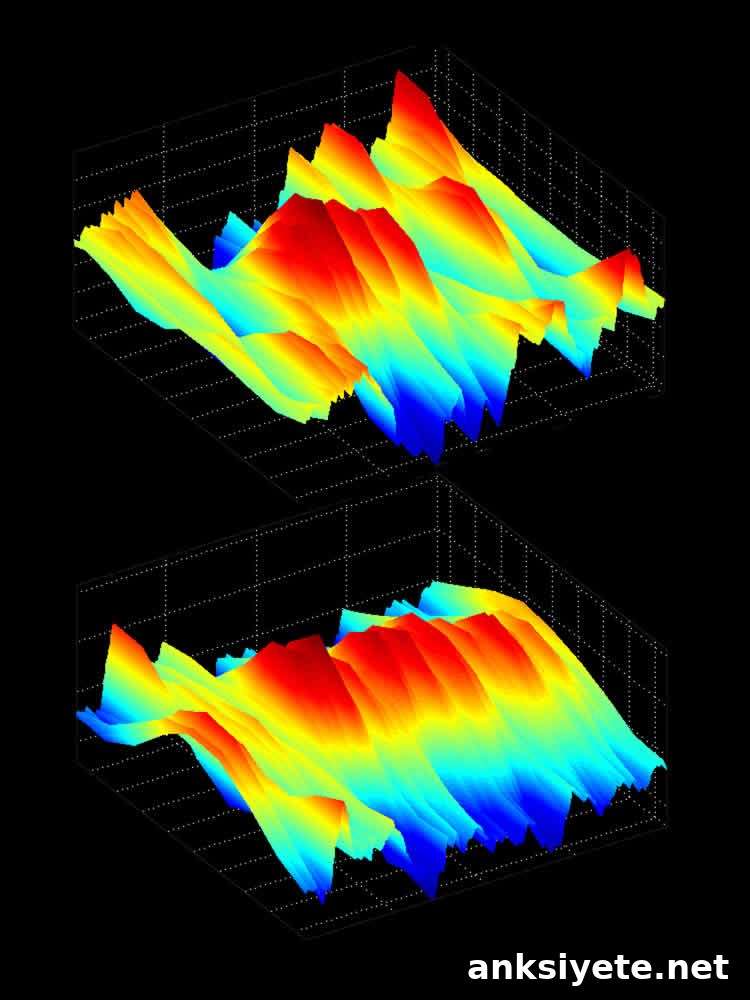
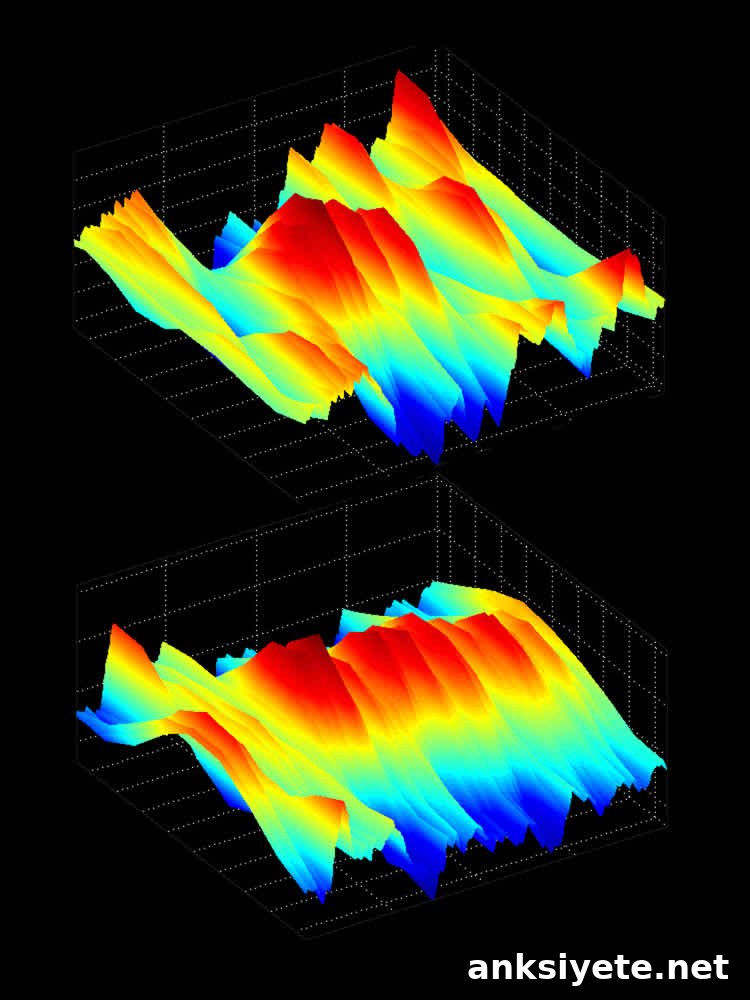
EEG electrodes capture electrical oscillations as a remembered object is encoded and held in memory.
Researchers at the University of Oregon have recorded the brain’s memory signals in near real time, revealing how rhythmic electrical activity corresponds to the precise content and quality of what we hold in short-term memory.
Using electroencephalography (EEG), the research team monitored synchronized neural signals from 25 student volunteers as each person memorized a simple visual item: a single oriented bar positioned inside a circle. By tracking oscillatory activity in the alpha frequency band (8–12 Hz), the investigators were able to decode the exact angle of the bar a participant was retaining. The same EEG measurements also predicted which individuals could store that visual information with greater precision.
The results, published in the May 28 issue of the Journal of Neuroscience, offer strong evidence that alpha-band electrical oscillations play a central role in visual working memory. Where prior studies have shown that brain activity can reflect the content of memory, this study demonstrates a less expensive and highly time-sensitive method to track those representations as they form and persist.
“These findings provide strong evidence that these electrical oscillations in the alpha frequency band play a key role in a person’s ability to store a limited number of items in working memory,” said Edward Awh, professor in the University of Oregon’s Department of Psychology and Institute of Neuroscience. He noted that identifying the specific rhythms linked to memory storage helps reveal the basic neural building blocks of a capacity-limited cognitive system. “If this rhythm is what allows people to hold things in mind, then understanding how that rhythm is generated — and what restricts the number of things that can be represented — may provide insights into the basic capacity limits of the mind.”
The experiment measured how the alpha rhythm changed both when the visual stimulus was first shown and during the subsequent delay when participants maintained the bar’s orientation in memory. Distinct patterns of synchronized alpha activity corresponded to early transient responses during encoding and later sustained activity during storage. By constructing tuning functions from spatially distributed alpha oscillations, the team could reconstruct the remembered orientation with high temporal precision.
Edward K. Vogel, a co-author on the study, and colleagues have long investigated the capacity limits of short-term memory. This project, funded by the National Institutes of Health, seeks to explain why humans can hold only a small number of items in mind simultaneously. “It turns out that it’s quite restricted,” Awh said. “People can only think about a couple of things at a time, and they miss things that would seem to be extremely obvious and memorable if that limited set of resources is diverted elsewhere.”
EEG offers an important advantage over functional magnetic resonance imaging (fMRI) for this type of research. While fMRI has been widely used to decode memory content, it is more expensive and provides much coarser temporal resolution. EEG captures rapid changes in electrical activity on the order of a tenth of a second, allowing researchers to resolve dynamic neural events that unfold far faster than fMRI’s typical multi-second sampling.
“With EEG we get a fine-grained measure of the precise contents of memory, while benefitting from the superior temporal resolution of electrophysiological measures,” Awh explained. “This EEG approach is a powerful new tool for tracking and decoding mental representations with high temporal resolution. It should provide us with new insights into how rhythmic brain activity supports core memory processes.”
The research was supported by the NIH National Institute of Mental Health through grant R01-MH087214 to Edward Awh and Edward K. Vogel. John T. Serences of the University of California, San Diego, was also a co-author on the study. The published article is titled “Induced Alpha Rhythms Track the Content and Quality of Visual Working Memory Representations with High Temporal Precision.”
Contact: Jim Barlow – University of Oregon
Source: University of Oregon press release
Image Source: University of Oregon/Journal of Neuroscience (image adapted from the press release)
Original Research: Abstract for “Induced Alpha Rhythms Track the Content and Quality of Visual Working Memory Representations with High Temporal Precision” by David E. Anderson, John T. Serences, Edward K. Vogel, and Edward Awh in Journal of Neuroscience. Published online May 28, 2014. doi:10.1523/JNEUROSCI.0293-14.2014