
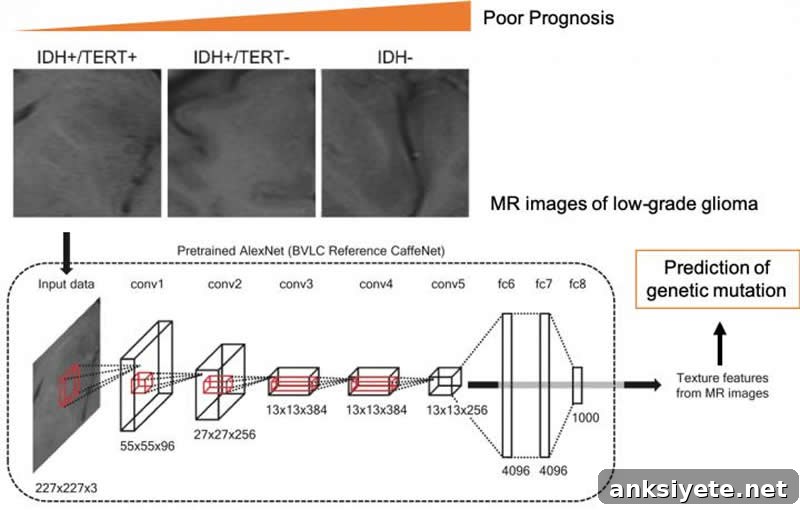
Summary: A new convolutional neural network applied to MRI brain scans can predict key genetic mutations in glioma tumors.
Source: Osaka University
Researchers at Osaka University have created a machine-learning method that uses magnetic resonance imaging (MRI) to rapidly predict genetic mutations in glioma tumors of the brain and spine. This noninvasive approach could speed up personalized treatment decisions and improve outcomes for patients. The study appears in Scientific Reports.
Cancer care has shifted toward precision medicine, where identifying the specific genetic alterations in a tumor helps determine the most effective therapies. For many cancers this relies on sequencing tumor tissue, but brain tumors can be difficult to biopsy. Waiting for surgical sampling and laboratory testing delays treatment decisions.
Glioma arises from the brain’s supporting glial cells. Two mutations that strongly influence prognosis and treatment are alterations in the isocitrate dehydrogenase gene (IDH) and mutations in the promoter region of the telomerase reverse transcriptase gene (TERT). Detecting these mutations earlier and less invasively could guide clinicians to better initial treatment choices. The Osaka University team developed a deep learning pipeline that predicts IDH and TERT promoter status directly from routine MR images.
“Machine learning is increasingly applied to medical imaging, but predicting hidden molecular features from images alone is still emerging,” explains lead author Ryohei Fukuma. Their pipeline uses a pretrained convolutional neural network (CNN) to extract rich texture features from multiple MRI sequences. Those learned features are then fed into a support vector machine classifier to determine the most likely molecular subtype of each glioma.
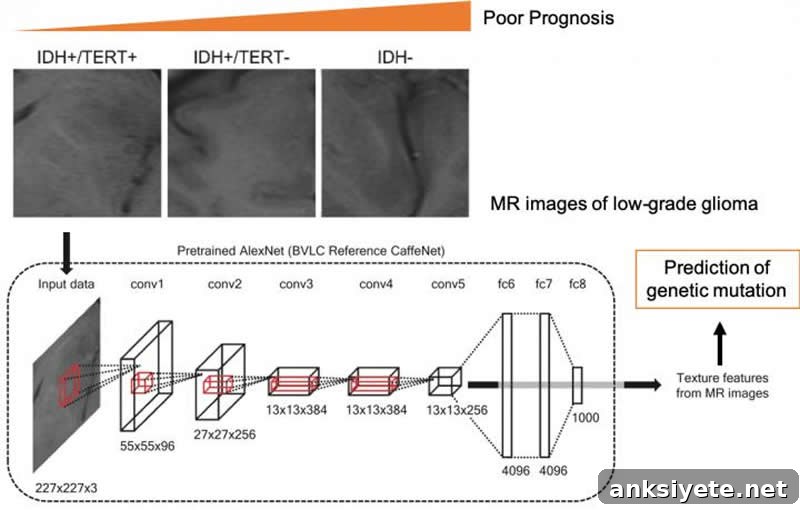
The researchers compared the CNN-derived texture features with conventional radiomic features—such as tumor size, shape, and intensity measures—and with patient age. MRI data from 164 patients with grade II or III gliomas across multiple institutions were grouped by genotype: (1) IDH wild-type; (2) co-occurring IDH and TERT promoter mutations; and (3) IDH mutant with TERT wild-type. The team applied a CNN (AlexNet) to four MR sequences to generate texture features and trained a linear support vector machine (SVM) to classify the three molecular groups.
Combining CNN texture features, radiomic measures, and patient age produced the best performance. Overall classification accuracy reached 63.1%, significantly outperforming classifiers that used only conventional radiomics or age. In particular, prediction of the TERT promoter mutation improved markedly when CNN-derived texture features were included, indicating that deep network features capture subtle image patterns that correlate with underlying tumor genetics.
Senior author Haruhiko Kishima notes, “This approach could reduce reliance on surgical biopsies and accelerate delivery of genotype-informed treatments. We aim to extend the method to other tumor types and leverage existing cancer gene and imaging databases.” If validated in larger, prospective cohorts, MRI-based molecular prediction could streamline clinical workflows and shorten the time to personalized therapy for glioma patients.
Source:
Osaka University
Media contact:
Saori Obayashi – Osaka University
Image source:
Image credit: Osaka University.
Original research (open access):
“Prediction of IDH and TERT promoter mutations in low-grade glioma from magnetic resonance images using a convolutional neural network.” Ryohei Fukuma et al., Scientific Reports. doi: 10.1038/s41598-019-56767-3.
Abstract (revised summary)
Genotype identification is critical for guiding glioma treatment. The authors developed a method that applies a pretrained convolutional neural network to preoperative MR images to predict IDH and TERT promoter (pTERT) mutation status in grade II/III gliomas. Using multisite MRI from 164 patients, they extracted CNN-based texture features from four MR sequences and classified tumors with a linear support vector machine into three genotype groups. Classification using the combined set of CNN features, conventional radiomic features, and patient age achieved an accuracy of 63.1%, significantly higher than models using radiomics or age alone. The CNN texture features notably improved prediction of pTERT status, suggesting that pretrained deep networks can capture imaging signatures of key molecular subtypes in low-grade glioma.