
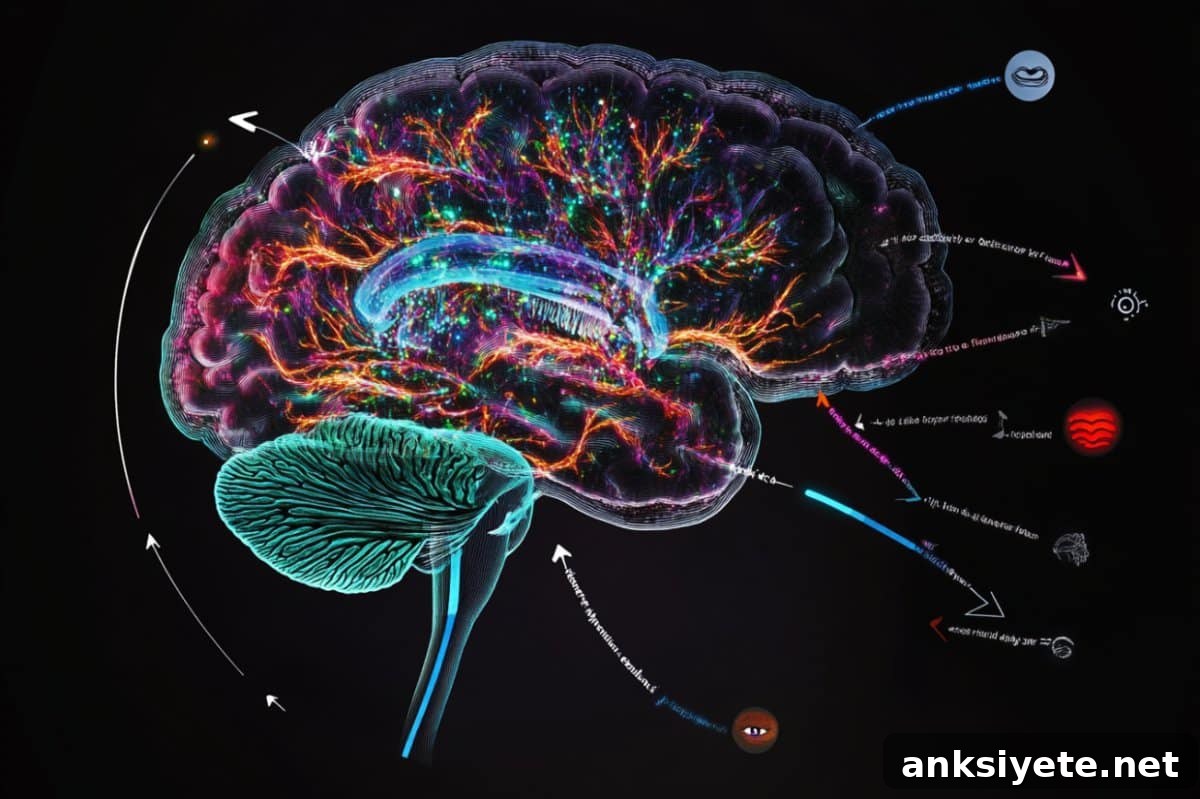
Summary: New research shows that neurons in the ventral visual cortex are far more flexible than previously believed, changing their responses in real time during object-recognition tasks. Instead of visual processing being purely feedforward, feedback signals from higher cortical areas carry prior knowledge and task context back to early visual areas, shaping perception moment by moment.
This top-down information enables early visual neurons to adjust their selectivity depending on behavioral goals and prior experience. These results challenge classical hierarchical models of vision and suggest new directions for studying perception and conditions such as autism.
Key facts
- Dynamic neuronal responses: Neurons in early visual cortex rapidly adapt their sensitivities according to task demands and expectations.
- Top-down feedback: Higher cortical regions transmit contextual and memory-based information to lower visual areas, guiding how stimuli are interpreted.
- Relevance to autism research: Disruptions in feedback signaling may help explain perceptual differences observed in autism, motivating targeted animal-model studies.
Source: Rockefeller University
Introduction
From the moment we open our eyes, the brain begins building internal representations of the world. Neurons in the visual cortex assemble elements of a scene into meaningful shapes and objects. Classically, this process has been described as a hierarchy that moves information in a feedforward direction—from simple features in early visual areas to complex object representations in higher regions of the temporal lobe.
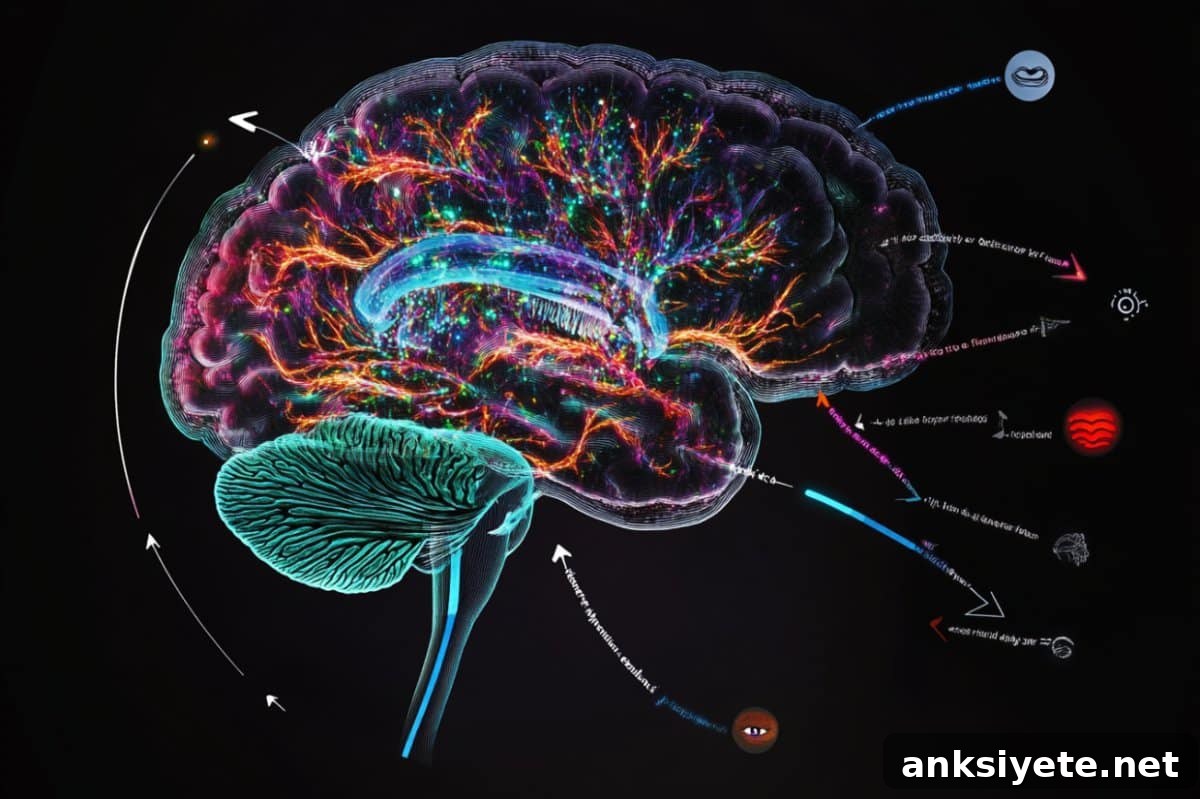
Although feedback connections from higher to lower cortical areas have long been anatomically documented, their functional role has been unclear. Research from Charles D. Gilbert’s laboratory at Rockefeller University reveals that feedback carries expectation- and task-dependent information that actively sculpts how early visual neurons respond.
Published in PNAS, Gilbert and colleagues show that this countercurrent stream of information conveys prior encounters and behavioral context, which in turn makes neurons adaptable rather than functionally fixed.
A different flow of information
Gilbert’s lab has studied the circuitry of visual perception and perceptual learning for years. The traditional model posits that early-stage neurons detect simple features (for example, line segments) and that complexity accumulates as processing ascends the hierarchy until neurons code entire objects. Work from Gilbert’s group challenges that sharp division.
Their previous discoveries include cortical plasticity in adult visual areas and long-range horizontal connections that link information across wide portions of the visual field. They have also shown that neurons can change which inputs they prioritize—favoring task-relevant signals over irrelevant ones—highlighting the flexibility of cortical circuitry.
In the current study, the team set out to determine whether this flexibility is a routine feature of object recognition rather than an exceptional property induced by artificial training.
Seeing is understanding: methods and behavioral task
The researchers worked with two macaque monkeys trained on object-recognition tasks using images of everyday items—fruits, vegetables, tools and machines—some familiar and some novel. As the animals learned, fMRI localized cortical areas responsive to the stimuli. That imaging guided placement of chronically implanted electrode arrays, allowing the team to record spiking activity from individual neurons while the animals performed delayed match-to-sample tasks.
On each trial, a sample image served as the cue. After a brief delay—during which the animal had to hold the cue in working memory—a test image appeared. The test could be a full object, a cropped or partial component, or an unrelated stimulus. The animals indicated whether the test matched the sample. These conditions allowed researchers to probe how neurons represent full objects and informative components under behaviorally relevant constraints.
Adaptive processing in early visual areas
Recordings revealed that individual neurons change their stimulus preferences depending on the cue and task context. The same neuron that responds preferentially to one target under a given cue can switch to prefer a different target when the cue changes. In other words, neurons act as adaptive processors tuned by momentary behavioral requirements and prior expectations.
Importantly, neurons in early stages of the ventral pathway—long thought to encode only simple features—showed sensitivity to far more complex stimulus attributes than previously appreciated. The study therefore reduces the presumed complexity gap between early and higher visual cortical areas.
Gilbert interprets these results to mean that adult cortical neurons are not rigidly specialized; instead they are dynamically tuned by sensory experience, behavioral context, and feedback signals that instruct lower areas which computations to perform. The feedforward signal then carries the outcome of those computations upward.
Implications for autism and broader brain function
These findings add to growing recognition that top-down interactions are a central feature of cortical processing—not just in vision but across sensory, motor and higher cognitive systems. Understanding the cellular and circuit mechanisms of these interactions could illuminate how they go awry in brain disorders.
To explore this possibility, Gilbert’s lab is beginning studies of animal models of autism. Using behavioral assays and advanced imaging methods available in the Elizabeth R. Miller Brain Observatory, researchers will compare perceptual performance and large-scale neuronal population dynamics between autism-model animals and wild-type controls. The goal is to identify perceptual differences and underlying circuit operations that might explain altered perception in autism.
About this visual neuroscience research news
Author: Katherine Fenz
Source: Rockefeller University
Contact: Katherine Fenz – Rockefeller University
Image: The image is credited to Neuroscience News
Original Research: Closed access. “Expectation-dependent stimulus selectivity in the ventral visual cortical pathway” by Charles D. Gilbert et al., PNAS. DOI: 10.1073/pnas.2406684122
Abstract (rephrased)
The traditional hierarchical model of the ventral object-recognition pathway emphasizes feedforward processing from a fixed set of simple primitives to whole-object representations in inferotemporal cortex. This study presents an alternative view: neurons continuously change their stimulus selectivity on a moment-to-moment basis under the influence of top-down expectations and perceptual task demands. Using an ethologically curated stimulus set and a delayed match-to-sample paradigm, the authors identify stimulus components that are informative for recognition alongside full-object responses, and they observe top-down effects for both informative and uninformative components. Functional MRI guided chronic electrode placement to link population-level responses to single-neuron dynamics, revealing how feedback and feedforward interactions jointly shape object recognition in the ventral visual pathway.