
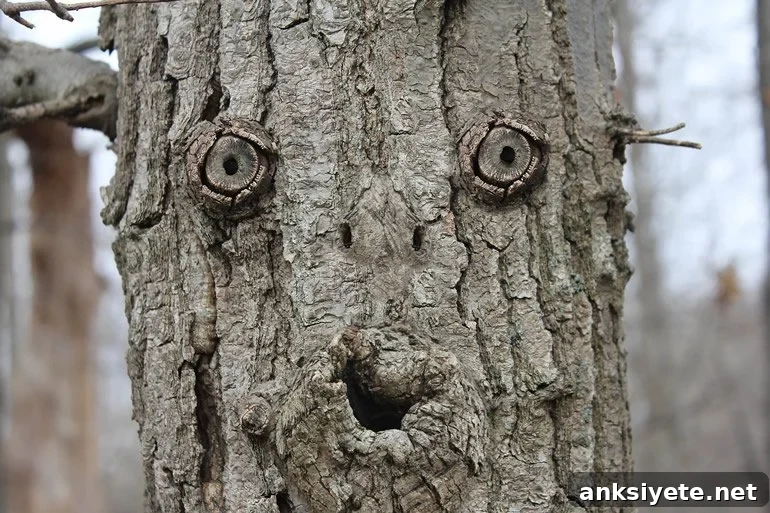
Summary: Face pareidolia—the tendency to perceive face-like patterns in inanimate objects—is a perceptual effect that arises when visual systems tuned for extracting social information from human faces respond to facelike configurations in the environment.
Source: University of New South Wales
If you often spot faces in objects—a scowling house, a surprised bowling ball, or a grimacing apple—you’re far from alone.
Face pareidolia, the common experience of seeing faces in everyday items, reflects how our visual system is organized. New research from UNSW Sydney shows that encountering these “false” faces engages many of the same brain mechanisms used to perceive real human faces.
Published in Psychological Science, the study led by Dr. Colin Palmer from UNSW Science’s School of Psychology highlights how widespread pareidolia is and how readily people around the world share images of facelike objects online.
“Social media sites and photo-sharing communities host thousands of images of objects that resemble faces, submitted by users around the globe,” Dr. Palmer notes.
“These objects often do more than simply look face-like; they can seem to carry personality or social meaning. For instance, a house’s windows can appear like watchful eyes, while a pepper might look cheerful.”
To understand why pareidolia occurs, the researchers examined what face perception entails. Human faces vary, yet they share a basic layout—typically eyes positioned above a nose and mouth. Our brains are highly sensitive to this arrangement, which draws attention to facelike patterns in nonliving objects.
“Face perception involves more than detecting a face,” Dr. Palmer explains. “We also identify who we’re seeing and interpret social cues—such as gaze direction and emotional expression. Specialized brain regions extract that social information from facial features.”
To test whether the same neural mechanisms respond to pareidolia as to real faces, Dr. Palmer and co-author Professor Colin Clifford used sensory adaptation methods. Sensory adaptation is a perceptual effect where recent visual experience temporarily alters how subsequent stimuli are perceived.
“For example, after viewing faces that consistently look left, a face that actually looks straight ahead can appear to have its gaze shifted to the right,” says Dr. Palmer. “This reflects habituation among neurons tuned to gaze direction.”
In their experiments, participants repeatedly viewed pareidolia images that implied a specific direction of attention (for instance, objects that looked as if they were ‘looking left’). After this exposure, participants’ judgments about where human faces were looking shifted in a predictable way.
“We observed that adaptation to pareidolia faces biased perception of gaze direction for real human faces,” Dr. Palmer reports. “This cross-adaptation indicates overlapping sensory mechanisms are engaged by both real faces and face-like objects.”
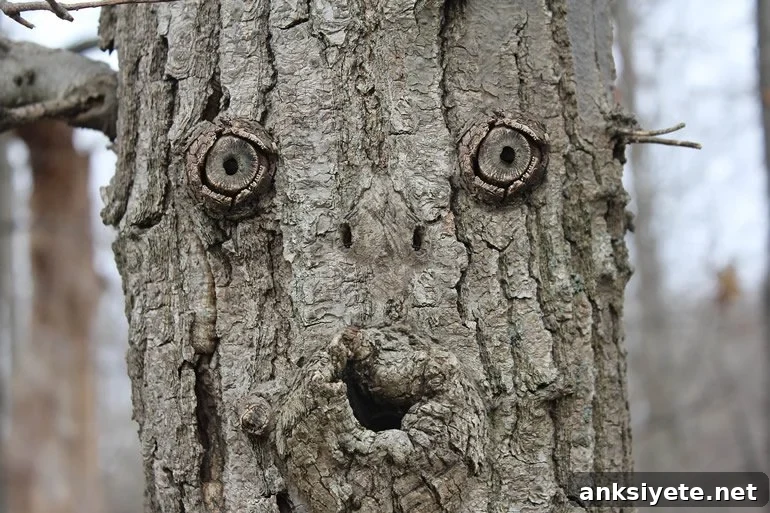
The researchers also found that when facelike features were removed from the objects—abolishing pareidolia—the cross-adaptation effects were significantly reduced. This supports the view that pareidolia is fundamentally a perceptual phenomenon: sensory input that resembles face structure activates visual systems evolved to extract social information from faces.
In practice, this means that if an object seems to be “looking at you” or appears to express emotion, it’s because the object’s features are sufficient to trigger face-processing mechanisms in your visual system.
Evolutionary perspective
Dr. Palmer suggests face pareidolia likely reflects evolutionary pressures favoring rapid and sensitive face detection. Similar effects have been observed in other primates, indicating these visual functions are evolutionarily conserved.
“Being adept at detecting faces is crucial for social interaction and threat detection,” he explains. “An overly sensitive system that sometimes produces false positives may be more advantageous than one that misses real faces.”
Beyond illuminating how the healthy brain processes faces, the study raises questions relevant to clinical conditions that affect face perception. Understanding the neural basis of face processing can inform research into prosopagnosia (difficulty recognizing faces) and aspects of the autism spectrum where reading facial social cues can be challenging.
“And so the longer-term goal of this kind of research is to understand how difficulties in face perception and everyday social functioning can come about.”
Future work will probe the specific neural circuits that decode social information from faces and investigate individual differences in how these mechanisms operate.
Funding: This research was supported by the Australian Research Council.
About this visual neuroscience research article
Source:
University of New South Wales
Contacts:
Lachlan Gilbert – University of New South Wales
Image Source:
The image is in the public domain.
Original Research: Open access
“Face Pareidolia Recruits Mechanisms for Detecting Human Social Attention” by Colin J. Palmer et al., Psychological Science.
Abstract
Face Pareidolia Recruits Mechanisms for Detecting Human Social Attention
Face pareidolia refers to perceiving face-like configurations in ordinary objects. We tested whether this phenomenon reflects activation of the same visual mechanisms that process human faces rather than being solely a cognitive association. Focusing on sensory cues to social attention, which engage neurons in temporal cortex susceptible to habituation, we found that repeated exposure to pareidolia faces implying a particular direction of attention produced systematic shifts in perception of human gaze direction. These cross-adaptation effects were diminished when facelike features were removed from the objects. The findings indicate that face pareidolia arises from sensory processing: when sensory input resembles facial structure, visual systems evolved to extract social content from human faces are recruited, producing the percept of a face where none exists.