
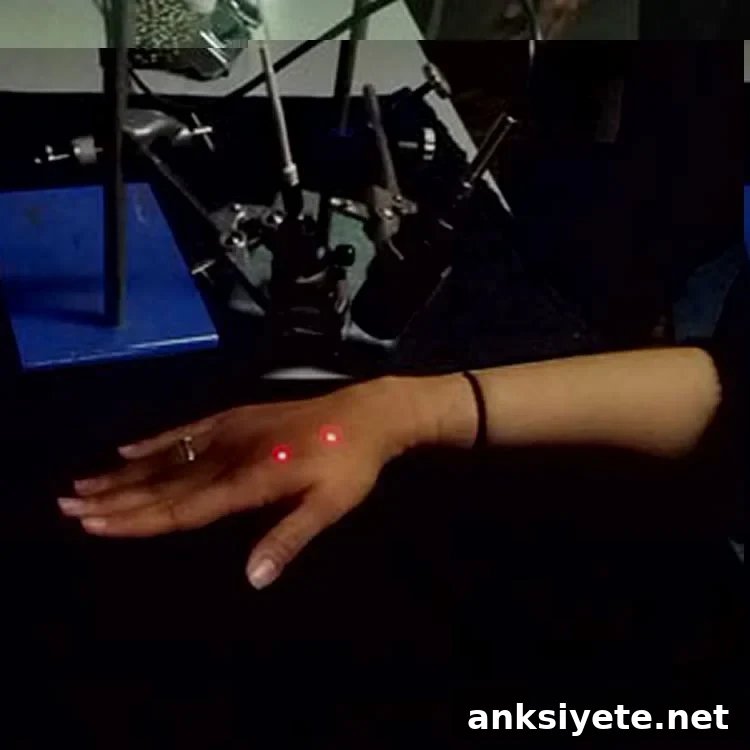
UCL study produces the first whole-body map of pain spatial acuity
“Where does it hurt?” is the instinctive first question when someone reports pain. A new study by researchers at University College London (UCL) provides the first systematic map showing how well people can localise pain—what scientists call spatial acuity for pain—across different parts of the body. The study finds that pain localisation is most precise at the forehead and the fingertips, and that the pattern of sensitivity across the body differs from that of touch.
Published in the journal Annals of Neurology and supported by the Wellcome Trust, the research used a specially calibrated laser to activate only the pain-sensing nerve endings in the superficial skin without engaging tactile receptors. By avoiding mechanical contact, the team could measure pain perception uncontaminated by touch—something that is hard to achieve with conventional tools such as needles or probes.
In the experiment, 26 healthy volunteers were blindfolded while pairs of brief, pain-inducing laser pulses were targeted at different body sites. Sometimes one laser fired, sometimes both; participants reported whether they felt a single sting or two distinct stings. By varying the distance between the two laser beams, the researchers determined the smallest separation at which participants could reliably distinguish one stimulus from two. That minimum separation is a measure of spatial acuity for pain at each tested location.
“Acuity for touch has been known for more than a century, and it is a routine part of neurological assessment,” said lead author Dr Flavia Mancini of the UCL Institute of Cognitive Neuroscience. “Surprisingly, nobody had previously established a comparable map for pain, largely because traditional testing methods also engage touch receptors. Our laser technique isolates cutaneous pain receptors so we can measure pain localisation directly.”
The results reveal a consistent pattern across participants: apart from the hairless skin of the hands, pain acuity generally improves toward the centre of the body. This gradient is the inverse of the typical pattern for touch, where acuity is greatest at the extremities such as the fingertips. For instance, pain localisation on the arm was sharper near the shoulder and lower near the wrist, whereas touch shows the opposite trend.
To test whether the ability to localise pain depends on normal tactile sensation, the team also studied a rare patient who lacks a sense of touch but retains normal pain perception. The patient’s pattern of pain acuity matched that of healthy volunteers, demonstrating that accurate pain localisation does not require a functioning touch system and is carried out by distinct sensory pathways.
Senior author Dr Giandomenico Iannetti of the UCL Department of Neuroscience, Physiology and Pharmacology emphasised the distinction between the two modalities: “Touch and pain are mediated by different sensory systems. While tactile acuity has been extensively characterised, pain acuity has been largely overlooked. We found that pain and touch can have similar overall levels of localisation precision, but their spatial distributions across the body differ markedly.”
Most sensory acuities correlate with the density of relevant nerve fibres in the skin, yet the fingertip emerged as a notable exception. Despite a relatively low density of pain-sensing fibres, the fingertips showed high pain localisation accuracy. “The high pain acuity of the fingertips is intriguing,” Dr Mancini noted. “One possibility is that frequent use of the fingertips trains the central nervous system to process nociceptive signals more precisely, but this requires further investigation.”
The study has practical implications for both acute and chronic pain assessment. Chronic pain affects millions of people and can arise from nerve damage that is hard to evaluate objectively. Dr Roman Cregg of the UCL Centre for Anaesthesia, who was not involved in the research, commented that the non-invasive laser method could offer a reproducible, quantitative way to monitor the function of pain networks and track nerve damage over time. He expressed interest in translating the approach into clinical settings to help assess and manage chronic pain conditions.
Contact: Harry Dayantis – UCL
Source: UCL press release
Image Source: Image credited to UCL and adapted from the press release
Original Research: Abstract for “Whole-body mapping of spatial acuity for pain and touch” by Flavia Mancini MD, Armando Bauleo MD, Jonathan Cole MD, Fausta Lui MD, Carlo A. Porro MD, Patrick Haggard MD and Giandomenico Iannetti MD in Annals of Neurology. Published online June 6, 2014. doi:10.1002/ana.24179