
Summary: Researchers have identified and blocked early molecular events in the brain that precede Alzheimer’s symptoms, offering a potential preventive strategy.
Source: Baylor College of Medicine.
Researchers from Baylor College of Medicine, Texas Children’s Hospital and Johns Hopkins University School of Medicine report that blocking the buildup of a toxic brain protein may one day help prevent or delay Alzheimer’s disease.
The study, published in Neuron, used a three-pronged experimental strategy to stop early molecular events that occur long before clinical signs of Alzheimer’s appear. In laboratory models, the team successfully prevented these early events and the downstream development of neurodegenerative pathology.
“Many common neurodegenerative diseases, including Alzheimer’s and Parkinson’s, involve the abnormal buildup of specific proteins in the brain,” said senior author Dr. Huda Zoghbi, professor of molecular and human genetics and of pediatrics – neurology and developmental neuroscience at Baylor and director of the Jan and Dan Duncan Neurological Research Institute at Texas Children’s Hospital. “Some proteins become toxic when they accumulate; tau is one such protein closely linked to Alzheimer’s and other dementias.”
“Most research has focused on the late stages of Alzheimer’s,” said first author Dr. Cristian Lasagna-Reeves, a postdoctoral fellow in the Zoghbi lab. “We aimed to identify what happens very early in the disease — before irreversible clinical symptoms — with the goal of preventing or reducing the initiating events that lead to devastating brain changes years later.”
The investigators reasoned that identifying enzymes that regulate tau levels could reveal new drug targets. Cells control protein abundance through enzymes called kinases, so the team performed a systematic inhibition screen of roughly 600 kinases to find those that influence tau accumulation.
“From our screen we identified a kinase named Nuak1; inhibiting Nuak1 consistently reduced tau levels,” said Zoghbi, who is also an investigator at the Howard Hughes Medical Institute.
The screening was done in parallel in cultured human cells and in the fruit fly, Drosophila. Using the fruit fly allowed the researchers to test the effects of kinase inhibition in an intact nervous system, assessing neuronal function and degeneration that cannot be modeled in simple cell cultures and is impractical to test at such scale in mice.
“Large-scale screening in the Drosophila model was essential because we could link changes in tau to functional outcomes in a living nervous system,” said co-senior author Dr. Juan Botas, professor of molecular and human genetics and of molecular and cellular biology at Baylor. “This approach helped us prioritize targets for validation in mammalian models.”
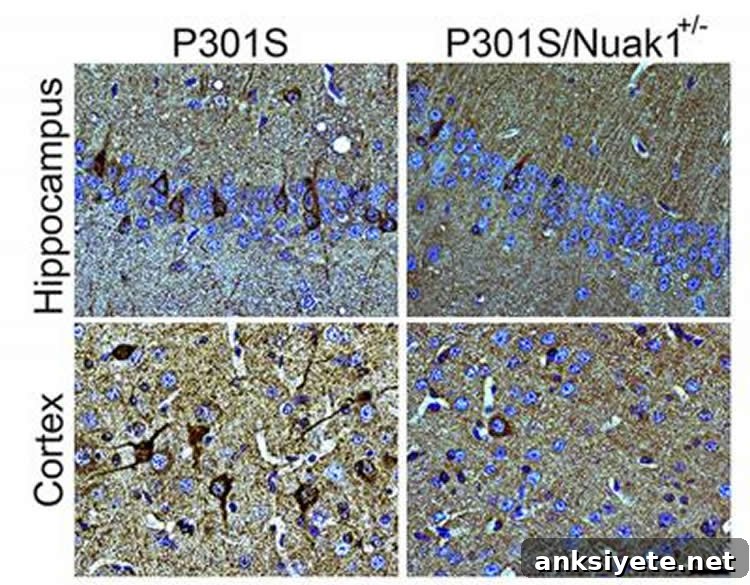
After confirming that Nuak1 inhibition lowered tau in both human cells and fruit flies, the team tested the finding in a mouse model of tauopathy. Reducing Nuak1 activity in the mouse model improved behavior and prevented neurodegeneration associated with tau accumulation.
“Seeing consistent results across three independent systems — human cells, flies and mice — convinced us that Nuak1 is a robust regulator of tau and a promising therapeutic target,” said Zoghbi. “The next step is to develop safe Nuak1 inhibitors that can lower tau levels without harmful side effects, with the long-term aim of preventing or delaying dementia in people at risk from tau accumulation.”
This work underscores that understanding basic disease mechanisms — in this case, how tau protein levels are controlled — can reveal strategies for prevention or treatment of Alzheimer’s, progressive supranuclear palsy (PSP), and other tau-related disorders. The authors compare the concept to cholesterol-lowering therapy for cardiovascular disease: maintaining tau at non-toxic levels might reduce the brain’s vulnerability to neurodegeneration later in life.
“Just as cholesterol-lowering drugs have reduced heart disease risk, future therapies that safely lower tau could prevent or delay Alzheimer’s and related dementias,” said Lasagna-Reeves.
Other contributors to the research include María de Haro, Shuang Hao, Jeehye Park, Maxime W.C. Rousseaux, Ismael Al-Ramahi, Paymaan Jafar-Nejad, Luis Vilanova-Velez, Lauren See, Antonia De Maio, Larissa Nitschke, Zhenyu Wu, Juan C. Troncoso, Thomas F. Westbrook and Jianrong Tang.
Funding: The study was supported by the Howard Hughes Medical Institute, the Robert A. and Renee E. Belfer Family Foundation, the Hamill Foundation, the Chapman Foundation, the National Institutes of Health (multiple NINDS and NIA grants), and additional institutional and foundation sources including Alzheimer’s and Parkinson’s research centers and core facilities that provided proteomics, microscopy and behavioral support.
Source: Graciela Gutierrez – Baylor College of Medicine
Image Source: Image credited to the researchers.
Original Research: Abstract for “Reduction of Nuak1 Decreases Tau and Reverses Phenotypes in a Tauopathy Mouse Model” by Cristian A. Lasagna-Reeves et al., published in Neuron (2016).
Baylor College of Medicine. “A Potential New Strategy to Prevent Alzheimer’s.” NeuroscienceNews. 22 October 2016.
Abstract
Reduction of Nuak1 Decreases Tau and Reverses Phenotypes in a Tauopathy Mouse Model
Highlights
• The AMPK-related kinase Nuak1 regulates tau levels
• Nuak1 is associated with tau pathology in Alzheimer’s disease (AD) and PSP patients
• Nuak1 directly phosphorylates tau at serine 356
• Reduction of Nuak1 rescues phenotypes in multiple tauopathy models
Summary
Many neurodegenerative proteinopathies share a common mechanism: abnormal accumulation of disease-associated proteins. Emerging evidence shows that lowering steady-state levels of these proteins can mitigate neurodegeneration in animal models. To identify genes that reduce tau levels — a key contributor to AD and PSP pathology — the authors combined parallel cell-based and Drosophila genetic screens. This approach revealed Nuak1, an AMPK-related kinase, as a regulator that stabilizes tau through phosphorylation at Ser356. Inhibiting Nuak1 suppressed neurodegeneration in tau-expressing Drosophila, and Nuak1 haploinsufficiency rescued behavioral and pathological phenotypes in a tauopathy mouse model. These findings validate decreasing total tau as a viable strategy to reduce tau-related neurodegeneration and identify Nuak1 as a promising therapeutic target for tauopathies.
“Reduction of Nuak1 Decreases Tau and Reverses Phenotypes in a Tauopathy Mouse Model” by Cristian A. Lasagna-Reeves et al., Neuron. Published online October 6, 2016. doi:10.1016/j.neuron.2016.09.022