
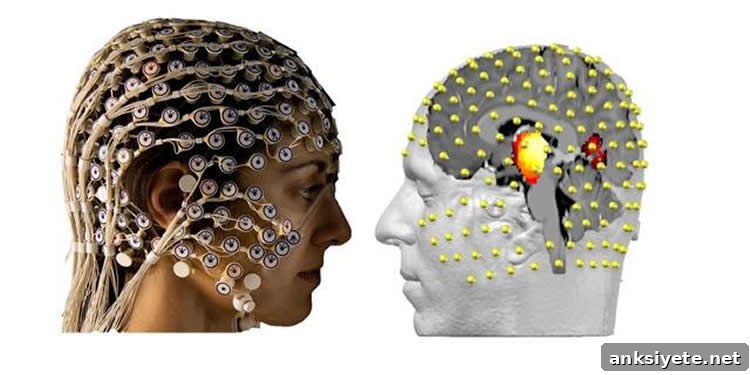
Summary: New research shows that high-density electroencephalography (EEG), combined with advanced signal-processing algorithms and anatomical imaging, can non-invasively detect and localize electrical activity originating from deep subcortical brain structures such as the thalamus and nucleus accumbens. These findings open new possibilities for studying and treating disorders that involve these regions, including Parkinson’s disease, Tourette syndrome and obsessive-compulsive disorder (OCD).
Source: University of Geneva
Subcortical brain regions lie deep beneath the cortex and remain difficult to study. Although these structures are known to play central roles in movement, emotion and higher-level associative processing, the precise patterns of their activity and how they communicate with the cortex are still not well understood. Disorders such as Parkinson’s disease, Tourette syndrome and OCD are linked to dysfunction within these deep networks. Current clinical tools that measure or modulate subcortical activity—like deep brain stimulation—require invasive implantation of electrodes. Researchers at the University of Geneva (UNIGE) and the University of Cologne evaluated whether non-invasive EEG, when combined with sophisticated mathematical source-imaging algorithms and anatomical imaging, can reliably detect signals from subcortical sites. Their results, published in Nature Communications, demonstrate that high-density EEG can reproduce signals typically accessible only with implanted electrodes, pointing toward less invasive diagnostic and therapeutic options.
Investigating subcortical structures is challenging because they are located far from the scalp. Two key nodes— the thalamus and the nucleus accumbens—participate in widespread networks that regulate motor functions, motivation, emotional processing and higher-order associative tasks. These regions communicate with each other and with cortical areas through coordinated electrical oscillations. Disruption of these interactions underlies the symptoms of several serious neurological and psychiatric disorders, which often begin during adolescence or later in life, explains Christoph Michel, Professor in the Department of Basic Neurosciences at UNIGE’s Faculty of Medicine.
Deep brain stimulation (DBS) is effective for some conditions such as Parkinson’s disease but remains highly invasive and is less successful for others, including OCD and Tourette syndrome, notes Martin Seeber, the study’s first author and a researcher in UNIGE’s Department of Basic Neurosciences. To improve treatments and better understand disease mechanisms, researchers need ways to measure deep brain activity in larger human samples without surgical implantation.
High-density EEG as a non-invasive probe of deep brain activity
High-density EEG records electrical activity across the scalp using many electrodes (256 in this study). The challenge is whether surface measurements can be reliably traced back to deep sources. To answer this question, the UNIGE team collaborated with a neurosurgical group led by Professor Veerle Visser-Vanderwalle at the University of Cologne. They measured intracranial signals from DBS electrodes placed in the centromedial thalamus and nucleus accumbens in four patients treated for OCD or Tourette syndrome while simultaneously recording 256-channel scalp EEG. These patients provided a rare opportunity to compare intracranial ground-truth signals with non-invasive measurements recorded at the scalp.
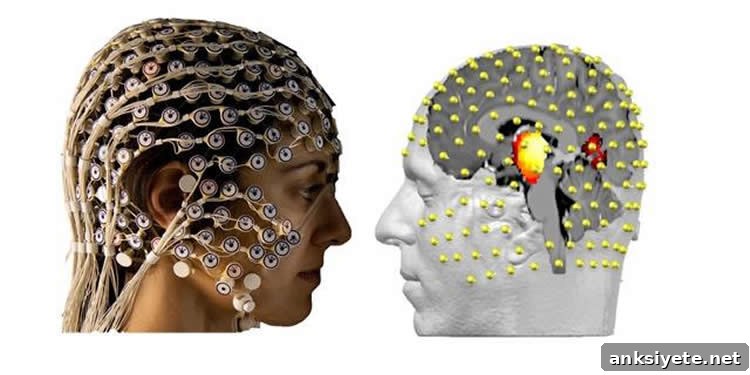
The team developed and applied mathematical source-imaging methods that incorporate realistic head models and anatomical constraints to interpret the EEG signals. By reconstructing the likely sources of surface-recorded activity, they could directly compare EEG-derived source signals with the simultaneous intracranial recordings from the DBS electrodes. The correspondence between the two signal sets was strong: envelope correlations of alpha-band activity derived from intracranial electrodes and from EEG source reconstructions were significant and highest near the actual electrode locations. In other words, scalp EEG—when analyzed with high-density recordings and appropriate computational models—can detect and spatially localize subcortical electrophysiological activity.
Implications for research and clinical practice
Confirming that non-invasive EEG can sense deep brain activity has several important consequences. First, it will allow researchers to study subcortical-cortical interactions in larger and more diverse human samples without the ethical and practical constraints of implanting electrodes. That broader access can accelerate studies into how these regions communicate and how those patterns change in disorders such as OCD and Tourette syndrome.
Second, the technique could guide improvements in treatments that aim to rebalance dysfunctional brain networks. Current neuromodulation strategies often rely on implanted hardware; robust EEG-based measures of subcortical activity may enable more precise, personalized stimulation protocols and could eventually support less invasive stimulation approaches. The authors also suggest that, with further development, non-invasive electromagnetic interventions might target deep structures from outside the skull, potentially reducing the need for implants.
Source: Christoph Michel — University of Geneva
Publisher: NeuroscienceNews.com (organized coverage)
Image credit: UNIGE
Original research: “Subcortical electrophysiological activity is detectable with high-density EEG source imaging” by Martin Seeber, Lucia-Manuela Cantonas, Mauritius Hoevels, Thibaut Sesia, Veerle Visser-Vandewalle & Christoph M. Michel, Nature Communications. Published February 14, 2019.
DOI: 10.1038/s41467-019-08725-w
University of Geneva. A Gentle Method for Unlocking the Mysteries of the Deep Brain. NeuroscienceNews. February 27, 2019.
Abstract
Subcortical electrophysiological activity is detectable with high-density EEG source imaging
Subcortical neuronal activity plays a central role in communication across large-scale brain networks. Although EEG provides the temporal resolution and whole-head coverage necessary to study brain dynamics, detecting and correctly localizing subcortical signals with scalp recordings has been debated. This study evaluated whether scalp EEG can detect signals recorded directly from intracranial electrodes implanted in the centromedial thalamus and nucleus accumbens. By recording simultaneous high-density (256-channel) EEG and intracranial activity from subjects with externalized deep brain stimulation electrodes, the researchers found significant correlations between intracranial signals and EEG source-reconstructed activity, particularly in the alpha band. Correlations were strongest for EEG source signals reconstructed near the actual electrode sites, providing direct evidence that scalp EEG can sense subcortical electrophysiological activity.