
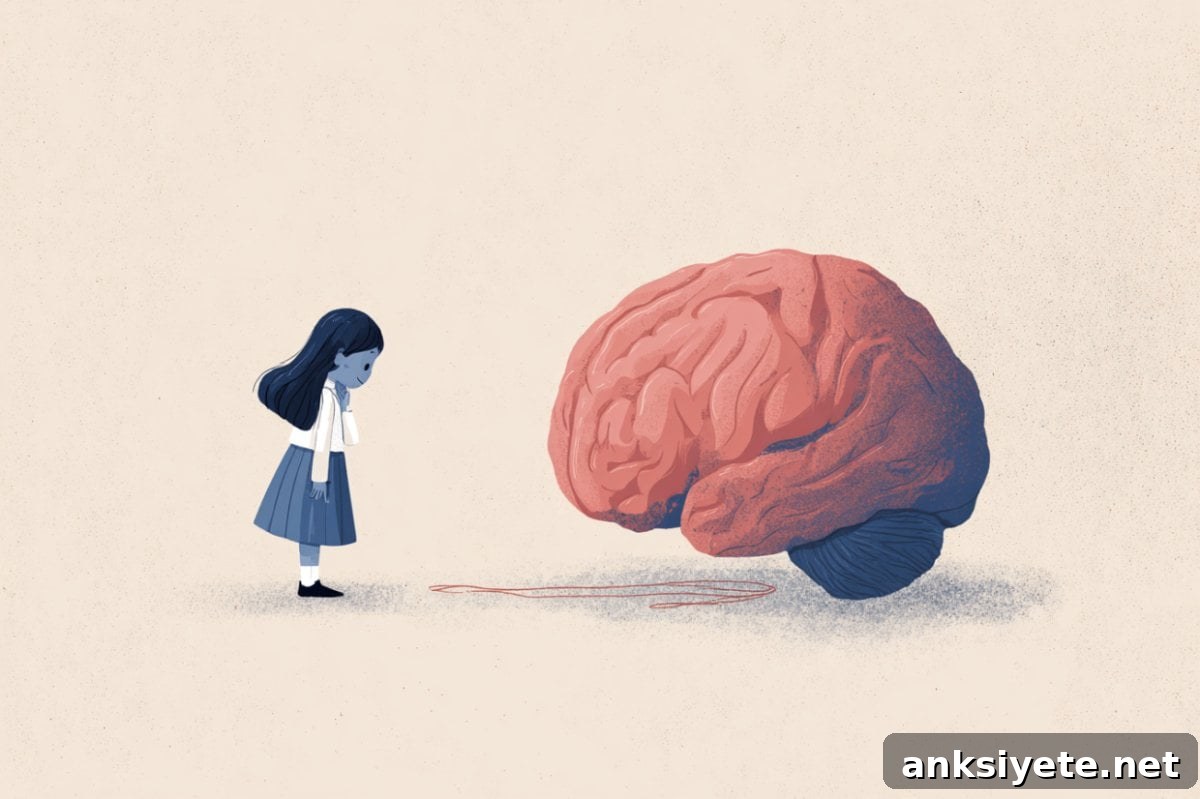
Summary: New research shows that trait shyness is associated with reduced spontaneous neural activity in the cerebellum—traditionally linked to motor control but increasingly recognized for roles in emotion and social cognition. Using resting-state fMRI and Regional Homogeneity (ReHo) analysis, investigators observed lower local synchrony in the cerebellar Crus I region among people who report higher shyness.
The study further found that the Behavioral Inhibition System (BIS)—a motivational system tied to avoidance of perceived threat—partially mediates the relationship between cerebellar activity and shyness. These results deepen our understanding of the neurobiology of social inhibition and suggest potential targets for future interventions.
Key Facts:
- Cerebellar Signature: Lower ReHo in the right posterior cerebellum (Crus I) correlates with greater trait shyness.
- BIS Mediation: The Behavioral Inhibition System (BIS) partially mediates the link between cerebellar synchrony and shyness; the Behavioral Activation System (BAS) does not show a mediating effect.
- Resting-State Focus: This study is the first to apply resting-state ReHo analysis specifically to localized neural correlates of shyness, highlighting intrinsic brain patterns rather than task-evoked responses.
Source: Neuroscience News
Shyness may reflect deeper patterns of spontaneous brain activity shaped by sensitivity to threat and avoidance.
A recent resting-state functional MRI study examined the neural basis of trait shyness in healthy young adults. Researchers measured localized spontaneous brain activity using Regional Homogeneity (ReHo), a metric that quantifies how synchronized the activity of each voxel is with its immediate neighbors. Participants who reported higher levels of shyness showed reduced ReHo in the right posterior lobe of the cerebellum, particularly in the Crus I area, indicating lower local neural synchrony in that region.
Crucially, the study linked this neural signature to individual differences in motivational tendencies: higher BIS scores were associated with both greater shyness and lower cerebellar ReHo. Mediation analysis showed that BIS partially explained the connection between cerebellar synchrony and shyness, suggesting that avoidance-related motivation helps bridge brain activity and social behavior.
These findings encourage a shift in focus beyond classical cortical regions commonly linked to shyness and social anxiety—such as the amygdala, prefrontal cortex, and insula—and position the cerebellum as an important player in social and emotional processing. Rather than viewing shyness only as a learned response or temperament shaped by experience, the results imply that baseline neural dynamics contribute to how shy individuals anticipate, interpret, and respond to social situations.
Beyond the Cortex: The Cerebellum’s Emerging Role in Social Behavior
Although prior neuroimaging work has emphasized cortical and limbic structures, this study underscores the cerebellum’s broader role in emotional regulation and social cognition. The Crus I region of the posterior cerebellum showed notably lower ReHo in participants with higher trait shyness, which may reflect decreased local coordination of spontaneous neural firing.
Lower ReHo in this cerebellar region could indicate disrupted integration of internal emotional states or less efficient processing of social feedback. In practical terms, when the cerebellum’s local networks are less synchronized, individuals might find it harder to interpret social cues or to recover quickly from social stressors, contributing to increased social inhibition.
This cerebellar area is also linked to default mode network dynamics and mentalizing processes—functions involved when people anticipate or reflect on social encounters. Such processes are central to the experience of shyness, where anticipation and self-focused reflection often heighten social discomfort.
Motivation Matters: BIS as the Bridge Between Brain and Behavior
To explain why cerebellar activity relates to shyness, researchers applied the BIS/BAS motivational framework. The Behavioral Inhibition System (BIS) responds to potential threats and uncertainty by promoting avoidance, while the Behavioral Activation System (BAS) drives approach toward rewards.
Participants completed standardized BIS/BAS questionnaires. Results showed a clear association between higher BIS scores and greater shyness, whereas BAS scores were unrelated to shyness in this sample. Mediation analyses indicated that BIS partly accounts for the relationship between cerebellar ReHo and shyness, implying that cerebellar synchrony influences—or reflects—a person’s propensity to avoid perceived social threats.
This interpretation aligns with models that view shyness as an approach–avoidance conflict: shy individuals may desire social connection but are held back by heightened threat sensitivity and avoidance tendencies. The cerebellum, which integrates sensorimotor, affective, and motivational signals, may play a role in resolving or amplifying that conflict.
Measuring Thought at Rest: The Power of ReHo
Regional Homogeneity (ReHo) focuses on local coherence of spontaneous brain activity rather than large-scale network connectivity. By measuring intrinsic activity while participants are at rest, ReHo can reveal fine-grained differences in regional neural synchrony that relate to stable personality traits like shyness.
The study’s resting-state approach suggests that shyness is not solely a reaction to external social situations but may be rooted in baseline brain states—a quieter, less synchronized cerebellum that predisposes individuals to social caution and avoidance.
Implications and Future Directions
These findings open new directions for theory and intervention. If lower cerebellar synchrony and elevated BIS sensitivity contribute to shyness, interventions targeting those systems—such as cognitive training or non-invasive neuromodulation—might help reduce social inhibition and improve social functioning.
Important questions remain about development and causality: is lower cerebellar ReHo a stable trait from early life, or does it emerge after repeated social withdrawal and anxiety? Longitudinal research could identify whether early support or training can modify cerebellar dynamics and prevent persistent social inhibition.
The study’s sample consisted of university students and did not include subgroup analyses by gender, so replication across broader age ranges, cultures, and clinical populations (for example, social anxiety disorder) will be important to generalize and extend these results.
By linking reduced cerebellar synchronization to increased shyness and heightened behavioral inhibition, this study reframes shyness as partly rooted in intrinsic brain organization. This perspective suggests that shy individuals are not simply maladapted but may have neural systems tuned to anticipate and avoid social uncertainty.
As neuroscience advances, understanding these intrinsic brain patterns will help clarify how personality traits like shyness develop and how best to support people who struggle with social engagement.
Key Questions Answered:
A: The right posterior cerebellum, specifically the Crus I region, showed reduced local neural synchrony (ReHo) in participants reporting higher shyness.
A: BIS scores were positively associated with shyness and partially mediated the relationship between cerebellar activity and shyness, indicating that avoidance motivation is a significant factor.
A: ReHo captures localized neural coherence with high sensitivity to regional differences, making it well suited to detect subtle trait-related variations in spontaneous brain activity.
About this shyness and neuroscience research news
Author: Neuroscience News Communications
Source: Neuroscience News
Contact: Neuroscience News Communications – Neuroscience News
Image: Image credited to Neuroscience News
Original Research: Open access.
“Associations between trait shyness and cerebellar spontaneous neural activity are mediated by behavioral inhibition” by Liang Li et al., published in Personality and Individual Differences (DOI provided in the original report).
Abstract
Associations between trait shyness and cerebellar spontaneous neural activity are mediated by behavioral inhibition
Shyness, characterized by discomfort and inhibition in social contexts, affects social functioning and well-being. Yet the neural mechanisms underlying shyness have been incompletely understood. The 2 × 2 model of shyness and sociability suggests that shyness emerges from a conflict between approach and avoidance motivations, operationalized by the Behavioral Inhibition System (BIS) and Behavioral Activation System (BAS).
This study used resting-state fMRI and ReHo analyses to examine associations between trait shyness and spontaneous neural activity in 42 healthy students (mean age = 21.36 ± 2.56), and to test whether BIS/BAS measures mediate those associations. ReHo analyses revealed that lower spontaneous neural synchrony in the posterior cerebellum was associated with higher shyness. Mediation tests showed that BIS partially mediated this relationship, whereas BAS did not. Inverse mediation checks supported the robustness of this pathway. These findings emphasize the cerebellum’s role in individual differences in shyness and highlight BIS as a key mediator, with implications for interventions aimed at improving social adaptation in shy individuals.