
Summary: A new machine-learning study maps how patterns of gene expression relate to cognitive and emotional functions across the human brain, offering a resource to guide future research into psychiatric illness.
Source: McGill University
Many psychiatric disorders have strong genetic components, yet how genes shape higher-order brain function remains unclear. This study presents a spatial map that links gene-expression signatures to specific psychological processes across the human cortex, highlighting molecular and cellular pathways that differentiate cognition from affect and pointing to potential targets for future investigation.
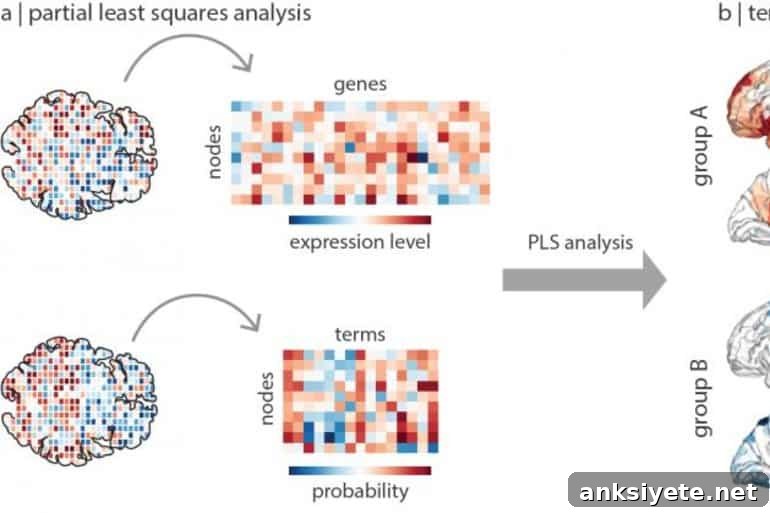
Led by Bratislav Misic at The Neuro (Montreal Neurological Institute–Hospital) of McGill University, the research team applied unsupervised machine learning to two open neuroscience resources: the Allen Human Brain Atlas, which documents regional gene expression, and the Neurosynth functional association maps, which summarize task-related brain activation from thousands of neuroimaging studies. By aligning these datasets, the authors identified reliable associations between transcriptional patterns and functional domains such as attention, memory, mood, and perception.
A major finding was a consistent molecular gradient separating cognitive processes from affective processes. Cognitive functions — including attention and perception — were more closely tied to gene signatures expressed in neuronal populations, particularly excitatory and inhibitory neurons. In contrast, affective and mood-related functions were associated with genes expressed in non-neuronal support cells, such as microglia and astrocytes, implicating neuroinflammatory and glial mechanisms in emotional regulation and in vulnerability to mental illness.
The affect-related gene signature showed strong localization to the anterior cingulate cortex, a region repeatedly implicated in mood disorders and emotional processing. The spatial relationship between gene expression, cell-type composition, and functional activation suggests that molecular and cellular architecture helps shape large-scale psychological organization across the neocortex.
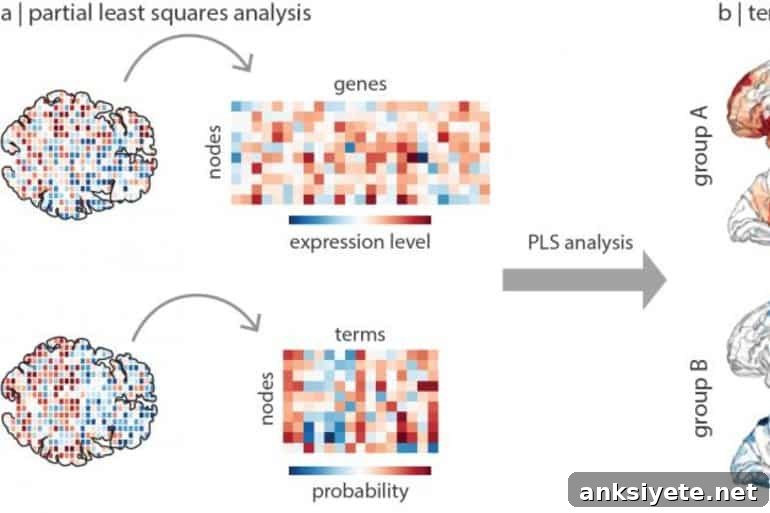
Published in the journal Nature Human Behaviour on March 25, 2021, the study directly connects spatial patterns of gene transcription to distributed cognitive and affective activations across the human neocortex. By doing so, it offers a principled bridge between microscale molecular biology and macroscale psychological function.
“In this work we found molecular signatures of different psychological processes,” says Bratislav Misic. “This is an important step toward understanding how thoughts and emotions emerge from specific genes, biological pathways and cell types.” The approach highlights how transcriptomic gradients and cell-type distributions align with the hierarchical organization of cortical networks.
Funding: The research was supported by the Canada First Research Excellence Fund (Healthy Brains, Healthy Lives initiative at McGill University), the Natural Sciences and Engineering Research Council of Canada, the Canada Research Chairs Program, the U.S. National Institutes of Health, the Canadian Institute for Advanced Research, and Google.
About this genetics research news
Source: McGill University
Contact: Shawn Hayward – McGill University
Image: The image is credited to The Neuro
Original Research: Closed access.
“Mapping gene transcription and neurocognition across human neocortex” by Justine Y. Hansen, Ross D. Markello, Jacob W. Vogel, Jakob Seidlitz, Danilo Bzdok & Bratislav Misic. Nature Human Behaviour
Abstract
Mapping gene transcription and neurocognition across human neocortex
Gene expression controls the proteins that shape synaptic wiring and neuronal activity. Coordinated activity among neuronal populations underlies complex psychological processes, but the extent to which spatial patterns of gene transcription influence cognition and emotion has remained an open question.
This study directly links microscale transcriptional patterns to macroscale functional activations by mapping regional gene-expression profiles onto functional activation maps of the cortex. Using unsupervised learning applied to large, open-access transcriptomic and meta-analytic functional datasets, the authors identified a ventromedial–dorsolateral gradient of gene assemblies that dissociates affective and perceptual/cognitive domains.
This molecular–psychological gradient reflects known hierarchical features of neocortical organization, including variations in cell-type composition, myeloarchitecture, laminar differentiation and intrinsic network affiliation. The signature becomes more pronounced across neurodevelopment and was replicated in independent datasets, supporting its robustness.
Together, these findings reveal spatially covarying transcriptomic and cognitive architectures and underscore the influence of molecular mechanisms and cell-type distributions on higher-order psychological functions, with implications for understanding the biological bases of psychiatric disorders and for guiding future translational research.