
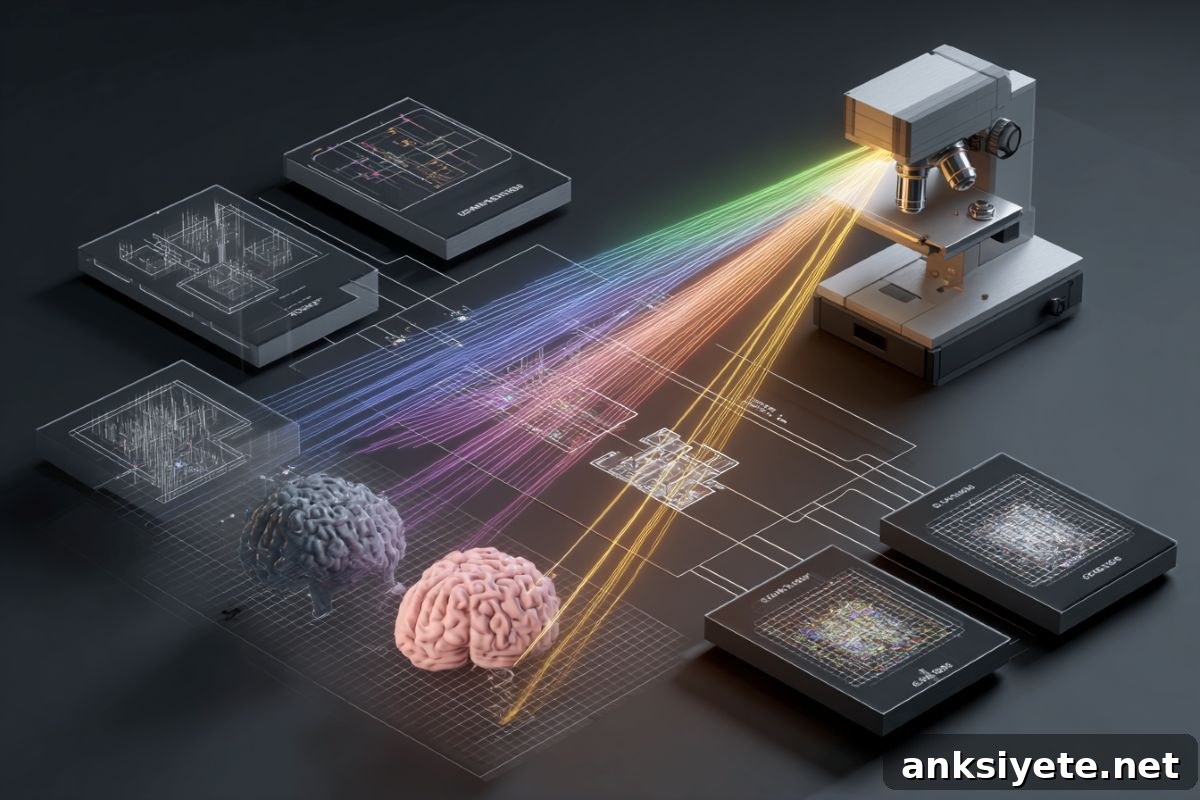
Summary: A significant technical advance has removed a long-standing barrier in behavioral neuroimaging. Researchers have introduced Neuroplex, an open-source imaging pipeline that enables simultaneous mapping of real-time functional activity for up to nine distinct neuronal populations in freely moving mice.
Neuroplex pairs lightweight, head-mounted miniscopes with high-resolution spectral confocal imaging and a custom Python alignment tool to match functional recordings with multicolor identity maps through the same implanted lens. This approach lets scientists link genetic or projection-defined cell identities directly to neural activity during behavior, opening new possibilities for longitudinal studies of learning, aging, and disease.
Key Facts
- Breaking the two-color limit: Traditional miniscopes are excellent for capturing activity in behaving animals but can typically distinguish only two fluorophores, forcing slow, animal-by-animal experiments.
- In vivo, non-destructive workflow: Neuroplex records activity with a miniscope, removes the miniscope without disturbing the implant, and immediately uses a spectral confocal microscope (ZEISS LSM 980) to resolve up to nine fluorescent labels through the same lens.
- Automated co-registration: A custom Python-based alignment script, developed with data scientists from MetaCell, uses anatomical landmarks to precisely match miniscope footage with the confocal color map.
- Validated in social behavior: As a proof-of-principle, the team labeled nine distinct projection circuits from the medial prefrontal cortex and recorded activity while animals interacted socially; the pipeline assigned roughly 75% of active neurons to a specific circuit with about 90% accuracy.
- Longitudinal tracking: Because Neuroplex is performed in the living animal through the same implanted lens, researchers can identify cell populations and follow the identical neurons over weeks to months.
Source: MPI Florida
Overview
Scientists at the Max Planck Florida Institute for Neuroscience (MPFI), in collaboration with ZEISS and MetaCell, developed Neuroplex to overcome spectral limitations of head-mounted miniscopes. Published in eLife, this technique makes it possible to observe how multiple, genetically or projection-defined neuronal populations contribute to behavior in the same animal and over extended timescales.
The Challenge
Head-mounted miniscopes revolutionized the study of neural activity in freely moving animals, but their limited spectral discrimination kept researchers from resolving more than two labeled cell types simultaneously. To compare multiple cell types, labs either ran repeated experiments across different animals or relied on post-mortem tissue processing to identify cell types after behavior. Both approaches are slow, low-throughput, and prevent direct longitudinal comparison of the same neurons.
The Solution: Neuroplex
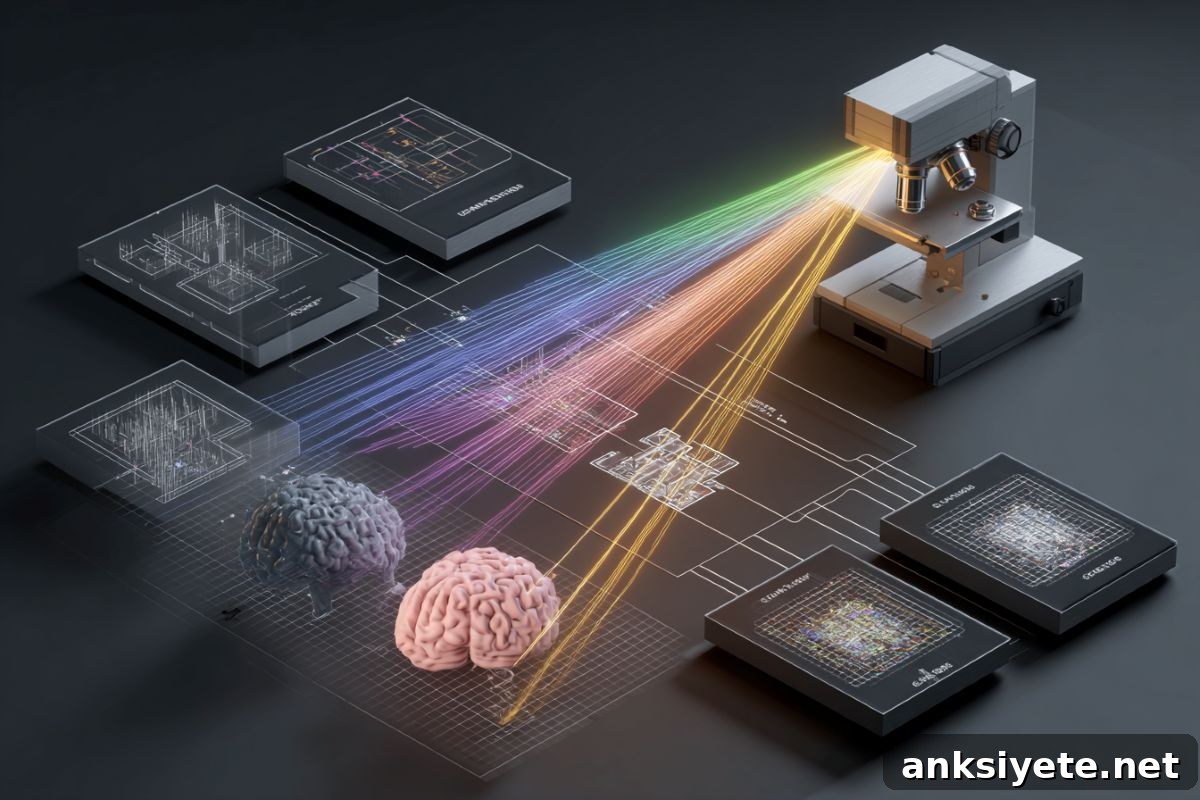
Neuroplex combines two complementary imaging modalities in the same living animal. First, researchers label up to nine neuronal subpopulations using distinct fluorescent tags. While the animal behaves, a head-mounted miniscope records calcium-dependent activity across the entire labeled population. The miniscope cannot resolve the different colors, but it captures precise, time-stamped functional signals.
After the behavioral session, the miniscope is gently removed and the animal is positioned under a spectral confocal microscope (ZEISS LSM 980) that images the same field through the same implanted GRIN lens. The confocal scan resolves each fluorophore’s spectral fingerprint, producing a multicolor identity map of the recorded neurons. A custom Python-based co-registration tool then aligns anatomical landmarks between the functional miniscope video and the confocal color image, assigning each recorded neuron to a specific labeled population.
MetaCell contributed the computational workflow and automation that translate complex imaging data into reproducible registrations and analyses. This computational pipeline improves accuracy and throughput while reducing manual effort and subjective bias.
Validation and Results
To demonstrate Neuroplex, the research team targeted nine projection-defined populations originating in the medial prefrontal cortex—an area central to decision making—and recorded activity as animals engaged in social interactions. The pipeline assigned about 75% of active neurons to one of the nine defined circuits. The automated assignment algorithm achieved approximately 90% accuracy with low false-positive rates.
By enabling direct comparisons of activity across many cell types in the same animal, Neuroplex reduces variability introduced by comparing separate animals and greatly increases experimental efficiency.
Longitudinal Tracking and Applications
Because Neuroplex is non-destructive and performed through the same implanted lens, researchers can identify circuit membership before behavior and measure how identified neurons change activity across days, weeks, or months. This capability is particularly valuable for studying learning-related plasticity, development, aging, and progression of neurodegenerative or neurodevelopmental disorders that affect multiple circuits over time.
What Comes Next
The team is refining color identification accuracy and working to broaden access to Neuroplex. Their aim is to adapt the workflow so it can be used with standard filter-based widefield microscopes in addition to high-end spectral confocal systems, making the approach more widely available to laboratories with varied equipment.
The increased throughput for cell-type- and circuit-specific functional data should accelerate mechanistic studies of neural computation and provide richer longitudinal datasets for disease models.
Funding: This research was supported by National Institutes of Health Grants R35-NS-116804 (RY) and F32MH120872 (M.L.P.). The content represents the authors’ responsibility and does not necessarily reflect official views of the funders.
Key Questions Answered
A: The limitation was not the labels but the miniscope optics. Miniscopes must be compact and lightweight for use on behaving animals, and those design constraints limit their spectral resolution. As a result, live miniscope videos show activity as monochrome signals, obscuring which cell belongs to which labeled population.
A: Neuroplex records uncolored functional activity with the miniscope, then images the same field with a spectral confocal microscope through the identical lens to resolve spectral fingerprints. A Python-based alignment program registers anatomical landmarks between datasets, matching each cell’s color identity to its recorded activity.
A: Many brain disorders involve progressive disruption across multiple cell types and circuits. Neuroplex enables tracking of several circuit-defined populations in the same animal over time, allowing researchers to observe how specific circuits degrade or compensate during disease progression.
Editorial Notes
- This article was edited by a Neuroscience News editor.
- The original journal paper was reviewed in full.
- Additional context was added by the reporting staff.
About this research
Author: Lesley Colgan
Source: MPI Florida
Contact: Lesley Colgan – MPI Florida
Image credit: Neuroscience News
Original Research: Open access. “Functional imaging of nine distinct neuronal populations under a miniscope in freely behaving animals” by Mary L. Phillips, Nicolai T. Urban, Taddeo Salemi, Zhe Dong, and Ryohei Yasuda. eLife. DOI: 10.7554/eLife.110277.3
Abstract
Functional imaging of nine distinct neuronal populations under a miniscope in freely behaving animals
Head-mounted miniscopes enable functional fluorescence imaging in freely moving animals, but are typically limited to at most two spectrally distinct fluorophores. Neuroplex combines miniscope calcium recordings with in vivo multiplexed confocal spectral imaging to distinguish nine projection-defined neuronal subtypes through the same GRIN lens. By co-registering neurons with fluorophore-specific spectral fingerprints via linear unmixing, this pipeline links projection-defined identities to behaviorally relevant activity and enables circuit-level dissection of behavior in single animals.