
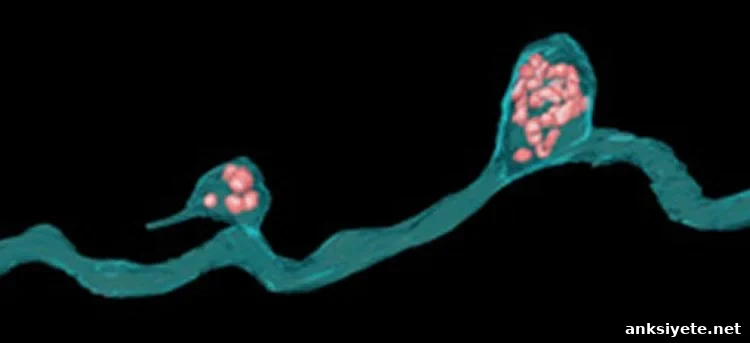
Certain retinal neurons hand off worn-out cell parts to neighboring support cells for disposal.
For decades, biologists have described individual cells as largely self-sufficient cleanup units that break down and recycle their own damaged or aged components. A new study challenges that assumption by showing that some neurons in the eye transfer damaged mitochondria—the cell’s energy-producing organelles—to nearby support cells for degradation. This discovery reshapes our understanding of cellular maintenance in the nervous system and could have implications for glaucoma and other neurodegenerative disorders linked with the accumulation of cellular “waste,” such as Parkinson’s disease, Alzheimer’s disease and amyotrophic lateral sclerosis (ALS).
The research was led by Nicholas Marsh-Armstrong, Ph.D., of the Kennedy Krieger Institute and the Johns Hopkins University School of Medicine, together with Mark H. Ellisman, Ph.D., at the University of California, San Diego. Earlier observations from their labs suggested that retinal ganglion cells—which carry visual signals from the eye to the brain—might be shedding parts of themselves to astrocytes, the star-shaped glial cells that surround and support neurons. Those initial findings hinted that mitochondria could be the specific components being transferred at the optic nerve head, the region where the axons of retinal ganglion cells bundle together as they exit the eye.
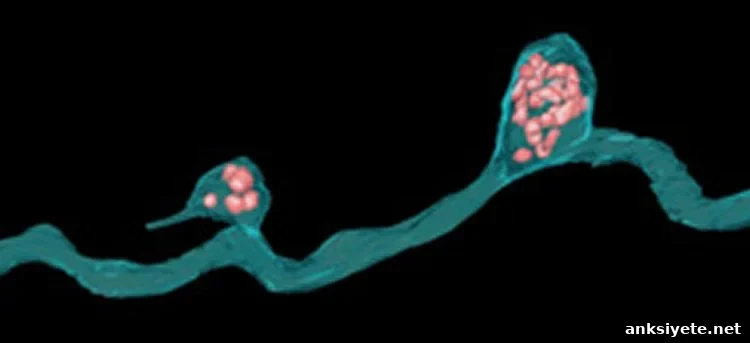
To test the idea, Marsh-Armstrong’s team genetically engineered mice to express fluorescent markers that reveal degraded mitochondria. Ellisman’s group then applied high-resolution electron microscopy and three-dimensional reconstruction techniques to visualize interactions between retinal ganglion cells and astrocytes at the optic nerve head. Combining these approaches allowed the researchers to directly observe astrocytes engulfing and digesting large numbers of mitochondria originating from adjacent retinal ganglion cell axons.
The finding was unexpected because it contradicts the widely held view that each neuron manages its own intracellular cleanup independently. “This was a very surprising study for us, because the findings go against the common understanding that each cell takes care of its own trash,” Marsh-Armstrong said. The process appears to be spatially focused: the optic nerve head serves as a specialized site for this transcellular disposal, suggesting local microenvironments in nervous tissue may facilitate intercellular housekeeping.
That location is notable because the optic nerve head is frequently implicated in glaucoma, a progressive optic neuropathy and the second leading cause of blindness worldwide. The authors plan to investigate whether disruptions in this mitochondrial transfer and degradation pathway could contribute to the cellular stress and axon loss seen in glaucoma. If the transfer of dysfunctional mitochondria to astrocytes is impaired, neurons might accumulate damaged organelles, increasing vulnerability to degeneration.
Beyond glaucoma, the study raises broader questions about how the nervous system maintains cellular health and removes potentially toxic materials. Many neurodegenerative disorders are characterized by intracellular buildup of damaged proteins and organelles. By demonstrating an alternative route for organelle disposal—where neurons outsource part of their housekeeping to glial partners—the research opens new avenues for studying whether similar transcellular degradation mechanisms exist in other brain regions, involve other organelle types, or change with age and disease.
While this work focuses on retinal ganglion cells and astrocytes in mice, it establishes a conceptual framework: neuronal health may depend not only on intrinsic degradation pathways like autophagy and mitophagy but also on coordinated interactions with surrounding support cells. Future research will be needed to determine how widespread this behavior is across neuronal types, how it is regulated, and whether enhancing or restoring such intercellular clearance pathways could offer therapeutic opportunities for neurodegenerative conditions marked by cellular waste accumulation.
This research received support from the National Eye Institute (grant numbers R01 EY022680 and R01 EY019960), a Catalyst for a Cure grant from the Glaucoma Research Foundation and the Melza M. and Frank Theodore Barr Foundation, the National Center for Research Resources (grant number 5P41RR004050), the National Institute on Drug Abuse’s Human Brain Project (grant number DA016602), the National Institute of General Medical Sciences (grant numbers 5R01GM82949, 5P41GM103412-25 and 5T32GM07814) and the National Science Foundation (grant number DGE-1232825).
Contact: Shawna Williams – Johns Hopkins Medicine
Source: Johns Hopkins Medicine press release
Image Source: Credit to UCSD; image adapted from the Johns Hopkins Medicine press release
Original Research: Abstract for “Transcellular degradation of axonal mitochondria” by Chung-ha O. Davis, Keun-Young Kim, Eric A. Bushong, Elizabeth A. Mills, Daniela Boassa, Tiffany Shih, Mira Kinebuchi, Sebastien Phan, Yi Zhou, Nathan A. Bihlmeyer, Judy V. Nguyen, Yunju Jin, Mark H. Ellisman, and Nicholas Marsh-Armstrong in PNAS. Published online June 16, 2014. doi:10.1073/pnas.1404651111