Neurofeedback Shows Promise in Treating Tinnitus
Summary: A study presented at RSNA 2017 suggests that fMRI-guided neurofeedback can reduce—and in some instances eliminate—the perception of tinnitus.
Source: RSNA
Researchers using functional MRI (fMRI) report that neurofeedback training may help people lessen the severity of tinnitus or, for some, remove it entirely.
Tinnitus is a common condition characterized by the perception of sound—often ringing, buzzing, or hissing—when no external source is present. It affects roughly one in five people and can lead to increased frustration, anxiety, and poorer quality of life when sufferers focus on the sound. The primary auditory cortex, the region of the brain responsible for processing auditory input, has been implicated in many cases of tinnitus-related distress and persistent awareness of the sound.
In this study, investigators explored whether targeted neurofeedback could help people redirect attention away from the internal sound and thereby reduce activity in the auditory cortex. Neurofeedback provides participants with a real-time external indicator of their own brain activity, allowing them to learn strategies to modulate that activity intentionally.
“The idea is that in people with tinnitus there is an over-attention drawn to the auditory cortex, making it more active than in a healthy person,” said Matthew S. Sherwood, Ph.D., a research engineer and adjunct faculty member in the Department of Biomedical, Industrial and Human Factors Engineering at Wright State University. “Our hope is that tinnitus sufferers could use neurofeedback to divert attention away from their tinnitus and possibly make it go away.”
To evaluate this approach, the research team enrolled 18 healthy volunteers with normal hearing for five fMRI-neurofeedback training sessions. During the sessions, participants wore earplugs that both blocked scanner noise and allowed controlled delivery of white noise. The investigators used single-shot echoplanar imaging, an fMRI technique sensitive to blood oxygenation level changes, which serves as an indirect measure of regional brain activity.
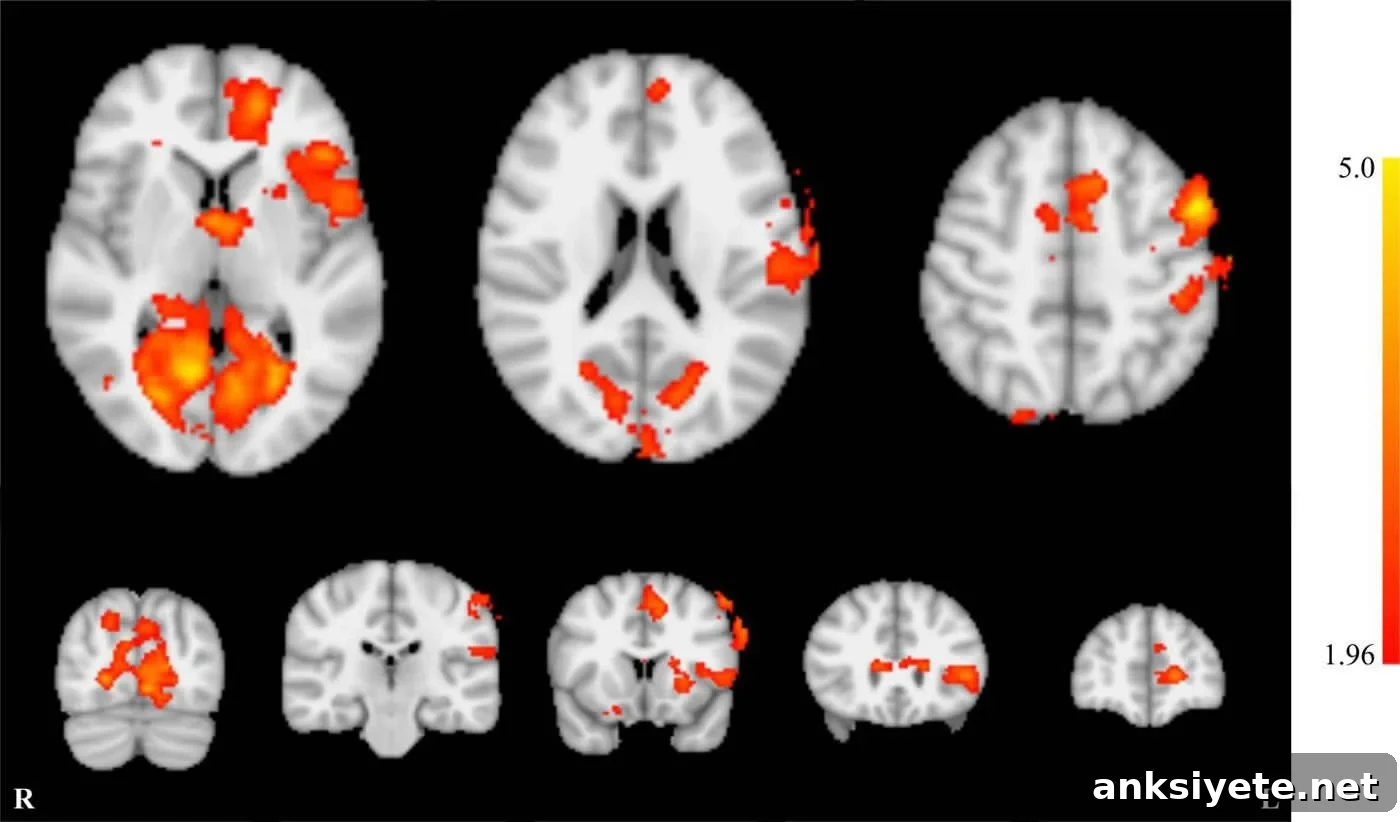
Initial mapping involved alternating brief periods of sound and silence to identify voxels in the primary auditory cortex that were most active during sound. Those voxels were then used to create the neurofeedback signal shown to participants during training.
During each fMRI-neurofeedback run, participants observed a visual bar representing activity in their primary auditory cortex while inside the MRI scanner. Each run included eight blocks, each consisting of a 30-second “relax” period followed by a 30-second “lower” period. Participants were instructed to watch the bar during the relax interval and to actively try to reduce the bar height during the lower interval by lowering activity in the auditory cortex.
The research team offered practical strategies to help participants achieve this modulation—techniques such as shifting attention from sound to other sensory experiences, focusing on breathing, or deliberately attending to touch or vision. Many participants reported that attending to their breath gave them a tangible sense of control and helped reduce auditory-cortex activation. As attention was diverted away from the internal sound, the measured signal in the auditory cortex declined.
To separate genuine neurofeedback effects from placebo-like influences, a control group of nine individuals received sham neurofeedback. They completed identical tasks and saw the same visual display, but the feedback reflected another participant’s brain activity rather than their own. Conducting the same procedures for both groups allowed investigators to isolate the effect of real neurofeedback on participants’ ability to regulate their primary auditory cortex.
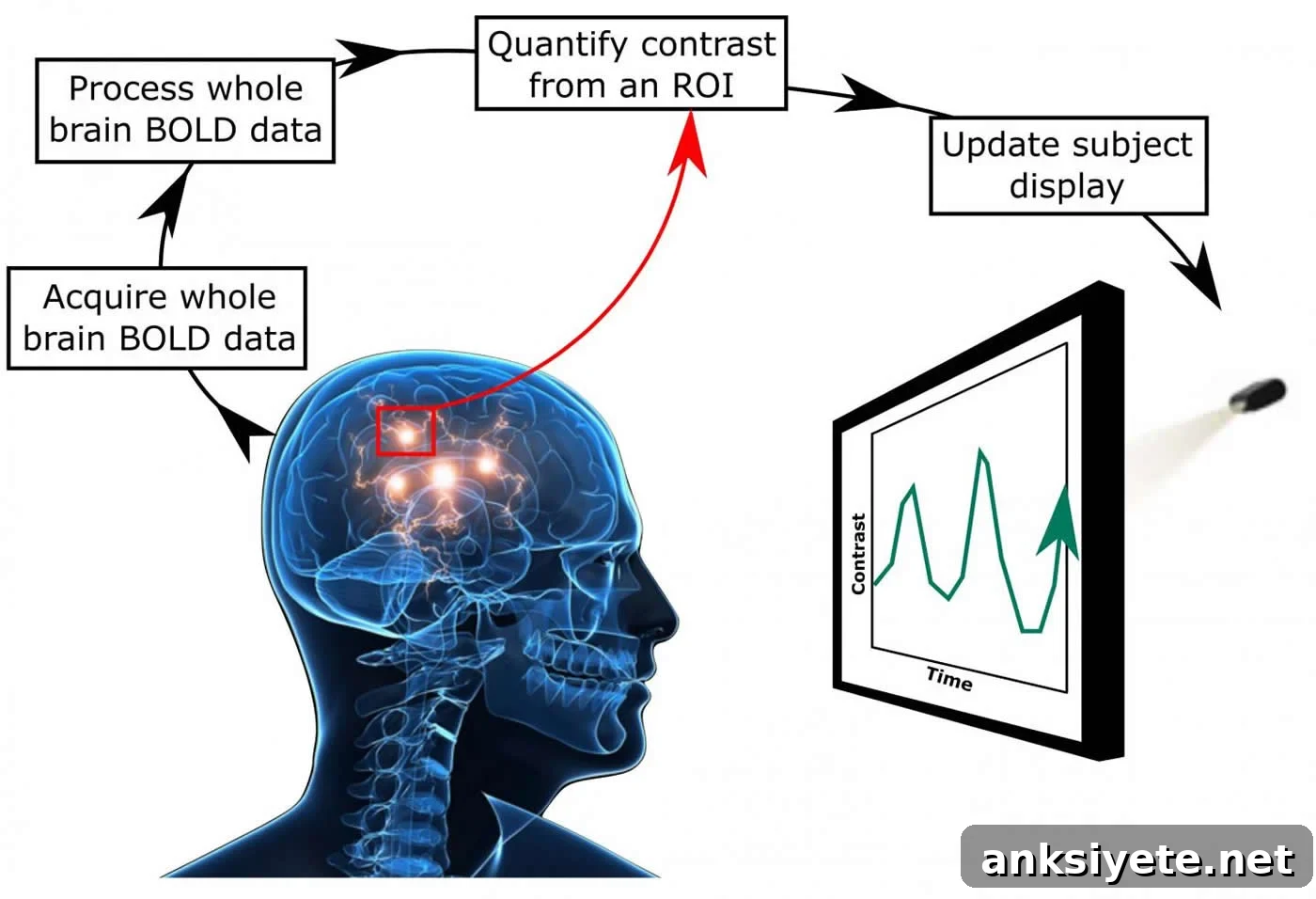
Standard approach to fMRI neurofeedback. Image credit: RSNA.
This work is the first application of fMRI neurofeedback to demonstrate a significant relationship between voluntary control of the primary auditory cortex and attentional processes related to tinnitus. Establishing that attention can be leveraged to reduce auditory-cortex activity is an important step, because although the exact neural mechanisms of tinnitus remain uncertain, attention is widely believed to play a key role in how the condition is experienced and sustained.
Beyond tinnitus, the findings point to broader therapeutic possibilities. If neurofeedback can reliably teach people to modulate brain regions tied to distressing perceptions, similar approaches might be adapted to manage other conditions where attention and perception magnify symptoms—pain being a clear example.
“Ultimately, we’d like to take what we learned from MRI and develop a neurofeedback program that doesn’t require MRI to use, such as an app or home-based therapy that could apply to tinnitus and other conditions,” Dr. Sherwood said. Developing accessible, noninvasive neurofeedback tools could make this type of training widely available outside specialized imaging centers.
Co-authors on the study include Emily E. Diller, M.S.; Subhashini Ganapathy, Ph.D.; Jeremy Nelson, Ph.D.; and Jason G. Parker, Ph.D. The research was supported by the U.S. Air Force under agreement number FA8650-16-2-6702. The views expressed are those of the authors and do not reflect official policy of the Department of Defense or its Components. The U.S. Government retains the right to reproduce and distribute reprints for governmental purposes. All subjects provided voluntary, fully informed consent as required by applicable regulations.
Source: Linda Brooks, RSNA
Publisher: Organized by NeuroscienceNews.com
Image Source: Images credited to RSNA
Original Research: Study presented at RSNA 2017, the 103rd Scientific Assembly and Annual Meeting.
MLA: RSNA. “Neurofeedback Shows Promise in Treating Tinnitus.” NeuroscienceNews, 27 November 2017.
APA: RSNA (2017, November 27). Neurofeedback Shows Promise in Treating Tinnitus. NeuroscienceNews.
Chicago: RSNA. “Neurofeedback Shows Promise in Treating Tinnitus.” Accessed November 27, 2017.