
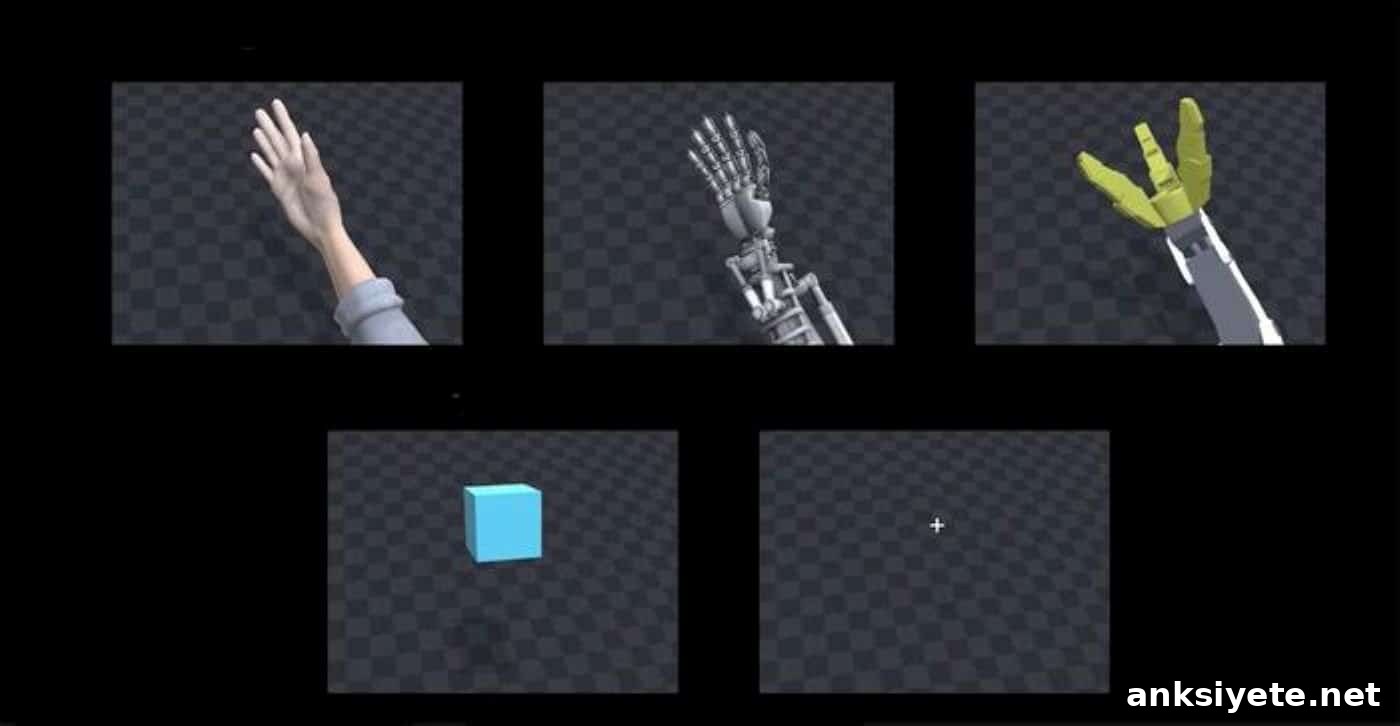
Summary:
Researchers recorded single-neuron activity from people with tetraplegia using intracortical brain-computer interfaces (BCIs) and found that motor cortex activity while watching actions scales with how human-like the observed actor appears. Rather than isolating a small set of dedicated “mirror neurons,” the results point to a distributed motor network whose observational responses increase with visual realism and can be modulated by cognitive recognition.
Key Facts:
- Graded response to anthropomorphism: Observational motor cortex activity is strongest when participants viewed a realistic human hand, and weakens progressively for a robotic hand, mechanical claw, and abstract cube.
- Network-based signaling: Observational responses arise from broad neuronal ensembles that scale recruitment and firing rates with the agent’s human-likeness instead of arising from isolated mirror-neuron cells.
- Top-down recognition affects firing: When a participant consciously recognized an ambiguous dot animation as a hand, motor cortex activity increased, showing that cognitive context can prime observational motor responses.
Source: Brown University / Mass General Brigham / VA Center for Neurorestoration and Neurotechnology
For decades, neuroscientists have described motor observation: neurons in motor cortex activate not only during self-generated movement but also when observing others perform the same actions. This so-called mirroring effect has been linked to imitation, motor learning, and social cognition across species. Yet how observational circuits decode a wide range of observed agents—especially prosthetic or robotic devices used with BCIs—has remained unclear.
A new study published in the Proceedings of the National Academy of Sciences (PNAS) by teams at Brown University, Mass General Brigham, and the VA Center for Neurorestoration and Neurotechnology shows that observation-related activity in human motor cortex varies continuously with effector anthropomorphicity—how human-like an observed agent looks.
“We wanted to know how visual feedback affects BCI users’ ability to control external devices like cursors or assistive robots,” said Jacob Gusman, the study’s lead author, who conducted the work as a graduate student at Brown. “Along the way we gained new insight into mechanisms underlying mirror-like responses in motor cortex.”
Intracortical Recordings Reveal Graded Network Responses
The work was embedded in the ongoing BrainGate clinical trial, which develops intracortical BCIs to restore communication and mobility for people with paralysis. Two participants with tetraplegia had microelectrode arrays implanted in the hand-knob region of motor cortex, permitting single-unit and population-level recordings while they watched animated effectors perform grasping motions.
Stimuli spanned a spectrum of anthropomorphism: a photorealistic human hand, an anthropomorphic robotic hand, a three-pronged mechanical claw, and an abstract geometric cube. Neural recordings showed that observational activity scaled with visual realism: the human hand produced the largest discharge, and activity decreased incrementally as stimuli became less human-like. This graded modulation appeared both across the neuronal population—more cells were recruited for human-like agents—and at the single-cell level, where firing rates rose for more realistic stimuli.
“These results suggest observational signaling is a network phenomenon sensitive to anthropomorphic features, rather than the product of a small set of dedicated mirror neurons,” Gusman explained.
Active Motor Control Overrules Visual Fidelity
When participants were instructed to actively attempt a grasp while viewing the animations, differences between the effectors largely vanished. During attempted movement, all agents—human or mechanical—elicited similarly strong motor cortex activation. The authors note that signals associated with motor intention dominate passive observation, indicating that the visual human-likeness of a prosthesis or avatar may matter far less once a user is actively controlling it via an iBCI.
Top-Down Cognition Drives Motor Decoding
The investigators also tested dot-pattern animations that suggested hand movement at varying levels of clarity. Dense, easily recognized dot configurations triggered robust motor firing. Crucially, in one exploratory trial an ambiguous dot pattern produced a sudden “aha” recognition in a participant who realized the dots depicted a grasping hand. Neural activity increased immediately after that recognition, demonstrating that subjective interpretation and top-down context can amplify observation-related responses in motor cortex.
“This finding indicates that beyond bottom-up visual cues, cognitive context plays a powerful role in shaping mirror-like motor responses,” Gusman said.
Informing the Next Generation of Neural Prosthetics
Beyond addressing fundamental questions about mirror-like processing, the study offers actionable insights for neuroengineering. Designers of brain-controlled assistive devices can take into account how visual representation and user intent interact: while realistic visual feedback may enhance passive observation-driven signaling, active user intention largely equalizes neural responses across device appearances.
“BrainGate’s ultimate goal is to restore movement and communication for people affected by neurological injury,” said co-author Leigh Hochberg, professor of engineering and neuroscience and director of the BrainGate trial. “These results deepen our understanding of how the brain plans and responds to movement and will help guide the design of future implantable BCIs.”
Editorial Notes:
- This article was edited by a Neuroscience News editor.
- The journal paper was reviewed in full and additional context was provided by staff.
About this Neuroscience and Neurotech Research:
- Media Contact: Kevin Stacey
- Source: Brown University
- Image Credit: BrainGate Clinical Trial / Brown University
- Original Research (Open Access): PNAS (September 21, 2026). Title: “Observation-related activity in the human motor cortex increases with effector anthropomorphicity.” Authors: Jacob T. Gusman et al.
- DOI: 10.1073/pnas.2537457123
Abstract
Observation-related activity in the human motor cortex increases with effector anthropomorphicity
Motor cortex neurons engage both during self-generated movement and while observing movements performed by other anthropomorphic agents. How these neurons respond to the variety of assistive or prosthetic devices that BCI users may control has been unclear. Here, single-unit activity in the precentral gyrus was recorded while iBCI users viewed grasp-like movements performed by virtual effectors ranging from human hands to robotic and dot-based stimuli.
Neural modulation correlated with effector anthropomorphicity at both the ensemble and individual neuron levels, indicating that motor cortex activity increases incrementally with the visual human-likeness of the observed agent. Participants’ subjective assessments of anthropomorphism, both solicited and spontaneous, matched changes in neural activity, highlighting the strong influence of contextual perception on observation-induced motor responses.
When participants attempted hand movements while viewing different effectors, motor cortex activity was comparable across agents, suggesting that active intent during iBCI control reduces dependence on an effector’s anthropomorphic appearance for intuitive device operation.