
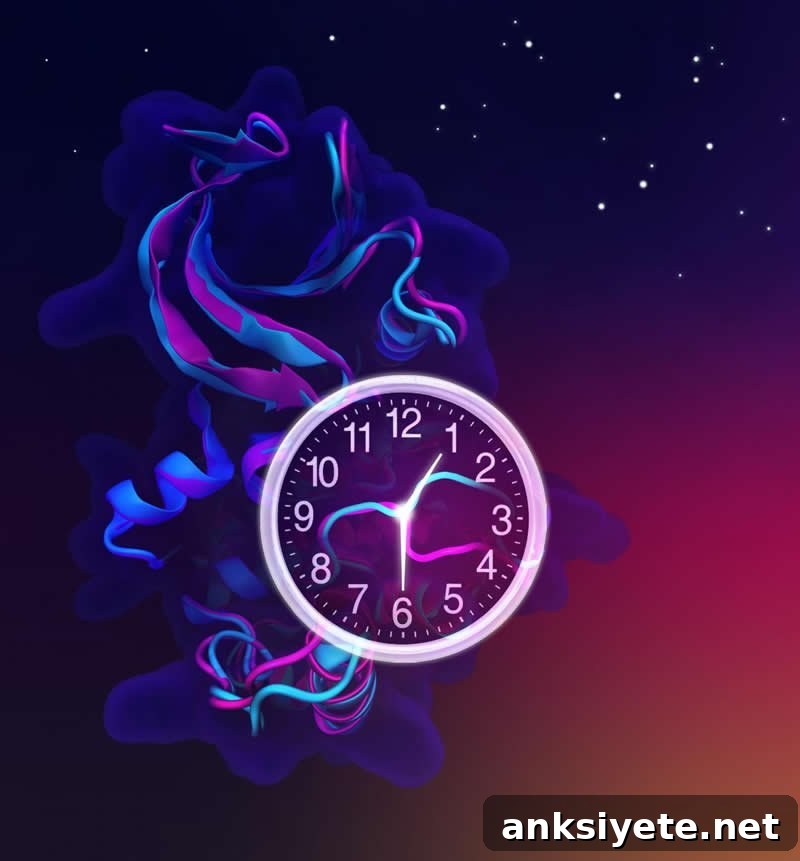
Summary: A new study reveals how specific genetic mutations can shorten the circadian clock, causing some people to be extreme “morning larks.” These mutations make the internal clock run on an approximately 20-hour cycle instead of aligning with the 24-hour day-night cycle.
Source: UC Santa Cruz
New research explains how mutations in a key enzyme alter molecular interactions that set the body’s daily timing, producing early sleepers and extreme “morning larks.”
Published February 11 in eLife, the study identifies a conserved molecular switch that controls the stability of the PERIOD (PER) protein, a core component of the circadian clock. The mechanism described by the researchers operates across animals from fruit flies to humans, helping explain how genetic changes reshape daily rhythms.
“Many people with sleep phase disorders have changes in their clock proteins,” said Carrie Partch, associate professor of chemistry and biochemistry at UC Santa Cruz and a corresponding author on the paper. “Mutations that shorten the clock tend to produce a morning-lark effect, while those that lengthen it make people pronounced night owls.”
The team focused on mutations in casein kinase 1 (CK1), an enzyme that modifies PER by adding phosphate groups in a process called phosphorylation. CK1 can phosphorylate two opposing sites on PER: one modification stabilizes the protein, while the other marks it for degradation. The balance between these modifications determines PER abundance and thus the period of the circadian rhythm.
Using structural and biochemical analyses, Partch’s lab demonstrated how mutations in CK1 or PER shift that balance toward phosphorylation of the degron site, promoting faster PER degradation and shortening the clock. Because PER proteins participate in a negative-feedback loop that times biological rhythms, changing PER stability disrupts the timing of sleep-wake cycles.
“We uncovered a compact molecular switch that governs how much PERIOD protein remains available,” Partch explained. “When the switch functions correctly, it produces a stable ~24-hour oscillation. Mutations that bias the switch toward degradation trim the period down toward roughly 20 hours in some cases.”
To connect biochemical observations with protein behavior in cells, the researchers collaborated with teams at Duke-NUS Medical School in Singapore and UC San Diego. Cellular experiments confirmed the in vitro findings, while molecular dynamics simulations revealed how CK1 flips between two structural states and how mutations bias the enzyme toward one state or the other.
The key element of this switch is the activation loop within CK1. One loop conformation promotes CK1 binding to the PER degron region, where phosphorylation triggers degradation. Mutations known to shorten period time favor this degron-binding conformation. The opposite loop conformation directs CK1 toward the FASP region of PER — a site named after Familial Advanced Sleep Phase Syndrome, an inherited disorder linked to early sleep timing.
When CK1 phosphorylates the FASP region, that region then stabilizes PER by binding to and inhibiting CK1, preventing the enzyme from adopting the degron-binding conformation. In effect, phosphorylation of the FASP site locks CK1 in a state that protects PERIOD from premature destruction, introducing a delay that helps synchronize the molecular clock with Earth’s 24-hour day.
Understanding this switch matters because circadian rhythms influence far more than sleep: they affect metabolism, hormone cycles, immune function, and many other physiological processes. By clarifying the molecular rules that set clock timing, the study opens the door to potential strategies for correcting or easing circadian disruption caused by genetic conditions, shift work, or jet lag.
“There might be ways to mitigate some of those effects,” Partch said.
CK1 is notable for its evolutionary antiquity: although the full feedback loop involving CK1 and PERIOD is found throughout animals, CK1 itself exists across all eukaryotes, including single-celled green algae where it has also been implicated in rhythmic behavior. That broad conservation supports the idea that CK1 dynamics play a universal role in timing mechanisms across diverse organisms.
“Our results provide a mechanistic foundation to understand the essentially universal role of CK1 as a regulator of eukaryotic circadian clocks,” Partch added.
Authors of the paper include co-first authors Jonathan Philpott (UCSC), Rajesh Narasimamurthy (Duke-NUS Medical School), and Clarisse Ricci (UC San Diego), with contributions from Alfred Freeberg, Sabrina Hunt, Lauren Yee, Rebecca Pelofsky, and Sarvind Tripathi (UCSC), and corresponding author David Virshup (Duke-NUS Medical School).
Funding: This research was supported by the U.S. National Institutes of Health and the National Medical Research Council of Singapore.
Source:
UC Santa Cruz
Media Contacts:
Tim Stephens – UC Santa Cruz
Image Source:
Clarisse Ricci/UCSD.
Original Research: Open access — “Casein kinase 1 dynamics underlie substrate selectivity and the PER2 circadian phosphoswitch.” Jonathan M. Philpott, Rajesh Narasimamurthy, Clarisse G. Ricci, Alfred M. Freeberg, Sabrina R. Hunt, Lauren E. Yee, Rebecca S. Pelofsky, Sarvind Tripathi, David M. Virshup, Carrie L. Partch. eLife. DOI: 10.7554/eLife.52343.
Abstract
Casein kinase 1 dynamics underlie substrate selectivity and the PER2 circadian phosphoswitch
Post-translational control of PERIOD stability by Casein Kinase 1δ and ε (CK1) plays a central role in metazoan circadian rhythms. Despite CK1’s deep conservation across eukaryotes, its regulation and the factors dictating substrate choice between functionally opposing sites on PERIOD remain incompletely understood. This study describes a molecular switch centered on a conserved anion-binding site in CK1 that controls the kinase activation loop’s conformation and thereby directs which PER2 sites are phosphorylated. Integrated experimental and computational analyses reveal an allosteric link between two anion-binding sites that dynamically tunes kinase activity. The authors show that period-altering kinase mutations from humans to Drosophila differentially bias this activation loop switch, producing predictable effects on PER2 stability and providing a structural and mechanistic basis to understand and potentially manipulate CK1’s role in circadian regulation.