
Summary: Researchers have identified neurobiological differences between men and women who are addicted to online gaming.
Source: RSNA.
Functional MRI (fMRI) scans reveal distinct brain activity patterns in men and women with Internet gaming disorder, a new study presented at the Radiological Society of North America (RSNA) annual meeting reports.
“Internet use is an integral part of the daily lives of many young adults, and a loss of control over Internet use can produce a range of harmful effects,” said the study’s senior author, Yawen Sun, M.D., a diagnostic radiologist in the Department of Radiology at Ren Ji Hospital, Shanghai Jiao Tong University School of Medicine. “Internet gaming disorder has become a significant public health concern among adolescents and young adults worldwide.”
Internet gaming disorder (IGD) is characterized by excessive, compulsive play of online games that displaces other interests and responsibilities. People with IGD often experience impaired performance at work or school, strained relationships, and withdrawal symptoms when they reduce or stop gaming.
Although prior surveys suggest IGD is more common in men, little research has explored whether the disorder affects male and female brains differently. This study aimed to identify sex-specific neural differences associated with IGD using resting-state fMRI, which measures spontaneous brain activity when subjects are not performing a structured task.
The research team recruited 32 men and 23 women diagnosed with IGD and compared them with age-matched healthy controls consisting of 30 men and 22 women. In addition to resting-state fMRI, participants completed the Barratt Impulsiveness Scale-11, a validated questionnaire assessing impulsive personality traits and behavioral inhibition.
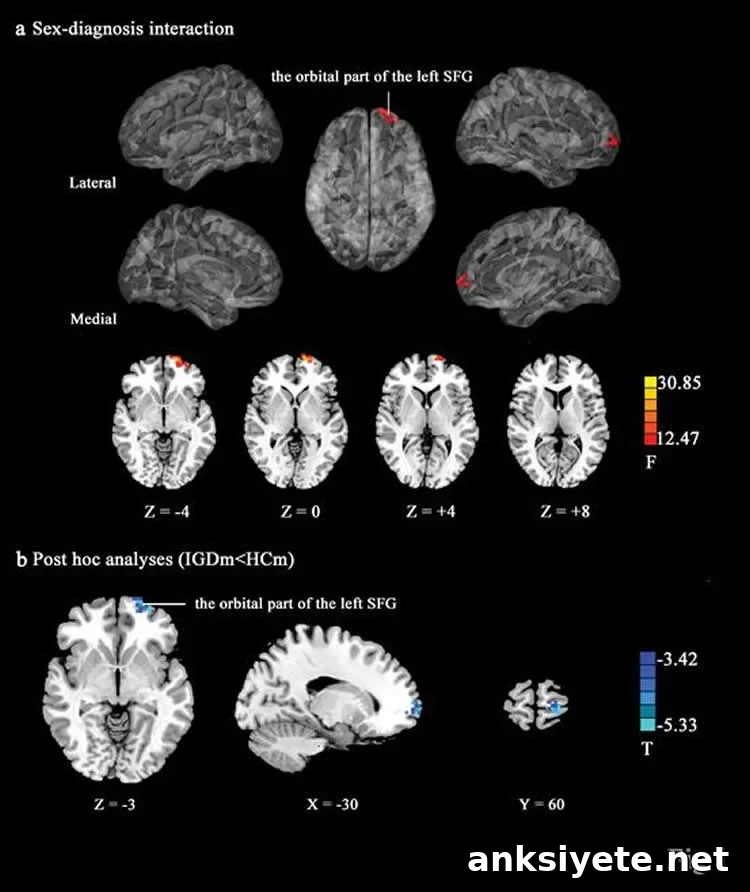
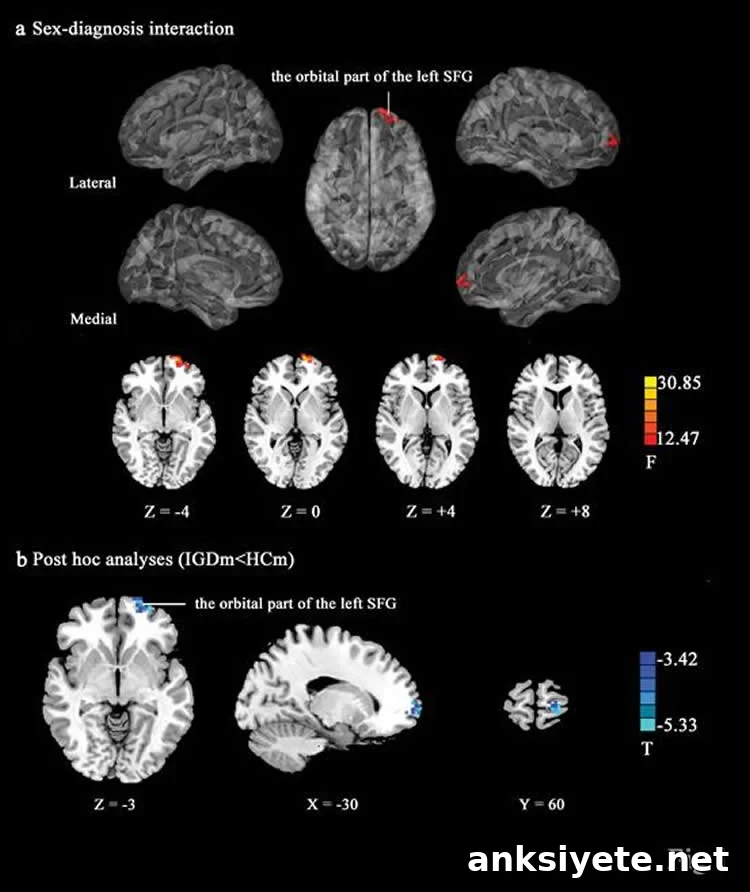
Analysis of resting-state activity revealed notable sex-based differences. Men with IGD showed altered regional and network-level brain activity, most prominently reduced activity in the left superior frontal gyrus—a portion of the prefrontal cortex involved in impulse control and executive functioning. Women with IGD did not display the same reductions in this region.
“Our findings show that changes in cerebral activity were evident in men with IGD but not in women with IGD, and that lower activity in the superior frontal gyrus among men may be linked to greater impulsivity,” Dr. Sun said.
These results suggest IGD interacts with sex-specific patterns of brain function. One possible explanation is differing maturational timelines: the prefrontal cortex, which underlies executive control and inhibition, typically matures later in males. That delayed maturation could contribute to weaker impulse control in young men and a higher tendency to engage in compulsive online behaviors.
“Men generally exhibit lower impulse control relative to women and show a more gradual increase in inhibitory capacity during development,” Dr. Sun added. “Because inhibitory control is a key factor in the onset of IGD, young men may be more likely to experiment with pathological Internet use than young women.”
The pattern of prefrontal dysfunction observed in men with IGD mirrors findings from some substance addiction studies, where impaired frontal activity correlates with elevated impulsivity and reduced behavioral control. This overlap supports a growing body of evidence that behavioral addictions such as IGD share neural and behavioral features with substance-related addictions.
However, the study’s authors caution that it remains unclear whether the observed brain differences are consequences of excessive gaming or preexisting vulnerabilities that increase risk for developing IGD. Longitudinal research and further fMRI studies are needed to determine whether these neural signatures predict onset, result from chronic gaming, or reflect a combination of both.
Online gaming has expanded rapidly over recent decades and now spans social, mobile, and multiplayer formats that reach millions worldwide. The widespread availability of interactive gaming platforms highlights the importance of identifying neural and behavioral markers that may help detect individuals at risk of developing maladaptive gaming habits.
Source: Linda Brooks – RSNA
Publisher: Organized by NeuroscienceNews.com.
Image source: Image credit: RSNA.
Original research: Findings presented at the 104th Scientific Assembly and Annual Meeting of the Radiological Society of North America (RSNA).