
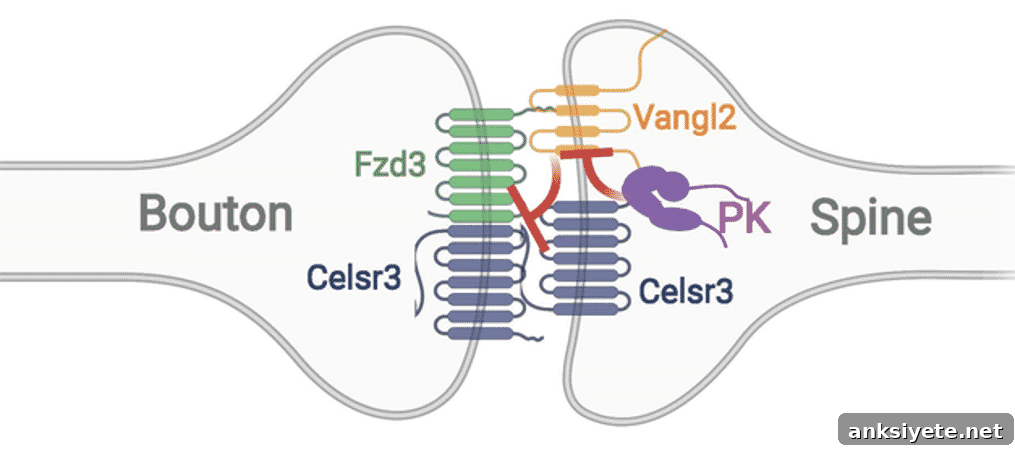
Summary: The planar cell polarity (PCP) signaling pathway plays a central role in the formation and maintenance of a large portion of glutamatergic synapses.
Source: UCSD
Synapses are the critical junctions between neurons where signals pass throughout the brain and nervous system. Among these, glutamatergic synapses are the primary excitatory connections and display substantial diversity in size and shape.
A major unresolved question in neuroscience has been how such a wide variety of glutamatergic synapses are assembled and maintained. Researchers have asked whether a common signaling mechanism exists that governs the development and persistence of the many types of these excitatory synapses.
Scientists at the University of California San Diego have been investigating the molecular mechanisms that could fill this knowledge gap.
In a study published Oct. 6 in Science Advances, postdoctoral scholar Yue Ban, Professor Yimin Zou and colleagues provide evidence that the planar cell polarity (PCP) pathway—a conserved signaling system that orients cells and tissues along the tissue plane—is widely used to form and maintain a large number of synapses.
“One main conclusion of this paper is that the planar cell polarity pathway is responsible for the formation and maintenance of a very large majority of glutamatergic synapses,” said Zou.
“Building on an earlier study that first implicated PCP pathway members in synapse formation, this new work emphasizes the pathway’s broad role in controlling synapse numbers in both the developing and mature brain.”
The research focused on Prickle, a key PCP component with four family members in mice. When Prickle1 and Prickle2 were selectively knocked out in the hippocampus and prefrontal cortex, the team observed a dramatic 70–80% reduction in PSD-95–positive glutamatergic synapses.
Crucially, deleting Prickle1 and Prickle2 during early development prevented the formation of about 70–80% of these synapses. Deleting the same genes in adulthood caused a comparable proportion of existing synapses to disassemble, demonstrating that PCP signaling contributes to both synapse assembly and long-term maintenance.
To probe how Prickle controls synapse numbers, the researchers created mice that carry a human autism-associated mutation in Prickle2. These Prickle2 E8Q mutant mice showed delayed or reduced formation of glutamatergic synapses and a pronounced decrease in synaptic proteins such as glutamate receptors—ion channels that detect presynaptic glutamate and activate postsynaptic neurons.
These findings suggest that some Prickle2 mutations impair the protein’s ability to assemble synapses or recruit essential synaptic components. Studying these mutant forms offers valuable insight into the molecular steps required for synapse formation and stability.
Further experiments revealed that Prickle2 promotes synapse formation by stabilizing an intercellular complex of PCP proteins that bridges adjacent neurons at the synapse. A mutant Prickle protein failed to stabilize this complex.
“Another main conclusion of this research is that the stability of the intercellular complex of PCP proteins, which we have recently found critical for synapse formation and maintenance, is promoted by Prickle,” said Zou.
The study also addresses opposing forces that regulate synapse stability. Previous work from the Zou lab showed that the PCP protein Vangl2 destabilizes synapses. In the current work, Prickle is shown to antagonize Vangl2; when Prickle cannot perform this stabilizing role, the PCP complex becomes less stable and synapses are more likely to disassemble.
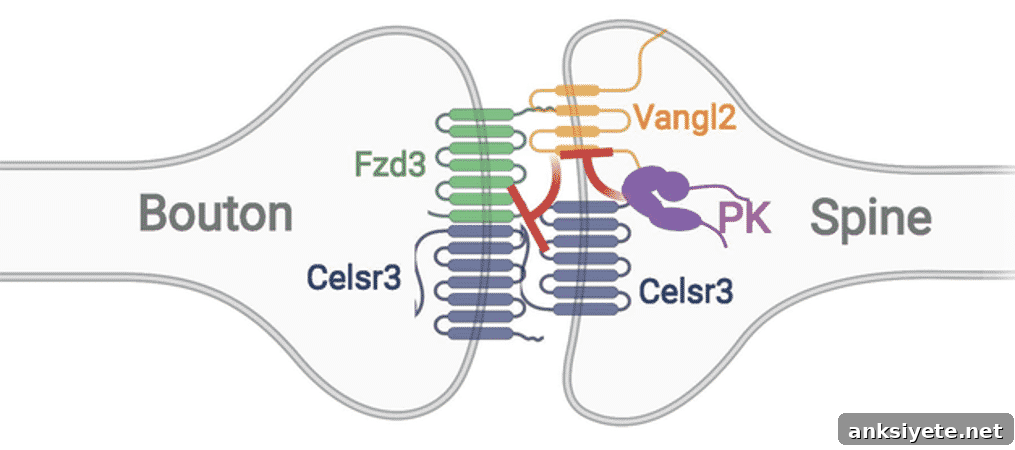
“Here we show that Prickle antagonizes Vangl2 with a mechanism which we are still trying to discover. Therefore, our synapses are constantly under the control of stabilizing and destabilizing forces, which helps explain how parts of the brain undergo continual remodeling,” Zou added.
The authors propose that the intercellular PCP complex is intrinsically asymmetric. That asymmetry can impose directional cues across the synaptic cleft, guiding the asymmetric assembly of presynaptic and postsynaptic protein complexes and ultimately determining the direction of synaptic transmission—a defining property of neuronal connections.
“This is the first time that a pathway controlling the direction of synaptic structures and synaptic transmission has been identified,” said Zou.
The Science Advances paper’s authors are Yue Ban, Ting Yu, Bo Feng, Charlotte Lorenz, Xiaojia Wang, Clayton Baker and Yimin Zou. Funding for the project included grants from the National Institutes of Health (RO1 MH116667 and R21 NS111648) awarded to Yimin Zou.
About this neuroscience research news
Author: Mario Aguilera
Source: UCSD
Contact: Mario Aguilera – UCSD
Image: The image is credited to Zou lab, UC San Diego
Original Research: Open access. “Prickle promotes the formation and maintenance of glutamatergic synapses by stabilizing the intercellular planar cell polarity complex” by Yimin Zou et al., Science Advances
Abstract
Prickle promotes the formation and maintenance of glutamatergic synapses by stabilizing the intercellular planar cell polarity complex
Whether a common signaling mechanism assembles glutamatergic synapses has been unclear. The authors show that knocking out Prickle1 and Prickle2 reduces PSD-95–positive glutamatergic synapse formation in the hippocampus and medial prefrontal cortex during postnatal development by 70–80%.
Double knockout of Prickle1 and Prickle2 in adult mice caused disassembly of 70–80% of PSD-95–positive glutamatergic synapses. In Prickle2E8Q/E8Q mice, PSD-95–positive glutamatergic synapses in the hippocampus were reduced by approximately 50% at postnatal day 14.
Prickle2 promotes synapse formation by antagonizing Vangl2 and stabilizing the intercellular PCP complex; the Prickle2 E8Q mutant fails to do so. Coculture experiments indicate that asymmetric PCP complexes can specify presynaptic versus postsynaptic polarity.
In sum, PCP components regulate the assembly and maintenance of a large fraction of glutamatergic synapses and also help specify the directionality of synaptic transmission.