
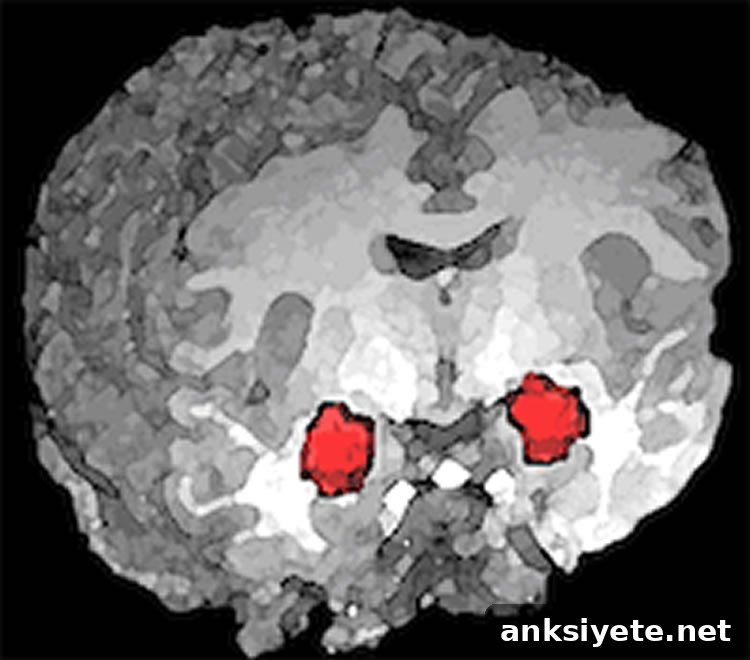
Contrary to evidence that the amygdala typically drives stress responses in adults, researchers at the Yerkes National Primate Research Center at Emory University report that during early development the amygdala appears to suppress stress hormones in nonhuman primates.
The study’s findings are published in the Journal of Neuroscience.
The amygdala is a key brain region involved in detecting threats and learning about danger. Changes in amygdala structure and function have been linked to psychiatric conditions including depression, anxiety disorders such as PTSD, schizophrenia and autism spectrum disorders. However, much of the existing research has focused on adult brains, leaving developmental roles of the amygdala less well understood.
“Our results support an emerging view in neuroscience: during childhood there is a developmental switch in amygdala function and its connectivity with regions like the prefrontal cortex,” says Mar Sanchez, PhD, a neuroscience researcher at Yerkes and associate professor of psychiatry and behavioral sciences at Emory University School of Medicine. The study’s first author is postdoctoral fellow Jessica Raper, PhD.
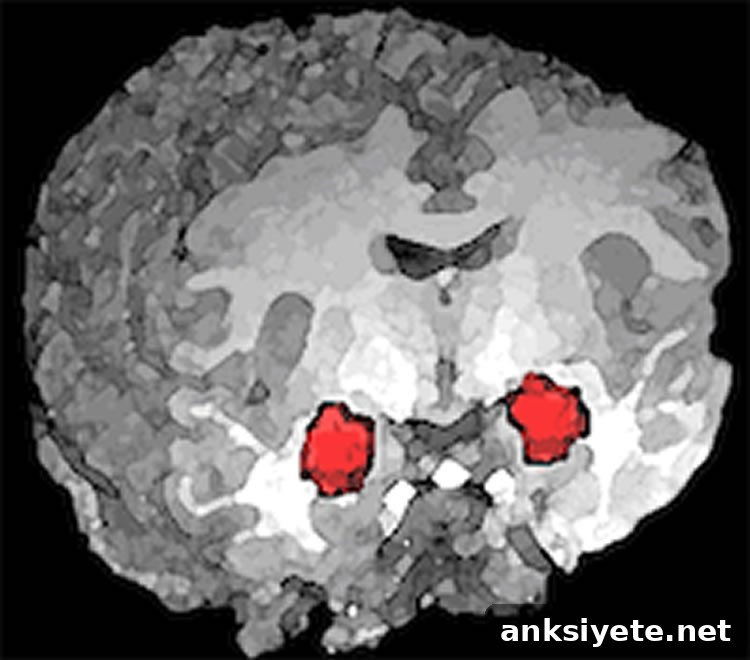
These results come from a larger longitudinal investigation at the Yerkes National Primate Research Center that follows rhesus monkeys from infancy into adulthood. The project examines how lesions to the amygdala during the first month of life affect the development of social and emotional behaviors and the neuroendocrine systems that control stress. The work is a collaboration between the laboratories of Mar Sanchez and Yerkes researchers Jocelyne Bachevalier, PhD, and Kim Wallen, PhD.
Earlier studies in this series showed that infant monkeys with neonatal amygdala damage had unexpectedly high levels of the stress hormone cortisol. That finding differed from results in adult animals, where amygdala damage is typically associated with reduced cortisol. To explore the mechanism behind this developmental difference, the researchers examined activity of the hypothalamic-pituitary-adrenal (HPA) axis—the endocrine network connecting the hypothalamus, pituitary gland and adrenal glands that orchestrates stress responses.
“We wanted to know whether the hormonal changes we observed in infancy persisted into later stages, and which brain circuits underlie those changes,” Sanchez explains. “In adult studies the amygdala and its connections are already mature when manipulated, whereas here the amygdala and its networks were still developing at the time of lesion.”
In the current paper the authors report that juvenile monkeys who received amygdala lesions as neonates continued to show elevated blood cortisol compared with control animals. Cerebrospinal fluid analysis also revealed increased levels of corticotropin-releasing factor (CRF), the neuropeptide that initiates stress responses in the brain. Elevated CRF and cortisol are biomarkers commonly linked to anxiety and emotional dysregulation in mood disorders.
Despite higher stress-hormone levels, monkeys with early amygdala damage displayed reduced emotional reactivity to threats: they showed less fear and aggression and exhibited lower observable anxiety in stressful situations. Importantly, these animals remained capable of normal social interactions within large group settings, a pattern that aligns with reports from human cases of amygdala damage, Raper notes.
“We hypothesize that the rich social environment of the colony supports compensatory development in cortical circuits that regulate social behavior,” Raper says. “However, neonatal amygdala lesions seem to impair the normal maturation of brain systems that regulate neuroendocrine stress responses.”
The researchers intend to continue following the animals into adulthood to determine the long-term consequences of early amygdala damage on stress hormones, behavior and physiological systems that can be affected by chronically high cortisol, including immune function, growth and reproductive health.
The study was supported by the National Institutes of Mental Health (MH050268, MH732525), the National Science Foundation (Center for Behavioral Neuroscience: IBN 9876754) and the Office of Research Infrastructure Programs (Primate Centers: P51OD11132, formerly NCRR P51RR000165).
Source: Lisa Newbern — Emory University
Contact: Emory University press release
Image credit: NIMH; image adapted from the Emory press release
Original research: Abstract for “Neonatal Amygdala Lesions Lead to Increased Activity of Brain CRF Systems and Hypothalamic-Pituitary-Adrenal Axis of Juvenile Rhesus Monkeys” by Jessica Raper, Shannon B.Z. Stephens, Amy Henry, Trina Villarreal, Jocelyne Bachevalier, Kim Wallen, and Mar M. Sanchez in Journal of Neuroscience. Published online August 20, 2014.