
Summary: A new study in newborn domestic chicks demonstrates that brain lateralisation is crucial for forming a left-to-right mental number line. Chicks with strong hemispheric specialisation consistently mapped numerical order from left to right, whereas weakly lateralised chicks showed no reliable directional bias.
These results offer direct experimental evidence that lateralised brain function drives spatial–numerical associations, supporting the idea that aspects of numerical representation may be biologically grounded rather than purely cultural. The findings advance our understanding of early cognitive development and help explain individual differences in numerical reasoning.
Key Facts
- Direct evidence: Brain lateralisation is necessary for left-to-right numerical mapping in chicks.
- Embryonic light impact: Light exposure during incubation increased lateralisation and improved spatial–numerical performance.
- Biological contribution: The study supports an innate component to number–space associations, alongside environmental influences.
Source: eLife
Lateralisation of the brain — the tendency for the two hemispheres to specialise in different tasks — underlies the emergence of a left-to-right mental number line, according to research on newborn chicks.
Published in eLife, the study is described by the editors as a fundamental contribution to research on numerical cognition and brain development. It tests the long-standing view that the mental number line is shaped mainly by cultural practices such as reading direction, by examining whether neural organisation itself can produce directional numerical mappings.
Many humans habitually visualise numbers along a line, with smaller values on the left and larger values on the right. While cultural factors — like the direction of reading and writing — influence this habit, evidence from infants and nonhuman animals suggests that spatial–numerical associations can emerge early and across species, pointing to a biological basis.
Brain lateralisation, also called hemispheric specialisation, means the left and right hemispheres process information differently and can take on specialised roles in perception, attention and cognition. In birds, embryonic light exposure is a well-established factor that promotes lateralisation.
Lead author Rosa Rugani, Professor of General Psychology at the University of Padua, explains: “Light exposure before hatching induces brain lateralisation in domestic chicks and enhances their spatial–numerical abilities and their tendency to scan from left to right.” The team set out to test whether lateralisation is not only correlated with but required for a left-to-right mental number line.
The researchers incubated 100 chick eggs: half were exposed to light during the final days of development and half were kept in darkness. These conditions produced two groups after hatching — chicks with strong lateralisation and chicks with weak lateralisation.
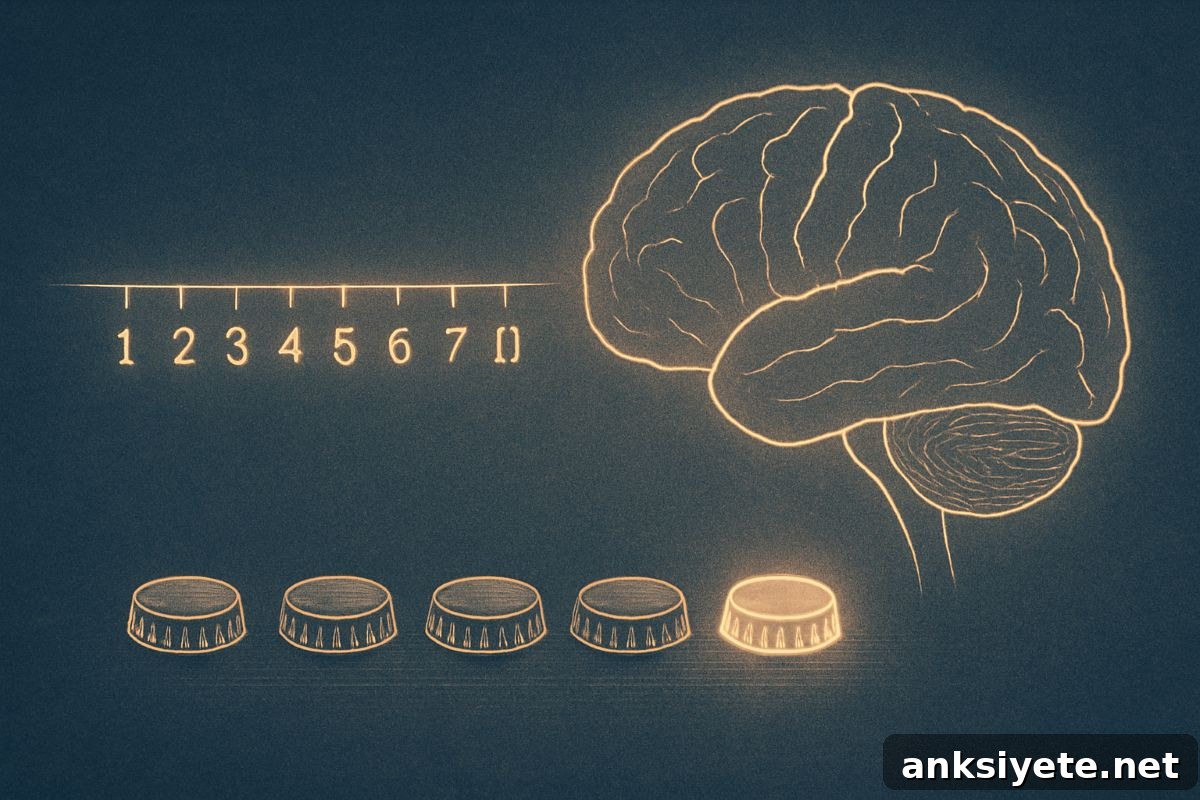
Post-hatching, the chicks were trained to find food hidden under the fourth cap in a vertical row of ten identical caps. After learning the task, the array was rotated 90 degrees to a horizontal orientation so that both the fourth-from-left and the fourth-from-right positions were plausible choices. This setup allowed the researchers to observe any spontaneous left–right numerical mapping.
Strongly lateralised chicks reliably chose the fourth cap from the left, indicating a left-to-right mapping of ordinal number to space. Weakly lateralised chicks did not show a consistent directional preference and selected between left and right at chance levels.
To identify hemispheric contributions, the team repeated tests while covering either the left or the right eye. Because each eye primarily projects to the opposite hemisphere, this monocular testing revealed which hemisphere was guiding performance. When able to use only the left eye (engaging the right hemisphere), strongly lateralised chicks again showed a leftward bias, while using only the right eye (engaging the left hemisphere) shifted choices toward the right. Weakly lateralised chicks failed to solve the task reliably under either monocular condition.
A follow-up experiment removed consistent spatial layout as a cue by varying the spacing between caps so that the physical position of the fourth cap changed across trials. Under these conditions, when ordinal information alone was available, neither strongly nor weakly lateralised chicks displayed a directional preference, indicating the left-to-right bias depends on reliable spatial cues in combination with ordinal information.
“For the first time, we show that brain lateralisation is not just associated with the mental number line — it is necessary for it,” says Rugani. The authors suggest that a natural left-to-right scanning pattern could be adaptive for foraging and other behaviours, enabling efficient inspection and enumeration of the environment.
Senior author Lucia Regolin, Professor of General Psychology at the University of Padua, adds that understanding the biological roots of numerical thinking can clarify why numerical skills develop when they do and why they may vary or be altered in individuals with atypical brain organisation. The work opens avenues for future research on how early sensory experiences shape cognitive outcomes.
About this numeracy and neuroscience research news
Author: Emily Packer
Source: eLife
Contact: Emily Packer – eLife
Image: The image is credited to Neuroscience News
Original Research: Open access. “Prenatal light exposure affects number sense and the mental number line in young domestic chicks” by Rosa Rugani et al., eLife
Abstract
Prenatal light exposure affects number sense and the mental number line in young domestic chicks
Humans commonly arrange numerosity along a left-to-right mental number line (MNL), often attributed to cultural factors. Yet newborns and other species display spatial–numerical associations (SNA) that suggest neural origins. Although theoretical accounts have connected SNA to brain lateralisation, direct experimental evidence was missing.
This study investigated how brain lateralisation influences numerical spatialisation in 100 newborn domestic chicks. Light exposure in ovo produced a group of strongly lateralised chicks and a group of weakly lateralised chicks. Chicks were trained to select the fourth item in a sagittal array; during testing the array was rotated 90°, making both the fourth-from-left and fourth-from-right positions correct.
When ordinal and spatial cues were reliable, strongly lateralised chicks outperformed weakly lateralised ones and showed a clear left-to-right directionality. When spatial cues were unreliable, neither group exhibited a directional bias. Monocular testing implicated the right hemisphere in integrating spatial and numerical information. These findings demonstrate that brain lateralisation is fundamental to developing a left-to-right oriented SNA.