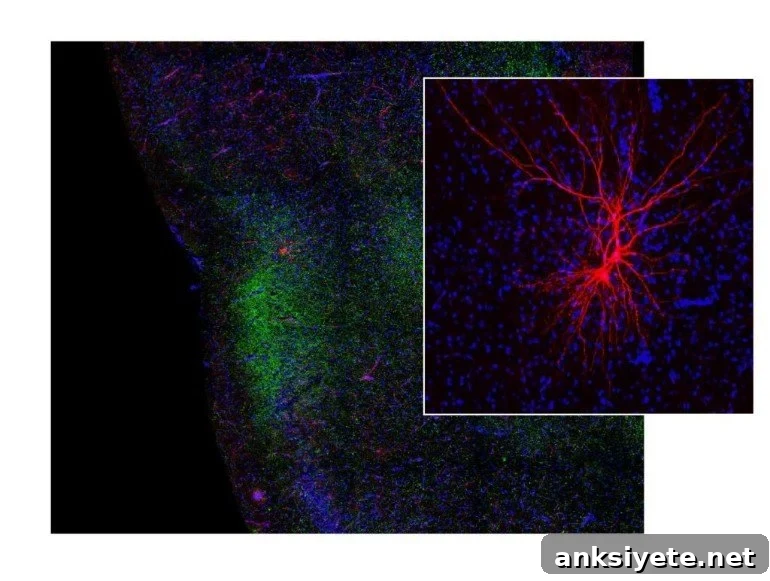
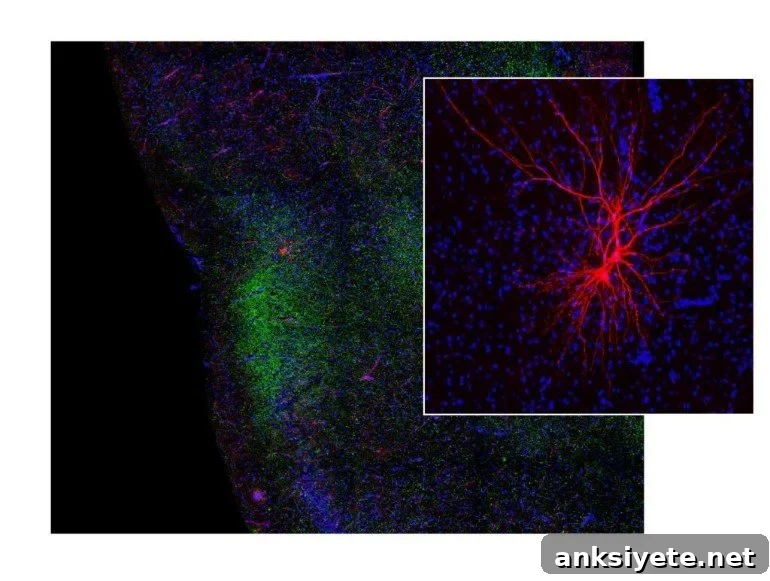
Summary: Learned avoidance of specific tastes depends on a long-term reduction in activity at the connections between brain regions that detect threat and those that process taste.
Source: Stony Brook University
Researchers at Stony Brook University report new evidence showing how an unpleasant bodily reaction after eating a once-pleasant food produces a lasting aversion, and how distinct brain regions interact to change behavior based on positive or negative experience. The study appears in the journal eLife.
The team conditioned rats to avoid the taste of sugar water—normally a preferred stimulus—by pairing consumption with a mild gastrointestinal malaise. This model mimics how a single episode of food poisoning can create a robust, long-lasting aversion to a food. While it has long been known that the basolateral amygdala (BLA) and the gustatory region of the insular cortex (gustatory cortex, GC) participate in conditioned taste aversion (CTA), how these brain areas work together to encode and store that aversion has been unclear.
Led by Arianna Maffei, Ph.D., Professor in the Department of Neurobiology and Behavior, and including postdoctoral fellow Melissa Haley and colleagues, the study probed the synaptic and circuit-level changes that underlie CTA. The researchers used optogenetics—an approach that employs light-sensitive proteins to control neuronal activity—in conjunction with electrophysiological recordings and behavioral testing to examine how activity and connectivity between the BLA and GC change after learning.
Their experiments reveal that forming a taste aversion is associated with a long-term weakening of synaptic transmission from the basolateral amygdala to the gustatory cortex. In other words, CTA leads to reduced amplitude of BLA-to-GC synaptic responses and a broader decline in activation of neurons within the gustatory cortex. These observations point to long-term depression (LTD), a sustained downward adjustment in synaptic strength, as a key mechanism for transforming a pleasant taste into one that is avoided.
“Our experiments provide the first direct evidence that learning to avoid certain tastes depends on the long-term reduction in the activity in connections between taste and threat sensors in the brain,” says Haley.
This finding contrasts with the common view that memory formation primarily relies on simultaneous increases in activity or synaptic strengthening. Instead, the study demonstrates that weakening of specific interregional connections can also encode a potent, behaviorally relevant memory. By reducing communication from the amygdala—an area implicated in threat and valence signaling—to the gustatory cortex, the brain appears to recode the hedonic value of a taste stimulus so that it is perceived as aversive.
The authors emphasize that altering the strength of communication between these two centers changes how animals perceive and respond to stimuli that were previously rewarding. Reduced amygdalocortical signaling shifts taste preference and leads to avoidance behavior, demonstrating a direct circuit mechanism for hedonic learning.
Beyond clarifying basic mechanisms of taste aversion, the results have potential implications for therapeutic approaches that aim to modify maladaptive preferences or addictions. By revealing that targeted reductions in specific pathways can change the hedonic value assigned to a stimulus, the study suggests new avenues for research into interventions that might help weaken harmful cravings or learned preferences. Maffei and Haley note, however, that further work is needed to examine how broadly these mechanisms apply across different types of aversive learning and in other species.
About this neuroscience research news
Source: Stony Brook University
Contact: Press Office – Stony Brook University
Image: Image credit: Stony Brook University
Original Research: Open access. “LTD at amygdalocortical synapses as a novel mechanism for hedonic learning” by Melissa S. Haley et al., published in eLife.
Abstract
LTD at amygdalocortical synapses as a novel mechanism for hedonic learning
A novel, pleasant taste becomes aversive when paired with gastric malaise, a form of learning called conditioned taste aversion (CTA). CTA is widespread across animal species and serves an important survival function: avoiding poisonous or harmful foods. CTA requires the gustatory portion of the insular cortex and the basolateral nucleus of the amygdala, but the synaptic mechanisms underlying the memory have been unclear. In this study, CTA in rats was associated with decreased expression of immediate early genes in the gustatory cortex and a reduction in the amplitude of BLA-to-GC synaptic responses, consistent with long-term depression (LTD) at that input. Artificially inducing LTD at the amygdalocortical synapse in vivo while presenting a novel tastant was sufficient to change the tastant’s hedonic value. These results provide direct evidence that amygdalocortical LTD contributes to taste aversion learning.